Bishop of Peterborough raises concerns about changes to bereavement benefits for parents of children

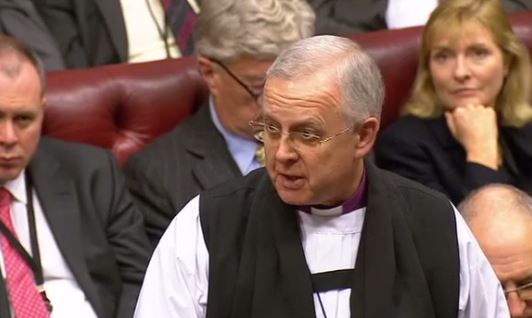
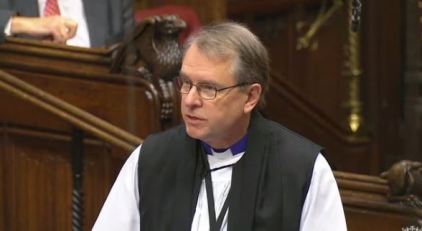
On 6th April 2017 Baroness Altmann asked Her Majesty’s Government “whether they will reconsider changes to bereavement benefits for parents with dependent children.” The Bishop of Peterborough, Rt Revd Donald Allister, asked a follow up question. The Bishop had been amongst the signatories of a letter from all sides of the House calling on the Government to reconsider its proposals.

The Lord Bishop of Peterborough: My Lords, I too signed the letter to the Secretary of State. I fully accept that the system needed reform, but those of us who spend a lot of time looking after people in bereavement know that a widowed parent may sometimes have to spend several years giving considerable extra time, attention and care to the children. In practice, that may necessitate working only part-time for a number of years while children are still at home. Previously in this House there was an assurance that income-related benefits would be there to support such parents, but under universal credit that is not so simple. Can the Minister reassure us that bereaved parents will not be subject to the in-work conditionality requirements that apply under universal credit? Continue reading “Bishop of Peterborough raises concerns about changes to bereavement benefits for parents of children”

Bishop of St Albans asks Government about future of Motability

stalbans190117On the 30th March 2017 Baroness Thomas of Winchester asked the Government ‘what steps they are taking to support independent living for disabled people of working age’. The Bishop of St Albans, Rt Revd Alan Smith, asked a further question relating to the Motability scheme.
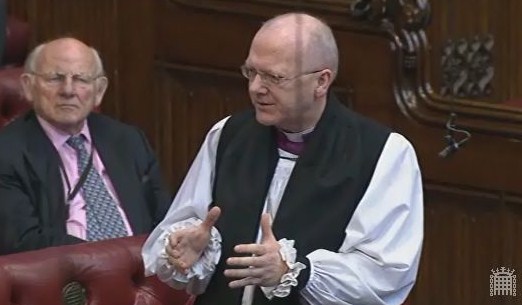
The Lord Bishop of St Albans: My Lords, the Motability scheme is a crucial element for getting people back into work, yet about 50,000 people have lost out on it. What is particularly worrying is that the vast majority of appeals are upheld, by which time those concerned have lost the vehicle and then have to get it again. It is costing a lot of time and money. Would Her Majesty’s Government consider having a scheme whereby people do not lose the vehicle until the end of the appeal process? This would make much more sense where the appeal is upheld. Continue reading “Bishop of St Albans asks Government about future of Motability”

Votes: Social Security (Personal Independence Payment) (Amendment) Regulations 2017

On 27th March 2017, two votes took place on a Statutory Instrument introducing changes to the regulations governing Personal Independence Payments. The Bishop of Winchester took part in both divisions.
Continue reading “Votes: Social Security (Personal Independence Payment) (Amendment) Regulations 2017”

Bishop of Oxford asks Government about link between benefit delays and food bank use

On 9th March 2017 Labour Peer Baroness Sherlock asked Her Majesty’s Government “what assessment they have made of the impact on claimants of the time taken between applying for Universal Credit and receiving payments.” The Bishop of Oxford, Rt Revd Steven Croft, asked a follow up question.

The Lord Bishop of Oxford: My Lords, in the last three months I have visited a large number of food banks across the diocese of Oxford in seemingly affluent communities, building on my experience of food banks in the diocese of Sheffield. All have underlined to me that the most common reason why people access food banks is delay in accessing welfare payments. Continue reading “Bishop of Oxford asks Government about link between benefit delays and food bank use”

Bishop of St Albans on importance of welfare system that leaves no one hungry

On 21st December 2016 Lord Farmer led a short debate in the Lords, to ask Her Majesty’s Government “what progress they are making in rolling out Universal Credit, and what assessment they have made of its impact”. The Bishop of St Albans, Rt Revd Alan Smith, took part in the debate:

Bishop of St AlbansThe Lord Bishop of St Albans: My Lords, I too thank the noble Lord, Lord Farmer, for this important debate. On behalf of these Benches, I take the opportunity to thank the Minister for his very considerable contribution, drive and service to this House, and wish him well as he leaves the Front Bench.

I think it is true to say that very few in this House disagree with the stated aims of universal credit—to simplify the benefits system and ensure that work always pays. However, I also suspect that there are quite a few of us in this House and, indeed, on these Benches, who fear that on occasion Her Majesty’s Government may have lost sight of that aim. Indeed, it seems that successive cuts to the welfare budget have been prioritised as an easy way of balancing the Government’s finances. Continue reading “Bishop of St Albans on importance of welfare system that leaves no one hungry”

Bishop of Newcastle calls for substantial review of use of benefit sanctions

Newcastle 2On 30th November 2016 Baroness Lister of Burtersett asked Her Majesty’s Government: “whether, in the light of the public debate around the film “I, Daniel Blake”, they plan to set up a review of the treatment of claimants in the social security system.” The Bishop of Newcastle, Rt Revd Christine Hardman, asked a follow up question:

The Lord Bishop of Newcastle: My Lords, given that the National Audit Office has today said that there is limited evidence that benefit sanctions work but rather that they result in “hardship, hunger and depression”, can the Minister update the House as to whether Her Majesty’s Government will now commit to a substantial review of the use and implementation of sanctions?”

Continue reading “Bishop of Newcastle calls for substantial review of use of benefit sanctions”

Bishop of Portsmouth responds to Chancellor’s Autumn Statement

portsmouth241016On 29th November 2016, Lord Young of Cookham moved that the House take note of the economy in the light of the Autumn Statement. The Bishop of Portsmouth, the Rt Revd Christopher Foster, spoke in the debate:
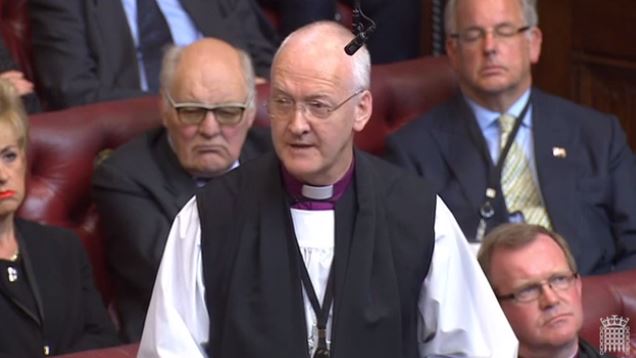
The Lord Bishop of Portsmouth My Lords, after nearly three years in this House, and having had the opportunity to speak in most of the debates responding to the Budget and Autumn Statements, it is not difficult to note the tendency for some contributors to applaud proposals they consider welcome; for others to criticise proposals they consider to have sectional interest or bias; and to have the expectation—or at least the hope—conveyed that the Chancellor and the Government will, and can, do even more when they are praised for welcome initiatives. I want to do a little of that this afternoon, though recognising the restrictions the Chancellor faces. I invite the Minister, and through him the Government, to reflect on what they ought to do—I introduce a moral note in using that phrase—to repair the fractures of trust, address growing injustices that are perceived as more hurtful than inequalities, and create not just a flourishing economy but a nation where people believe there is more that unites us than divides us. Indeed, my question to the Minister is whether the Government can better articulate their rationale and approach in the important area of inequality and injustice. Continue reading “Bishop of Portsmouth responds to Chancellor’s Autumn Statement”

Bishop of St Albans on the action needed to address child poverty

On 17th November 2016 the House of Lords debated a motion from Crossbench Peer Lord Bird, “to ask Her Majesty’s Government what plans they have to address the root causes of child poverty across the United Kingdom”.The Bishop of St Albans, Rt Revd Alan Smith, spoke in the debate:


The Lord Bishop of St Albans: My Lords, my thanks go to the noble Lord, Lord Bird, for tabling this important debate and for the challenging and spirited way in which he always makes his speeches, which not only entertain but very often get to the heart of many of the crucial issues. This debate is particularly timely because of the figures recently released by the End Child Poverty Coalition, which show that child poverty levels continue to rise steeply, reaching 47% in some areas. In his maiden speech the noble Lord, Lord Bird, spoke of the need to give those in poverty a hand up and not a handout. He focused on the importance of creating opportunities, rather than dependency. This of course has been one of the great themes of his life’s work. I believe that that is a crucial message. Continue reading “Bishop of St Albans on the action needed to address child poverty”

Bishop of Leeds calls on Government to protect children from effects of reduction in benefit cap

Leeds160620On 8th November 2016 the House of Lords debated a motion from Liberal Democrat Peer Lord Kirkwood to regret the changes to the benefit cap introduced by the Government and taking effect that week. The Bishop of Leeds, Rt Revd Nick Baines, supported the motion:

Lord Kirkwood of Kirkhope: That this House regrets that the Government have not, in advance of the entry into force of the Benefit Cap (Housing Benefit and Universal Credit) (Amendment) Regulations 2016 (SI 2016/909), made additional support available to those individuals affected by the benefit cap to find work.

The Lord Bishop of Leeds: My Lords, we have heard a number of impressive figures and statistics this evening. It seems to me that the principle underlying all this is that you can save money with one hand but you will pay it out with another. According to End Child Poverty statistics released this month, we have 3.5 million children living in poverty in the United Kingdom in the 21st century. In some regions, up to 47% of children are living in poverty. In my own diocese, in the Bradford local authority area, 32.7% of children are living in poverty after housing costs. The national average is 29%. In Leeds Central, it is 41.8%. If children are living in housing and food poverty—as we know they are from food banks and all the other stuff we see on the ground in our cities, towns and rural areas—then we will end up paying out through the National Health Service and in other ways for the consequences of what children do not have at present. Continue reading “Bishop of Leeds calls on Government to protect children from effects of reduction in benefit cap”

Bishop of Portsmouth says social mobility needs to be about more than helping people to ‘just manage’.

“It is hard, and sometimes impossible, to seek a new or better job or to support your children in their education if your daily preoccupation has to be with getting by.” – Bishop of Portsmouth, 27/10/16 

BishPortsspeechtaxcredits

On 27th October 2016 the House of Lords debated a motion from Lord Holmes of Richmond “To move that this House takes note of Her Majesty’s Government’s plans to promote social mobility.” The Bishop of Portsmouth, Rt Revd Christopher Foster, took part in the debate:

The Lord Bishop of Portsmouth: My Lords, in these few minutes I should like to set the concern and aspirations for social mobility—already so well introduced by the noble Lord, Lord Holmes, and other noble Lords—in the context of the challenges faced by many people, some in my own diocese, who face the daily grind and trial of simply getting by for the day or, at best, the week. The Prime Minister has referred to the need to focus on “just managing” families, and I agree with her, but surely the task is to help make it possible for them to do better than just manage, enabling their energy to be taken up not just in dealing with the everyday challenges but in improving life chances for themselves and their families, including social mobility. Continue reading “Bishop of Portsmouth says social mobility needs to be about more than helping people to ‘just manage’.”