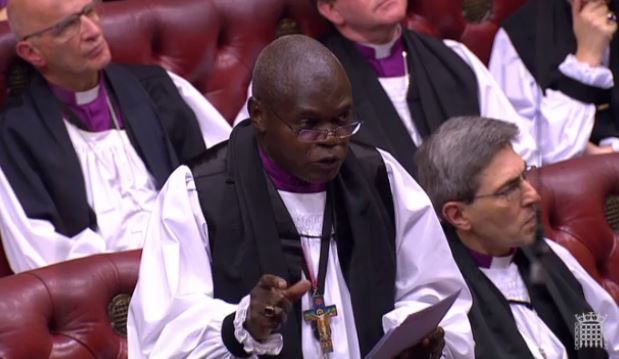
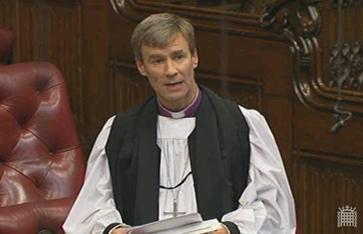
Bishop of Southwark speaks against Government proposals on tax credits

I fear that the introduction of these regulations will push a significant number of hard-working although low-earning families to breaking point.” – Bishop of Southwark, 26/10/15

BishSouthwarktaxcreditsOn 26th October 2015 the House of Lords debated a motion to approve the Government’s Tax Credits (Income Thresholds and Determination of Rates) (Amendment) Regulations 2015. Continue reading “Bishop of Southwark speaks against Government proposals on tax credits”

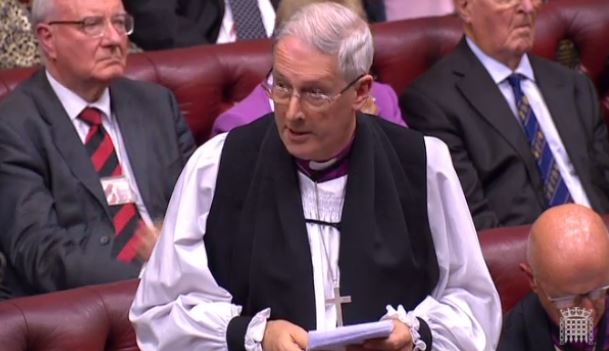
Bishop of Portsmouth puts motion to regret Government changes on tax credits

“I say to the Government that these proposals are morally indefensible. It is clear to me and, I believe, many others, that these proposals blatantly threaten damage to the lives of millions of our fellow citizens.“- Bishop of Portsmouth, 26/10/15

BishPortsspeechtaxcreditsOn 26th October 2015 the House of Lords debated a motion to approve the Government’s Tax Credits (Income Thresholds and Determination of Rates) (Amendment) Regulations 2015.

Alongside the motion to approve the House also debated four amendments to the motion, from Liberal Democrat, Crossbench and Labour Peers and one from the Bishop of Portsmouth, Rt Rev Christopher Foster. Continue reading “Bishop of Portsmouth puts motion to regret Government changes on tax credits”

Bishop of Peterborough asks the Government about benefits sanctions

On the 10th September 2015 Baroness Sherlock asked the government what plans they have to review the operation of sanctions on benefits. The Bishop of Peterborough, Rt Revd. Donald Allister, asked a supplementary question about the impact the cost of travel has on people in rural areas when they are required to attend appointments at JobCentre Plus.

14.02 PeterboroughThe Lord Bishop of Peterborough: My Lords, the Feeding Britain report showed that some people have been sanctioned for missing or being late for appointments when it is not their own fault. Is it not possible for the staff at Jobcentre Plus to be given some discretion in whether or not to apply sanctions? Along the same lines, is it fair that some people in rural communities have to spend £7 or more on bus fares to get to routine appointments when the likes of me, who can well afford bus fares, are entitled to a free bus pass?

Continue reading “Bishop of Peterborough asks the Government about benefits sanctions”

Bishop of Birmingham responds to the Budget

“The test of the success of this and future Budgets for a country living within its means will be the growing number of households that are equipped and completely free to earn the means to live.” Bishop of Birmingham 21/07/15

01.04.14 Bishop of BirminghamOn the 21st July 2015 the Bishop of Birmingham, the Rt Revd David Urquhart, responded to the  Budget Statement, during a debate in the House of Lords. The Bishop called for an inclusive capitalism and questioned Lord O’Neill the Commercial Secretary for the Treasury about the impact of the changes to working age benefits. The Bishop also spoke about the need to improve productivity via energising the local economy alongside investing in infrastructure, skills, training and apprenticeships.

Continue reading “Bishop of Birmingham responds to the Budget”

Bishop of Chester asks Government about Universal Credit

14.03 Bishop of ChesterOn the 7th July 2015 Lord Leigh of Hurley asked Her Majesty’s Government “what is their assessment of the experience of those claiming Universal Credit”. The Bishop of Chester the Rt Revd Peter Forster asked a supplementary question.

Continue reading “Bishop of Chester asks Government about Universal Credit”

Bishop of St Albans raises concerns of deaf people about cap on Access to Work fund

On 29th June 2015 Lord Touhig asked Her Majesty’s Government “what assessment they have made of the effectiveness of the Access to Work fund and what plans they have to help people with disabilities into work.” The Bishop of St Albans, Rt Revd Alan Smith, asked a supplementary question about the impact on deaf people of the cap on Access to Work grants.

Bishop of St AlbansThe Lord Bishop of St Albans: My Lords, perhaps I may press the Minister a little about the very real concerns of many people in the deaf community about the use of British Sign Language, not least because currently four-fifths of the highest-value awards are paying for BSL services. Indeed, the DWP’s own figures show that almost 90% of the users who will be affected by the cap that is to be brought in are deaf. How do the Government plan to continue to support and encourage deaf professionals on a par with the hearing community in the light of this cap? Continue reading “Bishop of St Albans raises concerns of deaf people about cap on Access to Work fund”

Bishop of St Albans leads debate on civil society, the common good and the Bishops’ General Election pastoral letter

“I am convinced that there is urgent work to be done to establish a new politics that seeks the common good. Indeed, I am keen that we will be able to explore the forms that such an approach to politics might take and the role that churches, charities and voluntary organisations, and indeed all intermediate institutions, can play in moving us in that direction.” – Bishop of St Albans, 11/6/15

On the 11th June 2015 the Bishop of St Albans, Rt Revd Alan Smith, led a House of Lords debate on the pastoral letter of the House of Bishops for the General Election of 2015. The debate was titled:

‘That this House takes note of the role played by civil society, in the light of the pastoral letter from the Church of England’s House of Bishops, Who is my neighbour?’

The Bishop’s speech is below in full, along with his closing remarks and links to the speeches of the other 16 participants.The speech and subsequent debate can also be watched here.

Bishop St Albans June 2015The Lord Bishop of St Albans: My Lords, there is much in our nation for which we can be profoundly grateful. Next week, as we mark 800 years since the sealing of Magna Carta, we give thanks for the long, yet sometimes tortuous, path that has led us to becoming a modern democracy. That moment was if not the birth then perhaps at least the conception of civil society at the beginning of a long gestation.

Last month, we celebrated 70 years of peace since the end of the Second World War, by which time civil society as we know it today was coming of age. As a nation, we have experienced extraordinary levels of economic growth over recent decades. Life expectancy has increased significantly and, importantly for this debate, in many communities in our nations, civil society is still strong and thriving. I for one am immensely grateful to be living in modern Britain and do not want to give any time to sentimental talk about a bygone era that probably never existed. Continue reading “Bishop of St Albans leads debate on civil society, the common good and the Bishops’ General Election pastoral letter”

Bishop of Leicester speaks on constitutional reform, devolution, human rights and welfare in debate on Queen’s Speech

“A no vote on the EU would hasten the demise of the Union and lead within a generation to a rump nation shorn of Scotland and of membership of the EU and without strategic influence internationally.”- Bishop of Leicester, 1/6/15

On 1st June 2015 the Bishop of Leicester, Rt Rev Tim Stevens, spoke in the debate on the Queen’s Speech, on constitutional, human rights, local government, devolution and welfare reform issues. The full text of his speech is below and it can also be watched online here.

LeicesterThe Lord Bishop of Leicester: My Lords, as the noble and learned Lord, Lord Falconer, has reminded us, the Prime Minister has offered us what he calls,

“a clear programme for working people, social justice, and bringing our country together—put simply, a One Nation Queen’s Speech from a One Nation Government”.

It is therefore clearly our responsibility to evaluate the Government’s programme against that yardstick, and to measure the gracious Speech on its potential for national unity and social justice, at every point. Continue reading “Bishop of Leicester speaks on constitutional reform, devolution, human rights and welfare in debate on Queen’s Speech”

Bishop of Truro leads debate on local welfare assistance for those in crisis

On 10th February 2015, the Bishop of Truro, Rt Rev Tim Thornton, led a debate in the House of Lords on local welfare assistance schemes and help for those in crisis. The full text of his speech is below, followed by those of Peers who participated. The Bishop of Portsmouth, Rt Rev Christopher Foster, also spoke in the debate towards the end.

Welfare Assistance Schemes

Question for Short Debate

7.30 pm

Asked by The Lord Bishop of Truro

To ask Her Majesty’s Government what steps they are taking to ensure that local welfare assistance schemes provide effective support to people in crisis and will continue to be able to do so.Bishop of Truro 20.6.13

The Lord Bishop of Truro: My Lords, I am very grateful indeed for this opportunity to raise a very important issue by putting some questions to the Government on, and raising matters relating to, local welfare assistance schemes. In doing so, I declare my interest that I am chair of the Children’s Society, a national charity which has conducted quite a lot of research in this area and to which I shall refer. Continue reading “Bishop of Truro leads debate on local welfare assistance for those in crisis”

Bishop of Portsmouth speaks in debate on Universal Credit conditionality

On 4th February 2015, Liberal Democrat Peer Lord German led a question for short debate in the House of Lords, to ask Her Majesty’s Government what are the results of the review into the setting of universal credit conditionality when children are in distress. The Bishop of Portsmouth, the Rt Revd Christopher Foster, took part in the debate. Speaking from personal experiences, the Bishop spoke of the need to provide greater flexibility and generosity in the suspension of conditionality of universal credit payments when children are in distress, particularly in circumstances where a child has lost a parent.

14.04.09 Portsmouth maiden speech 1The Lord Bishop of Portsmouth: My Lords, I am grateful to the noble Lord, Lord German, for prompting this debate about the review of universal credit when children are in distress. I speak this evening particularly about the distressing and challenging circumstances of the death of a parent, carer or sibling. I speak not only because I have experience as a priest alongside parents in such situations, as do so many of my clergy colleagues, and because I now support clergy in my diocese of Portsmouth ministering to those facing such deaths, but because of personal experience in my family. Continue reading “Bishop of Portsmouth speaks in debate on Universal Credit conditionality”