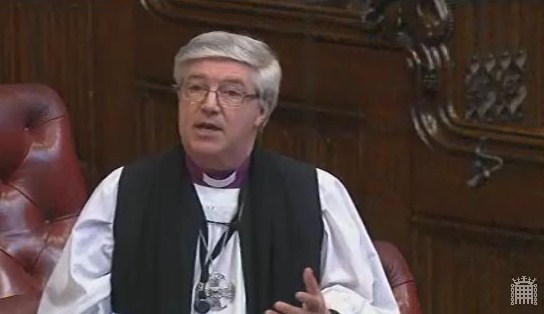
The Bishop of Leicester calls for evidence-based approach to provision of the Social Fund

Baroness Lister of Burtersett asked Her Majesty’s Government what arrangements will be made from April 2015 for the payment to local authorities of the moneys devolved from the Social Fund.

The Bishop of Leicester asked a supplementary question:

The Lord Bishop of Leicester: My Lords, in view of what the Minister has said, willLeicester she assure the House that there will be a proper assessment of the take-up of government funds by local authorities in 2013-14 to inform future consideration of the success or otherwise of these changes? How will the Government ensure that future consideration is linked to the wider impact of the Government’s welfare reforms?

 Baroness Stowell of Beeston: The Department for Work and Pensions is committed to reviewing how local authorities have been providing this support until now, and it will continue to do so during the course of 2014. What I hope we will see from that is that the very best practice which is being carried out in some local authorities will be used to inform other local authorities, and that the best practice is spread widely.

(via Parliament.uk)

Bishop of St Albans receives answers to written questions on energy policy and housing benefit

Written Questions answered on 24th January, 2014:

14.03 Bishop of St AlbansThe Lord Bishop of St Albans: To ask Her Majesty’s Government what steps they are taking to mitigate the additional cost of heating for rural households not on the gas grid.

The Parliamentary Under-Secretary of State, Department of Energy and Climate Change (Baroness Verma): The Government believes that domestic consumers living off the mains gas-grid should have access to secure and affordable fuel supplies to heat their homes.

Continue reading “Bishop of St Albans receives answers to written questions on energy policy and housing benefit”

Bishop of Ripon and Leeds takes part in affordable childcare debate

On 9th January 2014, the Bishop of Ripon and Leeds took part in Baroness Massey of Darwen’s debate on affordable childcare.

R_LThe Lord Bishop of Ripon and Leeds: My Lords, I am very grateful indeed to the noble Baroness, Lady Massey of Darwen, for initiating this debate and for expressing so clearly the issues involved and, indeed still more, for her determined advocacy in this House and elsewhere of the rights and needs of children, especially those children who are most at risk within our society.

Childcare provision in this country has grown like Topsy. As we have heard from a number of examples comparing our own experiences when we were young parents with those of our children as parents now, the need for childcare has become more and more crucial to both parents and children, and as a mainstay of our culture as well of our economy. However, there is such a complex system, which is part universal and part not, with childcare vouchers in their varied forms as an additional complication. Rather strangely, there is also the danger that universal credit will actually make the situation more, rather than less, complex.

Continue reading “Bishop of Ripon and Leeds takes part in affordable childcare debate”

Bishop of Chester takes part in debate on Autumn Statement

On 5th December, the Bishop of Chester took part in the debate on the Autumn Statement, which was repeated in the House of Lords by the Commercial Secretary to the Treasury, Lord Deighton.

14.03 Bishop of Chester Continue reading “Bishop of Chester takes part in debate on Autumn Statement”

Bishop of Derby takes part in debate on the cost of living

“Over the past 12 months in the city of Derby, we have seen a 100% increase in the use of food banks. The point I want to make in this debate is that the shift has moved away from the normal suspects, who are, tragically, homeless people, towards families who are housed, but whose incomes are so low that they cannot feed themselves seven days a week.”

On 31st October 2013, Baroness Prosser led a take-note debate on the current cost of living and its impact on family budgets. The Bishop of Derby, the Rt Revd Alastair Redfern, took part in the debate, focusing his remarks on the response of civil society to issues of food poverty in the UK, particularly the role of churches in providing food banks. He also spoke about work and income, questions around lifestyle, and the role of the state.

Bishop of DerbyThe Lord Bishop of Derby: My Lords, I, too, congratulate the noble Baroness, Lady Prosser, on securing this debate and on setting such a good framework in her introduction. I want to look particularly at the human cost of this issue and at the family budgets of those who are at the sharp end of the struggle in trying to deal with rising living costs. I shall begin with the big picture. Earlier this year I organised a hunger summit in Derby. We looked at food poverty in what we call the developing countries, but we also looked at food poverty in our own city. We took the opportunity to launch a remodelled food bank system to provide a more comprehensive service to meet the growing food poverty that we are finding in our own back yard. That is the context in which we should begin to look at the pressure on family budgets. We were supported by the Fair Share Trust. Indeed, the noble Lord, Lord Newby, was in the House earlier this week when there was a Question about food waste, and I hope that one of the things we can do with excess food is redirect some of it towards organisations such as the Fair Share Trust so that it can be used to supplement those families whose budgets are so stretched that they cannot afford to eat properly. Continue reading “Bishop of Derby takes part in debate on the cost of living”

Bishop of Ripon and Leeds calls for Government to examine reform of winter fuel allowance

On 23rd October 2013, Lord Greaves asked Her Majesty’s Government what proposals they have to reduce the level of economic inequality. The Bishop of Ripon and Leeds, the Rt Revd John Packer, asked a supplementary question:

R_LThe Lord Bishop of Ripon and Leeds: My Lords, bearing in mind the way in which wealthy pensioners, such as many in this House, are protected against the austerity cuts that other welfare recipients face, will the Government consider how to enable us to begin to bear our share of the burden, whether by taxing or means-testing the winter fuel allowance or otherwise?

Lord Newby: My Lords, one of the commission’s recommendations was that intergenerational equity could be improved if pensioners paid a higher share. That has not been the view that the Government have taken. Particularly given the very high levels of pensioner poverty, against which many noble Lords have campaigned over many years, we have taken the view that the real value of pensions should be protected during this period of fiscal consolidation. However, we accept that there may be more to be done. Indeed, for people who receive payments such as the winter fuel allowance, there are now a number of voluntary schemes under which they can make that payment available via charities so that it can be used for people on low incomes.

(via Parliament.uk)

Bishop of Ripon and Leeds raises concerns over implementation of welfare reforms

On 21st October 2013, the Bishop of Ripon and Leeds, the Rt Revd John Packer spoke during the debate on the Universal Credit, Personal Independence Payment, Jobseeker’s Allowance and Employment and Support Allowance (Claims and Payments) Regulations 2013. The Bishop said he hoped that proper attention would be paid in the working out of the universal credit system to the mother’s role, which in many circumstances was crucial when the whole family was under stress. He also expressed concern about the monthly payments system, which was making it more difficult to control family finances. The Bishop hoped that the Minister would give an assurance that one-month’s back-dating would be legitimate without a particular reason needed for it and would clarify the circumstances under which a claimant was considered unable to claim online due to system failure.

R_LThe Lord Bishop of Ripon and Leeds: My Lords, I am very grateful to the noble Lord, Lord McKenzie, for bringing this matter to our attention again, and for the three powerful speeches which we have already heard. First, I want to emphasise my concern about that part of the Motion which speaks of the way in which universal credit awards paid in respect of children will not necessarily by default be paid to the main carer of the children and the disproportionate impact this will have on women. Through my work, I have become increasingly aware of the mother’s crucial role in the sorts of situations that we have been discussing over the past few minutes and indeed over the past few years. The mother needs to have proper control of the money which is coming for the benefit of the family and in respect of her children. I hope that in our discussions and the way in which the regulations and the whole universal credit system are worked out we shall be able to pay attention to the mother’s role, which in many circumstances is crucial when the whole family is under severe stress. Continue reading “Bishop of Ripon and Leeds raises concerns over implementation of welfare reforms”

Bishop of Ripon and Leeds calls for greater research on impact of under-occupancy charge

On 21st October 2013, Baroness Hollis of Heigham asked Her Majesty’s Government what advice they give to social landlords whose tenants have fallen into arrears as a result of the under-occupancy charge. The Bishop of Ripon and Leeds, the Rt Revd John Packer, asked a supplementary question:

R_LThe Lord Bishop of Ripon and Leeds: My Lords, is the Minister aware of the evidence that people who are leaving accommodation to avoid the under-occupancy charge are being rehoused in private accommodation at greater cost? What steps are being taken to monitor this?

Lord Freud: My Lords, as I have just pointed out, we are undertaking an elaborate set of research programmes to understand this. If a family moves into private accommodation, which is more expensive, it does not necessarily mean that there is a net cost, because it frees up larger accommodation in the social rented sector to which a family can move from the expensive private sector.

(via Parliament.uk)

Bishop of Norwich raises concerns with civil legal aid reforms

On 17th July 2013, Lord Bach moved a motion to regret on the Civil Legal Aid (Financial Resources and Payment for Services) Regulations 2013.The Bishop of Norwich, the Rt Revd Graham James, expressed concern that the level at which permitted disposable capital was set would render some older people in particular less capable of securing legal aid without selling their homes. He hoped that if vulnerable people’s access to legal representation were damaged by the regulations the government would change course on humanitarian grounds and not defend the regulations on the basis of a flawed ideology.

14.06.12 Bishop of NorwichThe Lord Bishop of Norwich: My Lords, a key reference in this Motion of Regret is to “vulnerable people”, which is why this non-lawyer dares to stand amid such legal luminaries and feels a bit vulnerable himself.

A civilised country is one where we are all free under the law and where vulnerable people are not left defenceless against unjust treatment by another person, organisation or even an agent of government. Vulnerability is relative, of course, but the calculations that inform the regulations under discussion concern people who may be a very long way, as we have heard, from financial comfort and security, and may have multiple other needs. Continue reading “Bishop of Norwich raises concerns with civil legal aid reforms”