
Bishop of Worcester warns of risk of counterproductive responses to freedom of speech concerns at universities

On 22nd February 2016 Baroness Deech asked Her Majesty’s Government “what steps they are taking to ensure freedom of lawful speech at universities, in the light of recent disruptions to speeches.” She made reference in her follow up question to “incidents of intolerance and violence” on campuses, including “the silencing of a female Muslim reformer at Goldsmiths; smashed glass, fire alarms set off and the police called at King’s College London to stop an Israeli peace activist from speaking; Peter Tatchell at Canterbury and other examples”. She asked the Minister to speak to vice-chancellors “to ensure that the law on freedom of speech is upheld”. The Bishop of Worcester, Rt Revd John Inge, asked a follow up question:

worcesterThe Lord Bishop of Worcester: My Lords, now is not the time for confessions but I would observe that as an undergraduate, I saw things in very black and white terms. I do not now, despite what might be suggested by my attire. I would have loved to have been rebuked by Parliament as an undergraduate. Does the Minister agree that in intervening in situations such as these, we run the risk of being counterproductive? Continue reading “Bishop of Worcester warns of risk of counterproductive responses to freedom of speech concerns at universities”
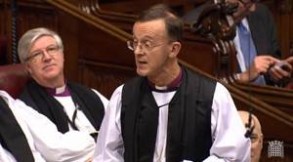
Bishop of Worcester “stigmatising Muslim communities not conducive to community cohesion”

worcesterOn the 27th January 2016 Lord Pearson of Rannoch asked the Government “what assessment they have made of the risk that Christians could be recorded as having committed an anti-Muslim hate crime from April 2016 by preaching the divinity of Christ or by reading aloud sections of the Bible in public, such as 1 John, Chapter 4, verses 1 to 3.” The Rt Revd John Inge, Bishop of Worcester, asked a follow-up question criticising the phrasing of Lord Pearson’s question and highlighting the  contribution of religion to the enrichment of public life. The transcript in full is available below.
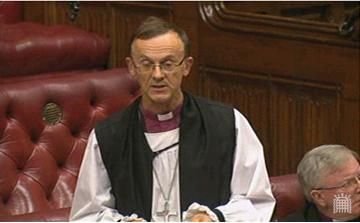
The Lord Bishop of Worcester: My Lords, does the Minister agree with me that Questions phrased in this manner are not conducive to building positive relations between faith communities, in particular with Muslim communities, as we are endeavouring to do in the church at a time when Muslims are feeling unfairly stigmatised? Does he further accept that Muslims, and people of all faiths, greatly enrich our society and make a significant contribution to the common good? Continue reading “Bishop of Worcester “stigmatising Muslim communities not conducive to community cohesion””

Bishop of Worcester asks how Government’s family test will shape its life chances strategy

On 26th January 2016 Baroness Lister of Burtersett asked Her Majesty’s Government “what impact the Family Test has had on policy-making”. The Bishop of Worcester, Rt Revd John Inge, asked a follow up question:

WorcesterThe Lord Bishop of Worcester: My Lords, I have not consulted their Graces the most reverend Primates the Archbishops, but I feel confident in saying that we on these Benches welcome the thrust of the life-chances strategy, which the Prime Minister outlined in a recent speech. We believe, as does the Prime Minister, that the family is the best anti-poverty measure ever invented—invented by God, in fact, although the Prime Minister did not add that. The increase in funding for relationship support is welcome, but could the Minister indicate how the priorities articulated in the family test might shape the development of the life-chances strategy as it is published and implemented in due course? Continue reading “Bishop of Worcester asks how Government’s family test will shape its life chances strategy”

Bishop of Worcester praises ‘common good’ value of restorative justice

On 18th November 2015 Lord Blair of Boughton asked Her Majesty’s Government “what assessment they have made of the effectiveness of restorative justice services in England and Wales.” The Bishop of Worcester, Rt Revd John Inge, asked an additional question:


WorcesterThe Lord Bishop of Worcester: My Lords, does the Minister accept that, whatever the statistics regarding effectiveness, for those who participate in it restorative justice is a profoundly affecting experience? I have witnessed the restorative justice programme in HM Prison Hewell in my diocese, and for all concerned—particularly for members of the community—it is a deeply affecting experience which is profoundly for the common good. Continue reading “Bishop of Worcester praises ‘common good’ value of restorative justice”

Bishop of Worcester asks Government about aid and protection for civilians in Iraq

On the 23rd and 24th September 2015 the Bishop of Worcester, Rt Revd John Inge, received answers to questions of Government about Iraq – on humanitarian aid, the impact of military action on civilians and support for building an inclusive state.


WorcesterThe Lord Bishop of Worcester: To ask Her Majesty’s Government what steps they are taking to ensure humanitarian access to civilian communities in Iraq in need of aid who are caught up in the fighting.


‘We cannot shirk our responsibility to be a force for good in the world’, Bishop of Worcester tells Peers

“We cannot shirk our responsibility to be a force for good in the world. The type of challenges highlighted by this debate can be managed only in partnership with others—working to win hearts and minds, as well as being involved in any defence initiatives.” – Bishop of Worcester, 2/7/15

On Thursday 2nd July 2015 the Lords debated a motion moved by Lord Ashdown of Norton–sub-Hamdon ‘that this House takes note of the United Kingdom’s role in addressing global challenges posed by terrorism, conflict, climate change and mass migration’. The Bishop of Worcester, Rt Revd John Inge, spoke in the debate.

The Lord Bishop of Worcester: My Lords, I begin by expressingmy profound sadness in the wake of the recent horrific terrorist attacks. A student from the University of Worcester was killed in Tunisia, which brought home to people locally that these problems are not “out there”. It demonstrated very clearly the connectivity, of which the noble Lord, Lord WorcesterAshdown, spoke so eloquently.

What should our response be to the unprecedented times described so well by the noble Lord? While recognising that we have faced more difficult times, as the First World War commemorations remind us, we need to hold on to the strategic objectives that have underpinned British foreign policy since 1945 but adapt them for these new circumstances. We need to recognise that, although we live in an unprecedentedly connected world, it remains fractured and broken, and we need to work ever harder in partnership with others for the global common good. Continue reading “‘We cannot shirk our responsibility to be a force for good in the world’, Bishop of Worcester tells Peers”

Bishop of Worcester- Extractives Industry (Written Answer)

On 25th March 2015, the Bishop of Worcester, Rt Revd John Inge, received answers to written questions on regulation of the extractives industry:

WorcesterThe Lord Bishop of Worcester: To ask Her Majesty’s Government what measures they will take against extractives industry companies which seek to subvert the intention behind the Reports on Payments to Governments Regulations 2014.

Baroness Neville Rolfe (Parliamentary Under-Secretary of State for Business, Innovation and Skills): The Government expects companies to comply with the requirements of the Reports on Payments to Government Regulations 2014.

The Regulations, which came into effect on 1 December 2014, set out the enforcement and penalty regime for any company that fails to comply in part or in full. It is a matter for the company to ensure that it is fully complying with the requirements. On a criminal conviction for not doing so the penalty may be a fine or a term of imprisonment for the directors of the company.

Reports made annually by companies under these Regulations will be published on Companies House website where both government and other interested parties will be able to consider the reports and their accuracy.

Continue reading “Bishop of Worcester- Extractives Industry (Written Answer)”

Bishop of Worcester – Russia and Eastern Europe (Written Answers)

On 26th February 2015, the Bishop of Worcester, the Rt Revd John Inge, received answers to two written questions, on the subject of security in Russia and Eastern Europe.

WorcesterThe Lord Bishop of Worcester: To ask Her Majesty’s Government what steps they are taking, as a member of the Organisation for Security and Co-operation in Europe, to bring about renewed discussions with Russia on a possible Euro-Atlantic security community. [HL5013]  Continue reading “Bishop of Worcester – Russia and Eastern Europe (Written Answers)”

Divisions – Modern Slavery Bill

On 23rd and 25th February 2015, bishops took part in two divisions on the Government’s Modern Slavery Bill, relating to the Independent Anti-Slavery Commissioner and the protection of overseas domestic workers.

House of Lords Division Lobby

Continue reading “Divisions – Modern Slavery Bill”

Human Fertilisation and Embryology (Mitochondrial Donation) Regulations 2015 – speech by Bishop of Carlisle

14.06.09 Bishop of CarlisleOn 24th February 2015 the House of Lords considered a Motion to Approve the Human Fertilisation and Embryology (Mitochondrial Donation) Regulations 2015, alongside a Motion from Lord Deben not to approve the Regulations but to set up a Joint Committee of Parliament to consider the issues in more detail. 

The Bishop of Carlisle, Rt Rev James Newcome, spoke during the debate, setting out his own position and that of the Church of England on the question of Mitochondrial Donation (also known as ‘three parent babies’). 

Earl Howe  concluded the debate on behalf of the government. An extract from his remarks can also be found below.

Concluding the debate, Lord Deben put his amendment to a vote, which was defeated: Contents 48; Not-Contents 280. The Bishops of Carlisle, Ely, St Albans and Worcester voted in favour of the amendment by Lord Deben. The Bishop of Norwich voted against the amendment. The Bishop of Bristol abstained. Continue reading “Human Fertilisation and Embryology (Mitochondrial Donation) Regulations 2015 – speech by Bishop of Carlisle”