
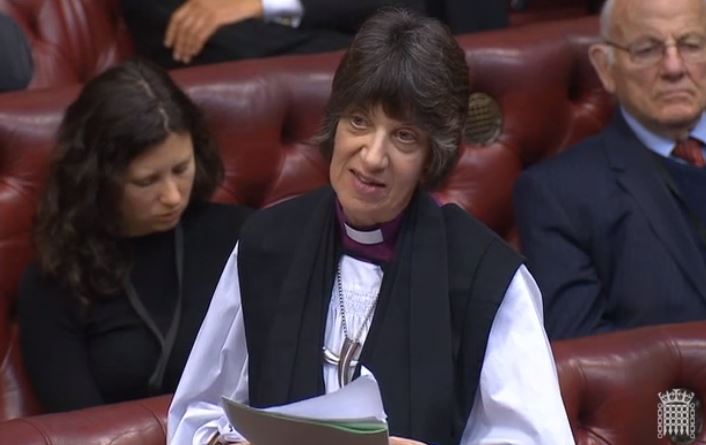
The Bishop of Gloucester spoke in support of amendments to the Terminally Ill Adults (End of Life) Bill focusing on healthcare for those in prison and safeguarding of prisoners under the bill on 12th December 2025:
The Lord Bishop of Gloucester: My Lords, I will speak to these amendments because I want to make a new point. A very vulnerable population that we must continue to remember is the prison population. Although we will deal with the prison population more fully in the group coming up, we must remember that this Bill currently does not exclude prisoners from being eligible. That means we must consider how each issue is likely to play out in a prison setting.
As we have heard extensively, these amendments deal with two main issues: first, access to primary care; and, secondly, how well that primary care physician knows the details of your medical history. The first is very closely related to inequalities and making sure that those who have worse access to care are not more likely to choose assisted dying. The prison population are therefore a key group that must be considered, since their health and access to healthcare are worse than that of the general population. That is evidenced by the recently published report by the Chief Medical Officer.
That report also highlights access to healthcare for those in prison. There is no automatic or compulsory enrolment of prisoners into primary care on the prison estate. Over 20% of the prison population do not complete registration on arrival. For those who do, the service is often slow or inaccessible. According to the Nacro report on physical health in prison, two in five prisoners waited for a month or longer for a GP appointment and one in 13 never got one. According to the Chief Medical Officer’s report, one in three prisoners does not have their full electronic health record available to prison healthcare staff. These are not just statistics. When I visit and talk with prisoners about their well-being and purpose, access to healthcare is always spoken about.
Briefly, I do not believe that the issue of how well a primary care physician knows your medical history has been sufficiently considered from a prison context. If a GP may be the person to conduct a preliminary discussion to consider a person’s application for an assisted death, how will they do that safely with incomplete information about their patient’s health record? We must question eligibility along these lines. Before we talk about the next group of amendments, I hope that there will be important safeguards for prisoners on the issues raised in this group.
Extracts from the speeches that followed:
Baroness Grey-Thompson (CB): My Lords, I will speak to Amendments 22, 24, 30C, 308, 347 and 458. I tabled these amendments after looking at data from other jurisdictions and listening to debates in another place. These amendments are probing. I want to be clear that they are here to invite debate not on the death penalty, abortion rights or who can become pregnant but merely on the groups and how they are impacted by the Bill.
With regard to my amendments on prisoners, those on remand and defendants on bail, there could be seen to be a conflict between prisoners’ rights to autonomy and the state’s duty to administer punishment. I was privileged to visit a young offender institution recently with the Duke of Edinburgh’s Award, which I chair. It is always very interesting to visit prisoners in young offender institutions and see the life that they live. UK staff are trained to spot prisoners who are at risk of bullying, suicide or self-harm. But I would like to understand—including in the context of what the right reverend Prelate the Bishop of Gloucester raised about prisoners’ access to primary care—how this would work in practice and which doctors would be allowed to have a conversation with prisoners.
Those deprived of liberty can be very vulnerable and prone to suicide. As we have heard, they could also experience a lack of care and palliative care. Yoann Della Croce argues that while prisoners in Switzerland should have the same level of care as the general population, assisted dying is a liberty that should not be extended to prisoners.
Baroness Fox of Buckley (Non-Afl): My Lords, I want to speak specifically to Amendment 22, about why prisoners should not be eligible for assisted dying. The amendments from the noble Lord, Lord Farmer, are also pertinent here.
The right reverend Prelate the Bishop of Gloucester raised the real and specific safeguard issues from the lack of medical records of prisoners, and I am sure we will hear more about the problems of medical care for prisoners. The terrible terminal diagnosis that one might get as a prisoner would be particularly frightening, I would think, because of the lack of medical care.
That is actually not my concern. Regardless of where one stands on assisted dying in general, I really hope that, when it comes to this Bill, noble Lords will consider the very particular circumstances of those incarcerated by the state. I hope the sponsors of the Bill will still be open to excluding prisoners and keeping them out of the Bill, on the basis, if nothing else, of their lack of autonomy.
I have to confess that I was rather taken aback when I heard Minister Stephen Kinnock in the other place state that excluding prisoners from this Bill would lead to a difference in treatment between prisoners and non-prisoners, an inequality, citing Article 8, private life, and Article 14, discrimination, of the ECHR. He noted that differential treatment would require objective and reasonable justification. It seems a bit shocking to me to have to explain this to a Minister, but my objective and reasonable justification is that, if you are in prison, you do not have the same rights as if you are not in prison.
The Lord Bishop of Gloucester: My Lords, I speak to Amendment 22 in the name of the noble Baroness, Lady Grey-Thompson, to which I have also added my name. I declare my interest as Anglican Bishop to prisons in England and Wales.
There are many reasons why I believe that assisted dying may not be a fair choice for the general population, as things stand, but today I am shining a spotlight, as has already been said, on the prison population. I do not think that there has been enough attention in the debate so far on how the Bill would function for those
in prison. I do not apologise for having spoken about prisons in the previous group, because this Amendment 22 is about excluding prisoners from the Bill, but the previous group of amendments assumed that prisoners would still be in the Bill. Therefore, we still need to look through that lens when we are discussing issues about GPs and medical records.
The prison population is in worse health than the general population. We have heard that. However, the reports from both the Health and Social Care Select Committee in the other place and the Chief Medical Officer paint a more concerning picture than that. Age-related illnesses, dependency and frailty can begin at an earlier age than in the general population. The prison population is ageing faster, and when I am visiting prisons I never cease to be shocked by the number of extremely elderly and frail people in prison. In most places, the prison system is not able to meet their needs properly—and that is not to criticise the prison staff, who are doing their best.
Nacro reported that, in 2019-20, people in prison missed 42% of scheduled hospital appointments. The Health and Social Care Select Committee goes as far as to say that
“so-called natural cause deaths, the highest cause of mortality in prison, too often reflect serious lapses in care”.
As has been said by the noble Lord, Lord Farmer, there is a lack of palliative and end-of-life care in prisons and, although there are some examples of excellent practice, action to improve this is voluntary and not supported by the commissioning of services.
Noble Lords may well say that prisoners should have equal access to care under the law, including assisted dying but, as has already been said, they do not currently have equal access to care. For me, this is not simply about the prison system and healthcare; it is about the perspectives and sense of well-being among those in prison. I will not rehearse everything that has already been said, but will just reiterate that the prison population experience high levels of hopelessness. We have frequently and rightly spoken about IPP prisoners in this House.
Again and again as I visit prisons, I hear about and see evidence of the high levels of self-harm in our prisons; it is particularly high in the female estate. Self-inflicted deaths in prison are predicted to continue to rise disproportionately compared to the general growth of the prison population. We need to be cognisant of the fact that, during the special Select Committee on the Bill, the Royal College of Psychiatrists talked about how a person’s wish to hasten their death can be impacted by what their life is like.
Although compassionate release is an option, it is rarely taken up. Crucially, according to Macmillan Cancer Support’s A Guide for Prisoners at the End of Life, it also requires a three-month prognosis. How does that interact with the Bill?
I visited a prison recently where there were discussions about a very elderly, sick, frail man being released from prison. Ironically, his family said, “Please don’t”, because they felt he would be too vulnerable being back in the community where he committed his offences. What options are there for him?
I want to reiterate the question: are we keeping our prison population in mind as a vulnerable group in the Bill? Particularly when our prisons are overcrowded and, to be extremely frank—although I think the noble Baroness, Lady Fox, was franker—the desire to remove people from the system is high. I fear how the Bill could play out among the prison population and hope that noble Lords will give further consideration to this important issue.
Extracts from the speeches that followed:
Lord Carter of Haslemere (CB): My Lords, I want to make a very brief intervention in relation to the prison population. It is only the second time I have spoken on the Bill. I declare an interest as a trustee of the Prison Reform Trust.
The suicide rate among male prisoners is four times as high as that of the general population. In the year to 2024, 89 male prisoners committed suicide. The Prison Service has a duty of care towards the prison population to protect them from committing suicide—to stop it. The Government run the Prison Service, so they must have a view on what to do about a prisoner whose suicide the Prison Service has correctly thwarted under its duty of care but who then requests an assisted death under the Bill. How will the Government balance those two conflicting things?
That is my short intervention—to ask that question. I wholly support all the comments made by the noble Baroness, Lady Fox, the noble Lords, Lord Moore and Lord Farmer, the right reverend Prelate the Bishop of Gloucester, and others on this crucial issue. I am genuinely interested to know what the noble and learned Lord, Lord Falconer, makes of this dilemma for the Prison Service and the Government.
Lord Deben (Con): The right reverend Prelate, whose experience is remarkable and whom I admire enormously for her work in the prisons, has reminded us of how old the prison population is and how much older it is becoming. I just do not think that those of us in this House who really believe that our major job in this Bill is to protect the vulnerable can possibly agree that people in prison should be included under the Bill. We should take them out.


You must be logged in to post a comment.