
On 7th December the House of Lords considered amendments to the Government’s Trade Bill. Three votes on amendments were held in which Lords Spiritual took part. All three amendments were passed:
Author: parliamentaryunit
Trade Bill: Bishop of St Albans support amendments to give parliament approval of trade deals
On 7th December the House of Lords considered the Government’s Trade Bill at its Report Stage. The Bishop of St Albans sponsored and spoke in support of amendment 6 from Lord Purvis of Tweed on parliamentary approval of future trade deals:
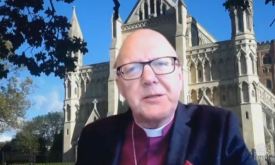 The Lord Bishop of St Albans [V] : My Lords, I support Amendment 6 in the name of the noble Lord, Lord Purvis of Tweed, and the revision he has made as he has engaged with the Government. I am grateful for his very clear exposition and will be concise in my support.
Modern trade agreements affect huge swathes of public policy, including consumer and workers’ rights, environmental legislation, food standards, health, public services and international development. MPs, who represent constituencies and work with a variety of stakeholders, deserve the right to assess the consequences of an agreement, as does your Lordships’ House.
Vote: Motion to approve report on conduct and suspension of Lord Maginnis
On 7th December the House of Lords voted on a Motion to approve a Report on the conduct of Lord Maginnis, a Member of the House. A vote for approval would also require the suspension of the Member. The Archbishop of Canterbury and Bishop of Manchester took part:
Bishop of Worcester calls for national child poverty strategy
On 7th December 2020 the Bishop of Worcester asked a question of Government on social mobility and the need for a national child poverty strategy:
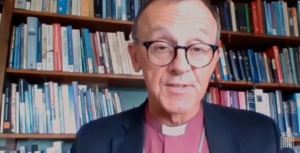 The Lord Bishop of Worcester [V]: My Lords, I speak today on behalf of the right reverend Prelate the Bishop of Newcastle, who has been delayed travelling to London. Like her, I am very aware of the relationship between child poverty and a lack of social mobility, but she has a special interest as independent chair of the North of Tyne Inclusive Economy Board. Child poverty is central to the Government’s levelling-up agenda. Since 35% of children in the north-east of England live in relative poverty, would the Minister tell us if Her Majesty’s Government will work with the Social Mobility Commission to develop a national child poverty strategy in response to the Covid-19 pandemic?
Bishops asks about cluster munition use, protection of refugees, cultural and religious sites in Nagorno Karabakh
On 7th December written answers were published to questions from the Bishops of Coventry, Leeds and Southwark on the conflict in Nagorno Karabakh:
 Nagorno Karabakh: Cluster Munitions
Nagorno Karabakh: Cluster MunitionsThe Lord Bishop of Leeds: To ask Her Majesty’s Government what assessment they have made of the use, if any, of cluster munitions during the recent conflict in the Nagorno-Karabakh region. [HL10621]
Bishop of St Albans asks about Ethiopia, armed conflict and food shortages:
On 7th December the Bishop of St Albans received written answers to questions on Ethiopia, armed conflict and food shortages:
 The Lord Bishop of St Albans: To ask Her Majesty’s Government what representations they have made to African members of the Commonwealth to encourage them to ensure a peaceful solution to the conflict in Tigray. [HL10708]
Continue reading “Bishop of St Albans asks about Ethiopia, armed conflict and food shortages:”
Week in Westminster, 30th November – 4th December 2020
 Parliament met in Westminster and online this week. The Bishop of Carlisle was on duty in the House of Lords and read prayers at the start of each sitting day.
He asked questions about Child Trust Funds, access to cancer treatment in the developing world, and supported amendments to prohibit or regulate the use of children by police and security services in covert investigations.
The Bishop of London asked about domestic abuse of elderly people during covid lockdown.
The Bishop of St Albans asked Government about the announced overseas aid cut, Eritrean refugees, and received written answers to questions on gambling, outdoor carol singing, hospice funding, the effects of quantitative easing, and the Regional Comprehensive Economic Partnership.
He and the Bishops of Coventry, Southwark and Leeds received written answers to seven questions about armed conflict, peace, reconstruction and religious and cultural sites in Nagorno Karabakh.
The Bishop of Portsmouth responded to the Government’s spending review announcement, focusing on universal credit and aid
The Bishop of Gloucester received written answers to questions on prisoner release over Christmas and contact with family.
Covert Human Intelligence Sources Bill: Bishop of Carlisle supports amendment to prevent use of children as covert agents
On 3rd December 2020 the House of Lords considered the Government’s Covert Human Intelligence Sources (Criminal Conduct) Bill 2020 at its Committee Stage. The Bishop of Durham had co-sponsored two amendments aimed at restricting or regulating the use of children as covert agents. The Bishop of Carlisle spoke in his place, in support of the amendments. As is usual practice they were withdrawn after debate and may be returned to at a later stage:
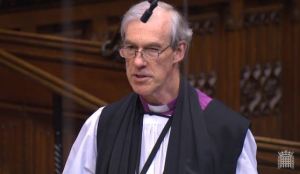 The Lord Bishop of Carlisle: My Lords, I speak in support of Amendment 43, in the names of my right reverend friend the Bishop of Durham, the noble Lord, Lord Young, and the noble Baronesses, Lady Chakrabarti and Lady Bull, and Amendment 60, in the names of the noble Baronesses, Lady Young and Lady Hamwee, and the noble Lord, Lord Kennedy of Southwark. As we have heard, both concern the treatment of children.
We should not for a moment underestimate some of the evils in our society that the Government and the forces of law and order are tasked with confronting. Some of those evils involve the abuse of children and vulnerable people, including, as we know, the scourge of county lines drug gangs, sexual predators and traffickers. It does not take much imagination to see how, as a result of this, there is a periodic temptation to use children as covert assets. We must clearly guard against that temptation; as we have already been reminded, our first duty must be to the care and well-being of children. This applies all the more to children who find themselves in vulnerable and harmful situations, such as those used and abused by criminal gangs.
Bishop of Portsmouth urges Government to keep uplift in universal credit for those ‘on cliff edge’
On 3rd December the House of Lords debated the Chancellor’s November Spending Review statement. The Bishop of Portsmouth took part in the debate:
 The Lord Bishop of Portsmouth [V]: My Lords, I was delighted to hear the Chancellor stress that the Government would continue to support the most vulnerable, but the proof of that assertion will be in how much money the Government are prepared to provide. That will be the barometer of what and who they consider most important. I therefore join my voice to those profoundly deprecating the proposed cut in development aid. I urge the Government to think again. Continue reading “Bishop of Portsmouth urges Government to keep uplift in universal credit for those ‘on cliff edge’”
Bishop of Carlisle asks about access to Child Trust Funds
On 3rd December 2020 during questions in the Lords on access to Child Trust Funds, the Bishop of Carlisle asked about provision for those who have learning disabilities but may also have life-limiting conditions:
 The Lord Bishop of Carlisle: My Lords, does the Minister agree that some children with learning disabilities who want to access trust funds might have life-limiting conditions? There might not be much time available for legal processes to be gone through. Can she assure the House that, if such situations have not already been considered, they will be given the attention that they deserve?

You must be logged in to post a comment.