 This week in the House of Lords bishops spoke in a debate on the root causes of poverty and supported the Refugees (Family Reunion) Bill. They asked questions about the two-child limit on benefits, credit limits and recycling. Continue reading “Week in Westminster, 11th-15th December 2017”
Author: parliamentaryunit
Bishop of Carlisle supports Refugees (Family Reunion) Bill
On 15th December 2017 the House of Lords debated the Refugees (Family Reunion) Bill [HL], a Private Member’s Bill introduced by Baroness Hamwee. The Bishop of Carlisle, Rt Revd James Newcome, spoke in support of the Bill:
 The Lord Bishop of Carlisle: My Lords, I too am most grateful to the noble Baroness, Lady Hamwee. I am delighted that this debate is about families, which is an apt topic as Christmas approaches. I am not speaking of the nostalgic image of a nuclear family around a groaning table; the Christian table is plainer but more welcoming and inclusive, a table around which all are welcome.
Round the table gathers a family. Our country has for so long and so rightly emphasised the family as a—perhaps the—key building block of society. At the present time we seek urgently for social integration, a society where shared values and shared culture bind us all into an ethos of mutuality which naturally, organically, squeezes out extremisms, violence, injustices and hate. Continue reading “Bishop of Carlisle supports Refugees (Family Reunion) Bill”
Bishops show support for Refugees (Family Reunion) Bill
The following letter, in support of Baroness Hamwee’s Refugees (Family Reunion) Bill signed by eight bishops, seven of whom are Lords Spiritual, appeared in The Times newspaper on 15th December 2017.

REFUGEE REFORM BILL
Sir, Britain is one of the few countries in Europe that does not allow refugee children who arrive alone in the UK to bring a parent here. This is the most glaring example of overly restrictive rules that deny many refugees the chance to live with their family. Today Baroness Hamwee will sponsor the Refugee Families Reunion Bill in the House of Lords, which would allow a wider range of family members to be reunited with refugees living in the UK. Continue reading “Bishops show support for Refugees (Family Reunion) Bill”
Bishop of St Albans highlights mental health link to poverty, and raises deprivation in rural areas
On 14th December 2017 Lord Bird asked Her Majesty’s Government “what plans they have to address the root causes of poverty and disadvantage in the United Kingdom.” In the short debate on the question, the Bishop of St Albans, Rt Revd Alan Smith, spoke about the link between poverty and mental health, and also the need for action on rural deprivation:
 The Lord Bishop of St Albans: I too thank the noble Lord, Lord Bird, for this debate. I want to make just a couple of points in the time I have.
Plenty of statistics have been bandied around today, and I can quote even more: 14 million people, by some counts, are living in poverty in this country, including 4 million children. The trouble with those and other statistics is that they hide the individual lives they represent: for example, the three men, whom many of us have seen, in sleeping bags in Westminster Tube station as I came in at 8 am yesterday morning; or Joe—not his real name—whom I met this morning in St Peter’s Street in St Albans as I went out to get my morning paper. There has been a visible increase in the number of people on our streets in places such as St Albans over recent months. I have got to know a number of them, and this morning, knowing I was coming in for this debate, I thought I had to sit and talk to Joe just for a minute. I felt I could not in all conscience come and speak on a subject such as this without actually finding out his name and just a little about his story. Continue reading “Bishop of St Albans highlights mental health link to poverty, and raises deprivation in rural areas”
Bishop of Carlisle – strong, stable family relationships help to address root causes of poverty and disadvantage
On 14th December 2017 Lord Bird asked Her Majesty’s Government “what plans they have to address the root causes of poverty and disadvantage in the United Kingdom.” In the short debate on the question, the Bishop of Carlisle, Rt Revd James Newcome, spoke about the importance of stable family life as an antidote to the causes of poverty.
 The Lord Bishop of Carlisle: My Lords, I, too, thank the noble Lord, Lord Bird, for securing this debate. As we have just heard, poverty cannot be measured simply in economic terms. It affects every area of a person’s life and, as a recent Demos report put it:
“The first step towards tackling poverty is understanding it better”.
Where better to begin than with its causes, about which I would like to make just two observations? Continue reading “Bishop of Carlisle – strong, stable family relationships help to address root causes of poverty and disadvantage”
Bishop of St Albans asks about automatic credit increases by lenders
 On 14th December 2017 the Bishop of St Albans, Rt Revd Alan Smith, received a written answer to a question on credit:
The Lord Bishop of St Albans: To ask Her Majesty’s Government how they will monitor the voluntary agreement by lenders not to give automatic credit limit increases to consumers. Continue reading “Bishop of St Albans asks about automatic credit increases by lenders”
Bishop of St Albans asks about improvements to recycling in local authorities
On 13th December 2017 Baroness Neville-Rolfe asked Her Majesty’s Government “what progress is being made towards establishing a single national standard for household recycling”. The Bishop of St Albans, Rt Revd Alan Smith, asked a follow up question:
 The Lord Bishop of St Albans: My Lords, in the past the Minister has quoted the very different levels of recycling in local authorities. Can he tell us Her Majesty’s Government’s thinking on how to incentivise local authorities that are not performing well to improve, and how to share best practice to increase their level of recycling? Continue reading “Bishop of St Albans asks about improvements to recycling in local authorities”
Bishop of Carlisle asks Government about effect on religious families of two-child limit on benefits
On 11th December 2017 Baroness Sherlock asked Her Majesty’s Government “why kinship carers who subsequently have their own child are not exempt from the two child limit.” The Bishop of Carlisle, Rt Revd James Newcome, asked a follow up question:
 The Lord Bishop of Carlisle: My Lords, the Government have chosen to pursue a deficit-reduction strategy by opting for a fiscally cautious welfare policy. However, has the Minister considered that some British families are larger for reasons of faith or principle? Speaking on behalf of people of all faiths in this country, my question is: what plans does the Minister have for ensuring that such families and children are not discriminated against by the policy? Continue reading “Bishop of Carlisle asks Government about effect on religious families of two-child limit on benefits”
Week in Westminster, 4th-8th December 2017
This week in the House of Lords the Archbishop of Canterbury led a debate on education, in which three other bishops spoke about schools, early years, further education and skills. Bishops also spoke in debates on the Autumn Budget Statement and in response to Government statements on Zimbabwe, the Social Mobility Commission, and terrorism. They asked questions about social housing in rural areas, and rough sleeping. In the House of Commons the Second Church Estates Commissioner answered questions from MPs on her bill to enable mother’s to have equal status on marriage certificates, and on religious minorities in Egypt. Continue reading “Week in Westminster, 4th-8th December 2017”
Education debate: Bishop of Oxford says digital technology learning should be in ethics as well as skills
On 8th December 2017 the Archbishop of Canterbury, Most Revd and Rt Hon Justin Welby, led a debate in the House of Lords, ‘That the House takes note of the role of education in building a flourishing and skilled society.’ The Bishop of Oxford, Rt Revd Steven Croft, spoke in the debate and his speech is below. The Archbishop’s opening and closing speeches can be seen here.
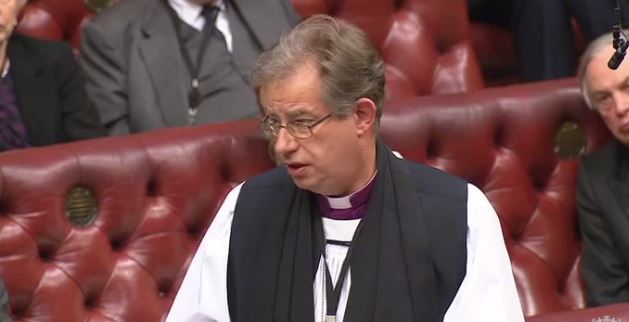 The Lord Bishop of Oxford: My Lords, like other speakers, I am grateful to the most reverend Primate the Archbishop of Canterbury for his leadership in this debate and in much else.
I speak this afternoon from three perspectives: as the bishop of a diocese with more than 280 church schools, both primary and secondary, and that number is rising; as a member of your Lordships’ Select Committee on artificial intelligence, which has been a fascinating enterprise; and as a grandfather with three, as yet unsuspecting, grandsons who will enter the education system in the next year or so. The eldest is two and a half and the youngest is just three months. Those grandsons will grow up in a different world. They will probably never drive or own cars; they will interact with screens and machines from an early age, something which is already happening; they will need to know how to set boundaries around their online lives; and their working life and their leisure will be more different from mine than my own is from my grandfather’s. Continue reading “Education debate: Bishop of Oxford says digital technology learning should be in ethics as well as skills”


You must be logged in to post a comment.