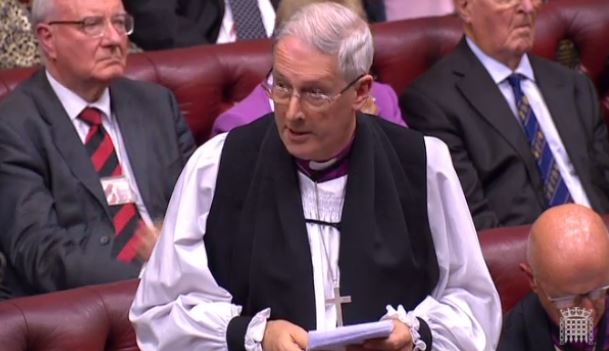
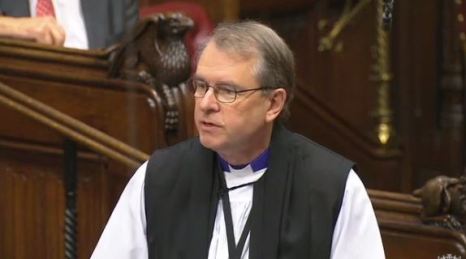
Archbishop of York responds to question from UKIP Peer on Muslim tenets of Taqiyya and Al Hijra

york-170117-bOn 24th January 2017 UKIP Peer Lord Pearson of Rannoch asked the Government “whether, as part of their strategy against Islamist terrorism, they will encourage United Kingdom Muslim leaders to re-examine the Muslim tenets of Taqiyya and Al Hijra.” He mentioned the Archbishop of Canterbury in his follow up question. The Archbishop of York, Most Revd John Sentamu, asked a question in response:

The Archbishop of York: My Lords, first, would the Minister agree that the term Taqiyya came into being at a time of terrible persecution? It did not get invented because people did not want to be difficult or awkward. Of my friends who escaped Amin’s torture, some left dressed as women. You would not say these Christians wanted simply to be deceptive; things have to be read in context. Secondly, the lecture by the most reverend Primate the Archbishop of Canterbury was a one-hour lecture in France; he is more than happy to repeat it if your Lordships’ House wants.

Continue reading “Archbishop of York responds to question from UKIP Peer on Muslim tenets of Taqiyya and Al Hijra”

Bishop of Durham calls for more joined-up approach to tackling child poverty

durham-230117On 24th January 2017 Baroness Lister of Burtersett asked the Government “why they have abolished the Child Poverty Unit which was sponsored by the Department for Work and Pensions, the Department for Education and HM Treasury.” The Bishop of Durham, Rt Revd Paul Butler, asked a follow up question:

The Lord Bishop of Durham: My Lords, I know the Minister will agree that no child chooses to live in poverty, so when a child is hungry or lives in poor housing, will the Minister and the Government recognise that these are our children, as a society, and that that means we must have good joined-up structures which tackle these issues? Does he also recognise that the abolition of the CPU does not hint at good joined-up structures? Continue reading “Bishop of Durham calls for more joined-up approach to tackling child poverty”

Bishop of St Albans asks government about number of forced marriages and support for those sent abroad

stalbans190117On the 23rd and 24th January 2017, the Bishop of St Albans, Rt Revd Alan Smith, received answers to written questions about British children being sent abroad to marry, and about the Forced Marriage Unit’s policy of not paying for the repatriation of British nationals forced to marry abroad.


Lord Bishop of St Albans: To ask Her Majesty’s Government what estimate they have made of the total number of (1) British nationals under the age of 16, and (2) British nationals aged 16–17, sent abroad in 2016 in order to enter into a forced marriage.

Lord Bishop of St Albans: To ask Her Majesty’s Government how many cases the Forced Marriage Unit dealt with in 2015 and 2016 respectively, in which (1) British nationals under the age of 16, and (2) British nationals aged 16–17, were sent abroad in order to enter into a forced marriage. Continue reading “Bishop of St Albans asks government about number of forced marriages and support for those sent abroad”

Bishop of Durham asks about UK representative in Burundi

durham-230117On the 24th January 2017, the Bishop of Durham, the Rt Revd Paul Butler, received answers to written questions about UK representation in Burundi.


Bishop of Durham: To ask Her Majesty’s Government what plans they have for a permanent representative in Burundi.

Baroness Anelay of St Johns: The Foreign and Commonwealth Office operates a permanent British Embassy Office in the Burundian capital Bujumbura. The non-resident British Ambassador to Burundi is based in Kigali, Rwanda.


(via Parliament.uk)

Bishop of Durham raises cases of imprisoned Sudanese pastors

durham-230117On 23rd January 2017, Baroness Cox asked the Government “what assessment they have made of recent developments in Sudan.” The Bishop of Durham, the Rt Revd Paul Butler, asked a follow up question:


Bishop of Durham: My Lords, while recognising that improvements between the Anglican Church of Sudan and the Sudanese Government have occurred, it remains the case that, after over a year, there are two Sudanese pastors, one Czech aid worker and a Sudanese civil rights activist still in al-Huda prison in Omdurman under the death penalty. Human rights activists say that there is no case at all. What contact have Ministers with the Government of Sudan regarding these prisoners and the treatment of Christians more generally? Continue reading “Bishop of Durham raises cases of imprisoned Sudanese pastors”

Bishop of St Albans raises concerns about self-harm by young people

stalbans190117On 19th January 2017 Labour Peer Lord Hunt of King’s Heath asked Her Majesty’s Government “what is their assessment of Young Minds’ analysis published on 21 December 2016 that 64 per cent of Clinical Commissioning Groups are diverting new funding for children’s mental health services to other areas”. The Bishop of St Albans, Rt Revd Alan Smith, asked a follow up question:

The Lord Bishop of St Albans: My Lords, this is a very serious and growing problem. Recent research has shown over the last five years that the number of hospital admissions associated with children’s self-harm has grown by 93% among girls and 45% among boys. It seems extraordinary that when money is announced for mental health services it is then not spent. First, how many years will we wait until we need to ring-fence that money, because this is a really important issue? Secondly, to pick up on the previous but one question, will the Government commit to producing guidelines for schools and colleges about preventing and responding to self-harm, so that we have some practical things put in place? Continue reading “Bishop of St Albans raises concerns about self-harm by young people”

Church Commissioner questions: Israel/Palestine, human trafficking, prisons, social media, low carbon economy, tourism, lead theft

On 19th January 2017 the Second Church Estates Commissioner, Rt Hon Dame Caroline Spelman MP, answered questions in the House of Commons from MPs on Israel/Palestine, human trafficking, prisons, social media, low carbon economy, tourism and lead theft. The transcript is below:

spelman-190117b Continue reading “Church Commissioner questions: Israel/Palestine, human trafficking, prisons, social media, low carbon economy, tourism, lead theft”

Church Commissioners’ written answer: measures to tackle indebtedness

On 19th January 2017 the Second Church Estates Commissioner, Rt Hon Dame Caroline Spelman MP, answered a written question from Andrew Rosindell MP on measures to tackle indebtedness: 

Andrew Rosindell (Romford): To ask the right hon. Member for Meriden, representing the Church Commissioners, what work the Church of England is undertaking to tackle indebtedness. Continue reading “Church Commissioners’ written answer: measures to tackle indebtedness”

Church Commissioners’ written answer: Church window repairs

On 19th January 2017 the Second Church Estates Commissioner, Rt Hon Dame Caroline Spelman MP, answered a written question from Mike Wood MP, on repairing historic windows in churches:

Mike Wood (Dudley South): To ask the right hon. Member for Meriden, representing the Church Commissioners, what estimate the Church Commissioners have made of the potential cost of repairing historic windows in churches. Continue reading “Church Commissioners’ written answer: Church window repairs”

Archbishop of York – free trade must also be fair trade

york-170117-bOn 17th January, Viscount Ridley asked Her Majesty’s Government “what plans they have to celebrate the bicentenary of David Ricardo’s principle of comparative advantage, and the case for free trade”. The Archbishop of York, Most Revd and Rt Hon John Sentamu, asked a follow up question. 

The Archbishop of York Does the Minister agree that the principle of comparative advantage works only if trade is not only free but also fair? Continue reading “Archbishop of York – free trade must also be fair trade”