Bishop of Newcastle speaks about transport links to Holy Island of Lindisfarne

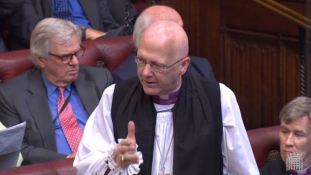
On 20th July 2017 the House of Lords debated a motion from Lord Berkeley “that this House takes note of the transport needs of remote island communities in England.” The Bishop of Newcastle, Rt Revd Christine Hardman, spoke about the Holy Island of Lindisfarne in Northumberland:

The Lord Bishop of Newcastle: My Lords, islands are special places and I am so grateful to the noble Lord, Lord Berkeley, for this debate and for learning, in his speech and those which have followed, so much more about the context of the Isles of Scilly. I discovered the Isles of Scilly only a few years ago. They are magical but after the boat trip over there, I understood why you can buy fridge magnets saying “I survived the ‘Scillonian’”.

Today, it is the transport needs of another remote island community I wish to speak about: the Holy Island of Lindisfarne in Northumberland. It is a very special place in my diocese. The island has been designated as an area of outstanding natural beauty. There is a national nature reserve covering 3,500 hectares. It has a rich historical and spiritual heritage including Lindisfarne Castle, owned by the National Trust, and Lindisfarne Priory, managed by English Heritage. The Holy Island of Lindisfarne is of course where St Aidan founded his monastery in the 7th century and based his mission to the people of Northumbria. Continue reading “Bishop of Newcastle speaks about transport links to Holy Island of Lindisfarne”

Bishop of Durham leads House of Lords debate on Refugee Welcome report

On the 19 July 2017 the Bishop of Durham, the Rt Revd Paul Butler held a short debate on the report of the All-Party Parliamentary Group on Refugees, Refugees Welcome? The Experience of New Refugees in the UK. The Bishop  asked the Government to appoint a Minister for Refugees and to implement the report’s call for a national refugee integration strategy. Baroness Williams of Trafford, Minister of State at the Home Office responded to the debate for the Government. Her speech and that of the Bishop, are reproduced in full below. All speeches in the debate can be read in full: here

The Lord Bishop of Durham: To ask Her Majesty’s Government what is their response to the report by the All-Party Parliamentary Group on Refugees, Refugees Welcome? The Experience of New Refugees in the UK, published on 25 April.

durham-230117

The Lord Bishop of Durham: My Lords, I am pleased to be able to introduce this short debate on the All-Party Parliamentary Group for Refugees’ report, Refugees Welcome?. It was a privilege to serve on this group. It was also often disturbing to hear the stories of those who, having experienced years of difficulty as asylum seekers, found the joy of being finally given refugee status taken away by the poor ways in which they were then treated. As a nation, we had agreed that they deserved to be fully welcomed—but our systems often left them bereft and destitute. As the report makes clear, we have work to do as a nation to ensure that those who we have agreed are refugees and whom we believe have much to offer our land are made truly welcome.

Continue reading “Bishop of Durham leads House of Lords debate on Refugee Welcome report”

Bishop of Chester reflects on future of electricity supply

On the 17th July 2017, the Bishop of Chester, the Rt Rev Dr Peter Forster spoke in Lord Hollick’s debate to ‘takes note of the Report from the Economic Affairs Committee The Price of Power: Reforming the Electricity Market (2nd Report, Session 2016-17, HL Paper 113).’ He raised a number of points about the future of the energy market, including the importance of transparency and tackling fuel poverty.

Chester1

Continue reading “Bishop of Chester reflects on future of electricity supply”

Bishop of St Albans on the post-Brexit challenges for the NHS

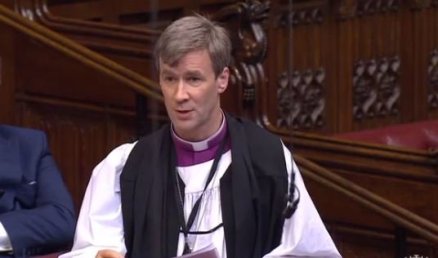
St Albans 2On 12th July 2017, Lord Warner led a short debate in the House of Lords on the question:  “to ask Her Majesty’s Government what assessment have they made of the risks to NHS sustainability arising from the United Kingdom’s departure from the European Union”. The Bishop of St Albans, the Rt Revd Alan Smith, contributed to the debate.
The Lord Bishop of St Albans My Lords, I thank the noble Lord, Lord Warner, for introducing this important topic for us this evening and for his helpful and comprehensive opening remarks.

Ensuring the sustainability of the NHS is undoubtedly a significant challenge, even before the potential consequences of Brexit are considered. The uncertainty surrounding the Brexit negotiations has created significant stress for many working in already pressurised health and social care systems.

Continue reading “Bishop of St Albans on the post-Brexit challenges for the NHS”

Bishop of Chelmsford – for better national security invest in wells as well as walls.

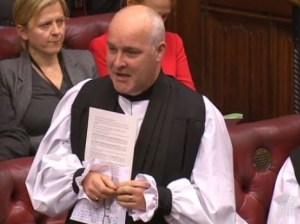
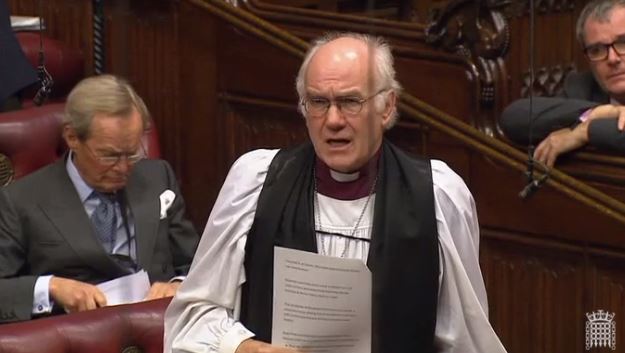
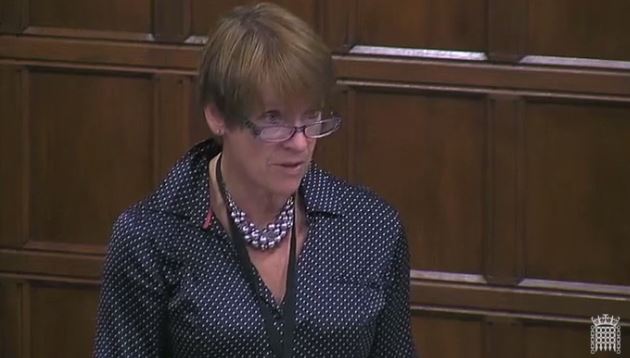
On the 10th July 2017, the Bishop of Chelmsford, the Rt Rev Stephen Cottrell spoke in  Baroness Vere of Norbiton’s debate: That this House takes note of the current security situation in the United Kingdom. The Bishop used his speech to argue for a view of security that focused on cultivating harmonious relationships as well as prevention. 

Chelmsford 251115Lord Bishop of Chelmsford: My Lords, building on that, I will try to be a little hopeful. I too thank the Government for the opportunity to discuss these matters. First, we need to acknowledge that in the light of these horrors we are right to identify security as a primary aim of government. In a debate such as this, we also need to make sure that we pay proper tribute to our Armed Forces, police, prison staff and many others who daily face danger and harm—and of course, as we know, who even lay down their lives, such as PC Keith Palmer.
Continue reading “Bishop of Chelmsford – for better national security invest in wells as well as walls.”

Bishop of Chester on the Balfour Declaration

On 5th July 2017 the House of Lords held a short debate on a question from Lord Turnberg, “To ask Her Majesty’s Government what plans they have to mark the centenary of the Balfour Declaration in November.” The Bishop of Chester, Rt Revd Peter Forster, spoke in the debate.

The Lord Bishop of Chester: My Lords, I want to make two points in my two-penn’orth of time.

First, the Balfour Declaration did not arise in a vacuum and in part reflected the very considerable contribution made by Jewish people, mainly recent immigrants of course, to Britain and the then war effort. To take an obvious example, it was a Jewish chemist at the University of Manchester who devised a clever new way to manufacture acetone from sugar and carbohydrate. It was a vital chemical in short supply for the manufacture of cordite. That chemist, Chaim Weizmann, went on to become the first President of the State of Israel. Continue reading “Bishop of Chester on the Balfour Declaration”

Bishop of Chester says soft power crucial to future UK influence in Middle East

On 4th July 2017 Lord Howell of Guildford moved “that this House takes note of the Report from the International Relations Committee The Middle East: Time for a New Realism (2nd Report, Session 2016–17 HL Paper 159).” The Bishop of Chester, Rt Revd Peter Forster, spoke in the debate:

The Lord Bishop of Chester: My Lords, in my contribution to our debate on these complex matters, I will comment on two areas. I do so with great appreciation for the report, so comprehensively introduced by the noble Lord, Lord Howell. It is full of excellent, empirical detail. We ought also to pay attention to certain overarching factors or narratives.

For my first point, I go back 30 years to the excellent BBC series presented by the historian John Roberts, “The Triumph of the West”. A book of that ​title was published to accompany the series. I reread it recently and thought how perceptive and prescient it was. Perhaps politically correct censors would not allow the title these days, but John Roberts’ compelling thesis was that the essential message of contemporary history was the dominance and penetration of western civilisation, driven on by the power unleashed by modern science. The term “globalisation” had yet to be coined, but in part of course it names the phenomenon. Modern science derives from western European civilisation from the 16th century onwards and carries many of the implicit assumptions of our culture. John Roberts’ name is not as well known these days as it should be. I knew him a little because he was a history don and later warden of my old college, Merton, although in those days I was an unreconstructed and perhaps even reprobate chemist. Sadly, he died prematurely but his works are still worth reading again, as I say. Continue reading “Bishop of Chester says soft power crucial to future UK influence in Middle East”

Caroline Spelman raises Christian persecution worldwide and blasphemy case in Pakistan

On 4th July 2017 the House of Commons debated a motion from Jim Shannon MP (DUP), ‘That this House has considered persecution of Christians and the role of UK embassies.’ The Second Church Estates Commissioner, Rt Hon Dame Caroline Spelman MP, spoke in the debate:

Dame Caroline Spelman (Meriden) (Con): Thank you, Mr Hanson, for calling me because I omitted to put in to speak last night, for which I apologise. It was an oversight, but one that I should not have committed.

An interesting cross-section of Members of Parliament is in attendance to support my hon. Friend the Member for Strangford (Jim Shannon) who, as chair of the all-party group on international freedom of religion or belief, had the foresight to call for this debate. We welcome to the Chamber new Members who are showing their concern for the persecuted, and returning Members who we know through their faith will take a stand for the persecuted. As my hon. Friend the Member for Torbay (Kevin Foster) so eloquently put it, we are all here to show our solidarity, and that is the important point. Some Members may not even speak, but we are numerous and we wish the persecuted out there to know that. Continue reading “Caroline Spelman raises Christian persecution worldwide and blasphemy case in Pakistan”

Bishop of Truro warns against seeing aid as only a financial investment

Bishop of TruroOn the 3rd July 2017, the Bishop of Truro, the Rt Revd Tim Thornton contributed to Baroness D’Souza’s debate: That this House takes note of the case for measuring the impact of the United Kingdom’s development aid budget. In a wide-ranging speech, the Bishop spoke of the importance of guarding against thinking about aid spending simply as a financial investment.
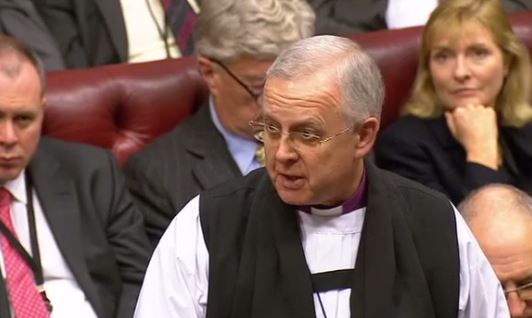
The Lord Bishop of Truro: My Lords, I am grateful to the noble Baroness, Lady D’Souza, for initiating this debate on such a very important and topical issue.

As no doubt we will hear from other speakers, the UK is known around the world as a leader in international development. It has achieved great results during the past two decades. I have no doubt of the importance of the case for measuring the impact of our development aid. I want to underline that case and also, perhaps more importantly for me, to ensure that we try to measure the right things if we can and do not understand aid only as a financial investment which can be measured simply in financial terms. I fear that too many people in our debate will go immediately from talking about aid to talking about money and finances rather than going back and thinking about what the word “development” might mean. It seems that development is in itself a fascinating idea in our world today with perhaps an assumption that other countries are less developed than we are. We must be careful about the assumptions and presuppositions we make when we use the word.

Continue reading “Bishop of Truro warns against seeing aid as only a financial investment”

Bishop of Peterborough calls for more effective delivery of mental health services

On 29th June 2017 the Bishop of Peterborough, Rt Revd Donald Allister, spoke during the final day’s debate on the Queen’s Speech, highlighting the need for a more effective approach to delivery of mental health services:

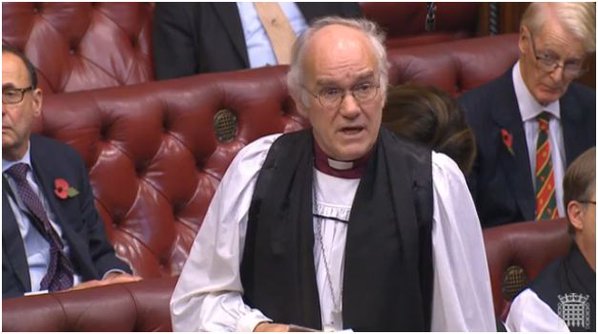
The Lord Bishop of Peterborough: My Lords, it is perplexing, given Mrs May’s commitment to mental health, that there is no mental health Bill in the Queen’s Speech, not least given the very strong commitments that were made about the need for legislation and the fact that this would happen. What there is in the Queen’s Speech about mental health is good, though it is vague. I hope that it is translated into more money for mental health, but it also needs to be translated into better delivery and accountability. That is what is lacking and what I want to think about for a moment. Continue reading “Bishop of Peterborough calls for more effective delivery of mental health services”