On 19th December 2017 the House of Lords debated its size, in the form of a Motion from Lord Burns ‘That this House takes note of the Report of the Lord Speaker’s committee on the size of the House’. The Bishop of Birmingham and Convenor of the Lords Spiritual, Rt Revd David Urquhart, spoke in support of the Committee’s proposals and said that bishops would look at the question of their numbers when legislation on Lords reform, backed by consensus, was forthcoming:
 The Lord Bishop of Birmingham: My Lords, as convener of the Lords spiritual, I welcome warmly the report of the Speaker’s Committee and pay tribute to the work of the noble Lord, Lord Burns, and his fellow committee members for their thoughtful and thorough attention to the question of the size of the House, which we all agree is in need of urgent resolution. I notice that the word “magic” has already been used in the debate, but the desire for love has also been added at Christmas time. To hear the leader of the Lib Dems imploring the work of the Lord in becoming pure is a most encouraging start to this debate.
The main recommendations of the committee are ones that I hope most of us in this House can rally behind. They offer a set of suggestions which, with good will and a spirit of co-operation, not least from the party leaderships, will provide us with a route map for reducing the membership of this House to a more acceptable level. That is something that my predecessors as convener and many others on these Benches have supported consistently. Rather than comment on the detail of the proposals, I thought that it would be helpful to focus my remarks on what the report did or did not say about the Lords spiritual. Continue reading “Bishop of Birmingham supports proposals to reduce size of House of Lords”

 The Lord Bishop of St Albans: I am grateful that the noble Baroness, Lady Berridge, tabled this debate, and in particular that she has framed it in the context of a celebration. Having said that, we also need to face the fact that there are a number of quite shameful things in our history that we need to confront. Continue reading “Bishop of St Albans suggests ways to mark the Windrush 70th anniversary”
 The Lord Bishop of Durham: My Lords, I add my thanks to the noble Lord, Lord Teverson, for securing this debate. This year’s COP 24 UN climate change conference will be a crucial opportunity for the world to accelerate its climate ambitions in order to try to meet the 1.5 degree Paris commitment. This country faces a choice: do we want to lead the charge on this or drag our heels somewhere near the back? I welcome the UK Government’s recent focus on environmental issues. Initiatives such as the green finance task force, the endorsement of the Financial Stability Board’s task force on climate-related financial disclosure and the UK’s setting up of the Powering Past Coal Alliance at COP 23 all show how we are influencing discussions at global climate change meetings.
  The Lord Bishop of Portsmouth: My Lords, I confide in you. Priests— even bishops, perhaps particularly so—are inclined to repeat themselves. I imagine noble Lords might have noticed. I have heard it said that we have only one sermon in us and just dress the message up differently each Sunday. I will be repeating my message today, and I am grateful to the noble Lord, Lord Sterling, for the opportunity to do so. I am just as grateful to the noble Earl, Lord Howe, for listening to my repetition with the grace, care and attention that we all appreciate.
 The Lord Bishop of Derby: My Lords, I, too, thank the noble Baroness, Lady Coussins. I want to say something about the general importance of the subject, and then some specific things about business and primary. The noble Baroness has set out a lot of the data, which is the foundation.
 The Lord Bishop of Durham: My Lords, I draw notice to my charitable interests as listed in the House register.
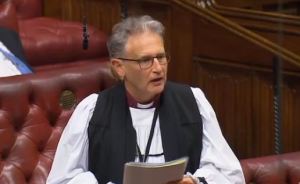 On 11th January 2018 the Bishop of Coventry, Rt Revd Christopher Cocksworth, led a debate in the House of Lords on the question: “to ask Her Majesty’s Government what is their post-conflict strategy for protecting the rights of religious and ethnic minorities in Iraq.” His speech is reproduced in full below, as is that of the Government minister responding. All speeches by those taking part in the debate
  The Lord Bishop of Gloucester: My Lords, I thank the noble Baroness, Lady Kidron, for obtaining this debate. I, too, thank her for her tireless work in this area.
 The Lord Bishop of Newcastle: My Lords, it may be no coincidence of timing that as we debate the performance of the major housebuilders, every day this week in the financial press we have seen the trading results of many of these major companies, the latest being Barratt this morning, the country’s largest housebuilder. There is a consistent picture of extraordinarily high levels of profit and cash being returned to shareholders. However, my first point is that past history tells us this will not last. Housebuilding is a highly cyclical industry and when the next recession comes, new house sales will plummet, as they did in 2003 and 2008. Housebuilders, especially the smaller ones, will fail, and there will be high unemployment in the building trades.
  On the 18 December 2017 Baroness Tyler of Enfield led a debate on the report of the Select Committee on Financial Exclusion – Tackling Financial Exclusion: A country that works for everyone? (
 The Church of England in Parliament
You must be logged in to post a comment.