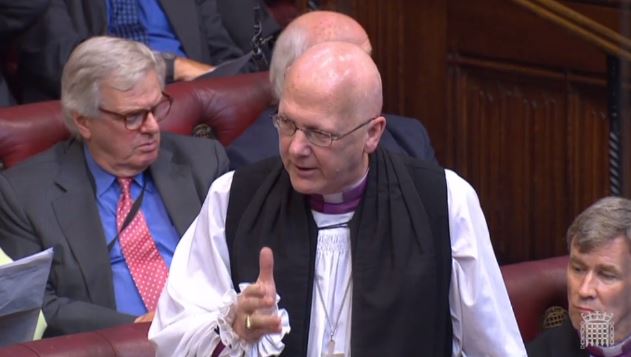
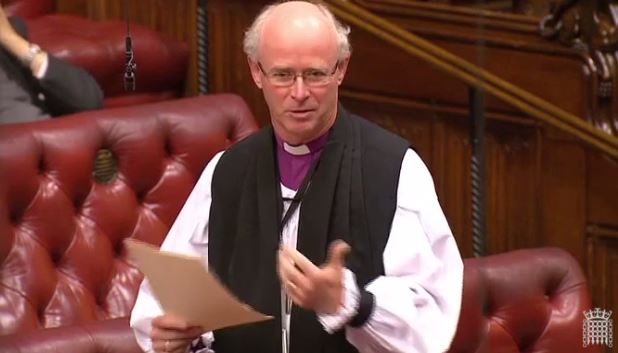
Bishop of Chelmsford calls for action to counter fear and race hatred after EU referendum

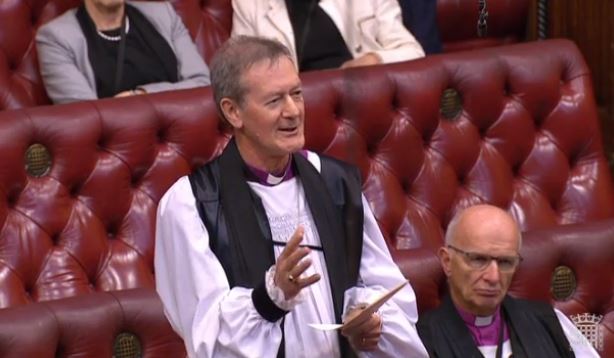
Chelmsford 251115On 27th June 2016, Baroness Stowell of Beeston repeated a statement on the result of the EU Referendum, made by the Prime Minister in the House of Commons. The Bishop of Chelmsford, Rt Revd Stephen Cottrell, asked a follow up question:


Lord Bishop of Chelmsford: My Lords, some commentators have said that the result of the referendum was a resounding victory for Brexit. I am not sure that I see it that way: 52 to 48 is, to my mind, a rather narrow victory. Where there is no overwhelming consensus, there is an overwhelming need to take account of the views of others. Nobody likes a bad winner. There has been too much hyperbole and spite in this debate. Yes, one side did win, the result is clear and we have to act on it. Those who advocated leave obviously need to take the lead in the negotiations that will take place. But we urgently need the sort of wise leadership that can build consensus. We need some sort of national Government—a coalition of good will where we can work together.

I serve the diocese of Chelmsford, which is, “east London in and Essex out”. Yesterday I spoke to a head teacher who said that the children were frightened when they went to school on Friday and that she had seen an increase in race hatred and intolerance. What plans are there to address the lack of unity in our nation and to counter the fear and race hatred that is on the rise? Can we ensure that those who lost this vote, as well as those who won, can be part of the planning going forward? Continue reading “Bishop of Chelmsford calls for action to counter fear and race hatred after EU referendum”
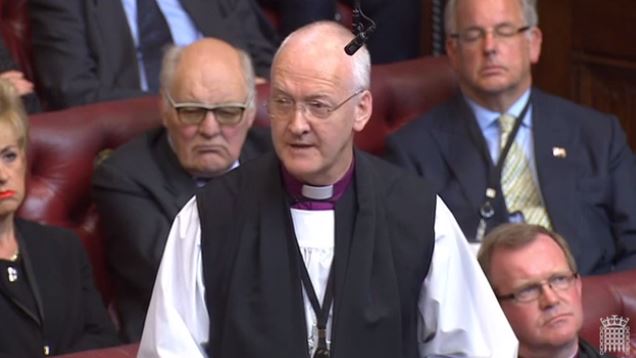
Bishop of Leeds pays tribute to Jo Cox MP

On 20th June 2016 both Houses of Parliament were recalled to pay tribute to Jo Cox MP.

In the House of Lords the Bishop of Leeds, Rt Revd Nick Baines, spoke on behalf of the Bishops’ Benches. His tribute follows:

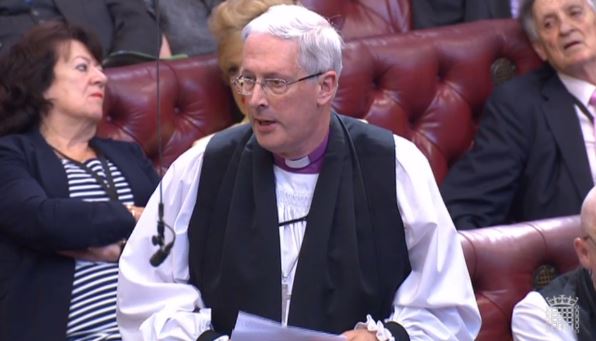
Leeds160620The Lord Bishop of Leeds: My Lords, I speak on behalf of the Archbishops and Bishops and the Church of England. I do not want to repeat what has already been said but to associate ourselves with those remarks and offer deep sympathy to Brendan, the children and the wider family, and to the Members of the other place.

We live with our mortality and the fragility of civilisation. It is not very deep, and it can be easily penetrated. When I heard of Jo’s death, in my office in Leeds, I was reminded of those words from “Julius Caesar”:

“Cowards die many times before their deaths. The valiant never taste of death but once”.

There are many cowards around who have died inside, and Jo was the antithesis of that: she was full of life. She was passionate, she was intelligent and she was always generous. Her constituents, among whom I have spent the last few days, are unequivocal about that. Continue reading “Bishop of Leeds pays tribute to Jo Cox MP”

Bishop of Sheffield speaks on Church response to the migrant crisis

On Wednesday 15th June 2016 the House of Lords debated the Report from the European Union Committee The EU Action Plan against migrant smuggling (4th Report, Session 2015–16, HL Paper 46). The Bishop of Sheffield, Rt Revd Steven Croft, spoke in the debate:

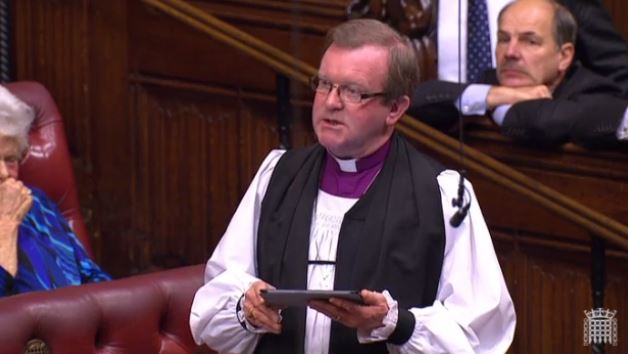
14.03.27 Bishop of SheffieldThe Lord Bishop of Sheffield: My Lords, I welcome the two reports before us in all their complexity and I thank the members of the European Union Committee for their expertise, which is already evident in this debate. I particularly welcome the committee’s recommendation in paragraph 8 that the mandate of Operation Sophia is reviewed and renewed, along with the EU’s subsequent decisions. Clearly, this operation alone cannot be the complete answer to the challenges that we face. However, the European Union must not return to the position that it held before the Lampedusa tragedy of apparent indifference to those who seek to cross the Mediterranean in danger of their lives. Nor can we neglect the spread of people-smuggling on and across our borders. Continue reading “Bishop of Sheffield speaks on Church response to the migrant crisis”

Bishop of Derby highlights importance of local grassroots work in combating FGM

On 9th June 2016 Lord Berkeley of Knighton led a short debate to ask Her Majesty’s Government “what steps they intend to take in the light of NHS statistics showing that in 2015 over 1,000 cases of female genital mutilation were reported every three months and the lack of any successful prosecutions to date.” The Bishop of Derby, Rt Revd Alastair Redfern, spoke in the debate, highlighting the historic and cultural influences behind the practice and the work taking place at a local and grassroots level to reduce instances of FGM and support the law. 

Derby 191115cThe Lord Bishop of Derby: My Lords, I, too, thank the noble Lord, Lord Berkeley, for introducing this vital debate and making the point that we need to keep this subject in the public domain to raise awareness and challenge people.

I want to offer some perspectives from my experience in Derby, where I operate as a bishop at grassroots level, to try to help understand why we are in this position and how we might best tackle things. Your Lordships will know that FGM is a very ancient practice going back to at least the fifth century BC. It was mentioned by Herodotus, especially in Egypt and Ethiopia, all that time ago. I remind noble Lords that FGM was practised until the 1950s in western countries as part of dealing with what was then called “female deviancy”. Things such as hysteria, epilepsy and lesbianism were dealt with by this horrific practice as an enlightened medical approach to those conditions. We have to recognise that it is not only deeply embedded in ancient culture, but until quite recently in the west, we have been implicated in using this barbaric method for medical reasons. Continue reading “Bishop of Derby highlights importance of local grassroots work in combating FGM”

Bishop of Southwark: special educational needs children “not a burden but a gift”

On 26th May 2016 Lord Addington led a debate in the House of Lords “That this House takes note of the case for improved individual school capacity to deal with commonly occurring special educational needs and disabilities, in the light of the increasing number of academies and free schools.” The Bishop of Southwark, Rt Revd Christopher Chessun, took part: 

SouthwarkThe Lord Bishop of Southwark: My Lords, I am also very grateful to the noble Lord, Lord Addington, for securing this debate. Our schools prepare young people for our communities and are committed to seeing that all children are valued and respected, which serves to build a society where all know the fullness of life. Last week in this House, the right reverend Prelate the Bishop of Ely reminded us:

“Life in all its fullness means being exacting, rigorous, ambitious and having appetite for all that excellence demands”.—[Official Report, 19/6/16; col. 63.]

He added in another speech that,

“we cannot allow our commitment to academic rigour blind us to the fact that we are teaching people, not subject matter”.

This is core to the Christian idea of education as a matter of mutual flourishing, of which academic achievement is only a part, albeit an important part. Continue reading “Bishop of Southwark: special educational needs children “not a burden but a gift””

Queen’s Speech: Bishop of Portsmouth responds on the economy and life chances

On 25th May 2016 the House of Lords held the fourth and final debate on the Queen’s Speech. The Bishop of Portsmouth, Rt Revd Christopher Foster, spoke in the debate on the Government’s proposals for the economy and life chances.

BishPortsspeechtaxcreditsThe Lord Bishop of Portsmouth: My Lords, in responding to the gracious Speech, I am delighted to welcome, first, the maiden speech of the right reverend Prelate the Bishop of Newcastle and to congratulate her. To be in the House and on this Bench today is a pleasure. We are colleagues again here, as we were in St Albans diocese some years ago. We have a shared conviction that the work of the Church and of government is to support the welfare of all people, reminding ourselves that welfare is properly understood not in the restricted sense in which we so often use it in our debates about benefits and eligibility but as the well-being of all people in the whole of their lives. Bishop Christine has powerfully reminded us of the perspective from her diocese and the north-east. Continue reading “Queen’s Speech: Bishop of Portsmouth responds on the economy and life chances”

Queen’s Speech: Bishop of Newcastle gives maiden speech

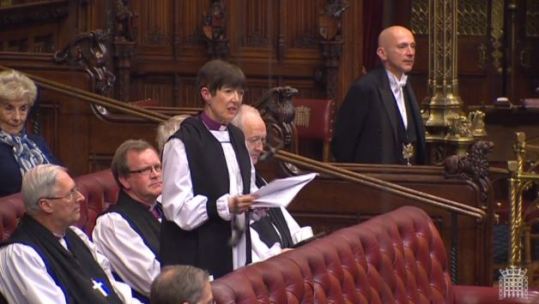
On 25th May 2016 the House of Lords held its fifth day of debate the Queen’s Speech. During the debate the Bishop of Newcastle, Rt Revd Christine Hardman, gave her maiden speech, becoming the second female bishop to speak in the House of Lords. As well as introducing herself to the House she addressed the Government’s life chances strategy, and regional growth in the North. Her speech is below in full, alongside responses from Peers.Newcastle 5

The Lord Bishop of Newcastle: My Lords, the theological understanding of grace is of the love and mercy given to us by God because God desires us to have it, not because of anything we have done to deserve it. In these early days in your Lordships’ House, it is grace that I have experienced—wonderful kindness and a warmth of welcome from your Lordships, the staff and all who work in this place. It has been entirely undeserved but a truly heart-warming experience. It will be no surprise to your Lordships that one of the loveliest and warmest welcomes came from the late Lord Walton—a fine and godly man, and a distinguished son of the north-east.

Queen’s Speech: Bishop of St Albans on human rights and human dignity

However, the proposals for a British Bill of Rights to replace the Human Rights Act make me question whether the celebrations last June were something of a missed opportunity.

Continue reading “Queen’s Speech: Bishop of St Albans on human rights and human dignity”

Queen’s Speech: Bishop of Rochester welcomes prison reform plans

As for language, the Secretary of State is fond of quoting a Mr Osborne—perhaps not that Mr Osborne, because they seem to be on opposite sides of various debates, but the words of a Mr Osborne who, in 1914, was the warden of Sing Sing prison in New York. He is quoted as expressing his aspiration to turn it from a scrapheap to a repair shop. That quotation carries quite a lot, but in rather different language, the Roman Catholic Church in this country said something similar in a document in 2004 when it spoke of prisons having the potential to be places of redemption. Speaking from these Benches, I find it interesting that the Secretary of State uses quite freely what we would recognise as theological language of redemption and restoration when expressing his aspirations for what will happen in prisons. If he is serious about that, and about redemption and restoration being at the heart of the prison system, my interest is certainly piqued and my support is lurking there waiting to be given.

Continue reading “Queen’s Speech: Bishop of Rochester welcomes prison reform plans”

Queen’s Speech: Bishop of Southwark on extremism, freedom of speech and British values

On 24th May 2016 the Bishop of Southwark, Rt Revd Christopher Chessun, spoke in the third day of debate on the Queen’s Speech. He addressed the Government’s proposals for tackling extremism, British values and prison reform, and remarked on the need for unifying language and behaviour in political debate.

Southwark

The Lord Bishop of Southwark: I will make a number of points which I hope will be of value to your Lordships’ House and respond appropriately to Her Majesty’s gracious Speech. It is clear to me that Ministers in this Government understand freedom, as did their predecessors, as freedom in security. We have heard in the Queen’s Speech that we may expect legislation,

“to prevent radicalisation, tackle extremism in all its forms, and promote … integration”.

This may be necessary, but I have concerns about our ready desire to legislate solutions to problems where other avenues present themselves. The recent lowering tone and content in public discourse is an example. It diminishes sympathy and challenges what constitutes legitimate and proper boundaries for political debate. I agree with the Chief Rabbi that:

“There has been nothing more disheartening … than the suggestion that this is more about politics than about substance”.

I am bound to observe, for example, that there were lapses of judgment during the recent mayoral election in London.

We need a politics of generosity that transcends such divisiveness, a narrative that does not engender fear, and I applaud indications within major political parties that recognise this. Continue reading “Queen’s Speech: Bishop of Southwark on extremism, freedom of speech and British values”