Bishop of Southwark asks about the government’s asylum agreement with Rwanda

The Bishop of Southwark received the following written answers on 26th May 2022:

The Lord Bishop of Southwark asked Her Majesty’s Government:

  • in respect of paragraph 9.1.2 of the Memorandum of Understanding with the government of Rwanda for an asylum partnership arrangement signed in Kigali on 13 April, what equivalent standard applies in Rwanda for the Home Office requirement that interpreters are members of the Institute of Translating and Interpreting, The Chartered Institute of Linguists, or if with a company, then the latter is a member of the Association of Translation Companies.
Continue reading “Bishop of Southwark asks about the government’s asylum agreement with Rwanda”

Bishop of Oxford speaks in a debate on artificial intelligence

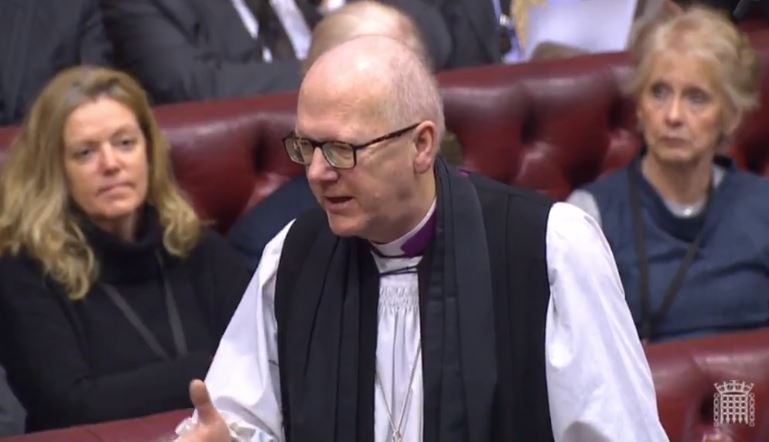
The House of Lords debated the AI in the UK (Liaison Committee Report) in grand committee on 25th May 2022. The Bishop of Oxford spoke in the debate:

The Lord Bishop of Oxford: My Lords, it is a pleasure to follow the noble Lord, Lord Evans, and thank him in this context for his report, which I found extremely helpful when it was published and subsequently. It has been a privilege to engage with the questions around AI over the last five years through the original AI Select Committee so ably chaired by the noble Lord, Lord Clement-Jones, in the Liaison Committee and as a founding board member for three years of the Centre for Data Ethics and Innovation. I thank the noble Lord for his masterly introduction today and other noble Lords for their contributions.

There has been a great deal of investment, thought and reflection regarding the ethics of artificial intelligence over the last five years in government, the National Health Service, the CDEI and elsewhere—in universities, with several new centres emerging, including in the universities of Oxford and Oxford Brookes, and by the Church and faith communities. Special mention should be made of the Rome Call for AI Ethics, signed by Pope Francis, Microsoft, IBM and others at the Vatican in February 2020, and its six principles of transparency, inclusion, accountability, impartiality, reliability and security. The most reverend Primate the Archbishop of Canterbury has led the formation of a new Anglican Communion Science Commission, drawing together senior scientists and Church leaders across the globe to explore, among other things, the impact of new technologies.

Continue reading “Bishop of Oxford speaks in a debate on artificial intelligence”

Bishop of Oxford asks about the cost of living

The Bishop of Oxford asked the following question in a debate about the cost of living, on 25th May 2022:

The Lord Bishop of Oxford: My Lords, the Minister and other noble Lords will be aware of the paradox that it is often the very poorest people in society who pay a higher tariff for their electricity through pre-payment meters and the like. They may not have bank accounts or the ability to pay on any kind of credit. Are the Government proposing to do anything to help and support those who are locked into these higher energy prices when they can least afford then?

Continue reading “Bishop of Oxford asks about the cost of living”

Bishop of St Albans asks about agricultural exports

The Bishop of St Albans received the following written answers on 25th May 2022:

The Lord Bishop of St Albans asked Her Majesty’s Government, further to the report by the National Farmers Union Growing our agri-food exports to 2030 and beyond, published on 27 April, what plans they have to match Agricultural and Horticulture Development Board levy contribution funding to help grow British agricultural exports.

Continue reading “Bishop of St Albans asks about agricultural exports”

Social Security Bill: Bishop of Carlisle speaks in debate

On 24th May 2022, the house debated the Social Security (Special Rules for End of Life) Bill in its second reading. The Bishop of Carlisle spoke in support of the bill, mentioning caveats relating to palliative care and prognoses. The Bill was committed to a grand committee.

The Lord Bishop of Carlisle: My Lords, from these Benches I am glad to be able to support the Bill, which is welcomed by so many charities and which will bring relief to so many anxious families. It seems to have four significant strengths, the first being clarity. The rules surrounding benefits and healthcare at the end of life are confusing and not always easy to navigate. The Bill goes some way towards making things simpler and more straightforward both for people who are terminally ill and for their families, and that has to be a good thing.

Continue reading “Social Security Bill: Bishop of Carlisle speaks in debate”

Bishop of Carlisle asks about children’s social care

The Bishop of Carlisle asked a question on 24th May 2022, during a debate on the Independent Review of Children’s Social Care:

The Lord Bishop of Carlisle: My Lords, as we have already heard, much is to be welcomed in this review, which clearly has the needs of vulnerable children and young people right at its core. The emphasis on boosting early help to prevent children reaching a crisis point is crucial.

Continue reading “Bishop of Carlisle asks about children’s social care”

Bishop of Oxford asks about zoonotic diseases

On 24th May 2022, the Bishop of Oxford asked a question during a debate on establishing a zoonosis research centre in the UK:

The Lord Bishop of Oxford: My Lords, I am sure the Minister is aware that the rapid increase in zoonotic diseases has its roots in the environmental crisis: deforestation, habitat destruction, intensive farming and unregulated trade in wild animals. Therefore, as well as the vital areas of medical research and response to disease, how are the Government focusing their intervention on prevention as well as diagnosis and cure?

Continue reading “Bishop of Oxford asks about zoonotic diseases”

Bishop of St Albans asks about the rural economy

The Bishop of St Albans received the following written answer on 24th May 2022:

The Lord Bishop of St Albans asked Her Majesty’s Government what assessment they have made of the report by the APPG for Rural Business and Rural Powerhouse Levelling Up the Rural Economy: An Inquiry into rural productivity, published on 27 April.

Continue reading “Bishop of St Albans asks about the rural economy”

Bishop of St Albans asks about productivity in rural areas

The Bishop of St Albans received the following written answer on 24th May 2022:

The Lord Bishop of St Albans asked Her Majesty’s Government what plans they have to close the 18 per cent productivity gap in rural areas.

Lord Benyon (Con): Latest statistics show rural areas in England contributed over £260 billion to our economy in 2019. There are over half a million businesses registered in rural areas.

There are many successful rural businesses, providing high levels of employment, and vital supply chains. However, we know that productivity in some rural areas has fallen behind other parts of the country.

Continue reading “Bishop of St Albans asks about productivity in rural areas”

Bishop of St Albans asks about housing

The Bishop of St Albans received the following written answer on 24th May 2022:

The Lord Bishop of St Albans asked Her Majesty’s Government what plans they have to subject conversions and repairs on existing buildings to zero-rated VAT in-line with the VAT regime for new builds.

Baroness Penn (Con): The Government currently maintains a zero-rate of VAT on the construction of new build residential properties. This is to incentivise their construction and provide a lower burden of tax for purchasers of new homes.

Continue reading “Bishop of St Albans asks about housing”