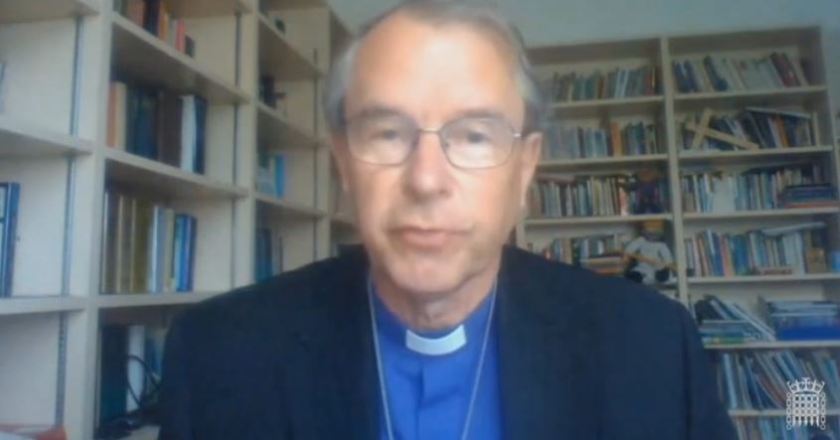
Bishop of Oxford calls for household access to digital connection to be treated equally to other household utilities

On 5th October 2020 Baroness McDonagh asked the Government “what assessment they have made of the impact on primary and secondary school students’ ability to learn for those students (1) who have digital connectivity, and (2) who do not have such connectivity, when learning from home due to the COVID-19 pandemic.” The Bishop of Oxford asked a follow up question:
The Lord Bishop of Oxford [V]: My Lords, I thank the Minister for her Answer and for what the Government have already done. Before the pandemic, 23% of children in socioeconomic groups D and E lacked home broadband and access to laptops, et cetera. Does the Minister agree that we now need to measure data poverty and its effects more carefully? Will the Government commit to legislating for household digital access to be treated as a utility on an equal footing with the right to access for water and heat—a change supported by the general public? Continue reading “Bishop of Oxford calls for household access to digital connection to be treated equally to other household utilities”

Bishop of St Albans asks about prosecutions for genocide against Myanmar generals

On 5th October 2020 the Bishop of St Albans received a written answer to a question on Myanmar:
The Lord Bishop of St Albans: To ask Her Majesty’s Government what assessment they have made of the UN Human Rights Council Report of the independent international fact-finding mission on Myanmar, published in September 2018, and in particular the recommendation that senior generals of the Myanmar military be investigated and prosecuted for genocide; and what support they plan to provide to the case brought by the government of The Gambia against the government of Myanmar currently before the International Court of Justice. [HL8425] Continue reading “Bishop of St Albans asks about prosecutions for genocide against Myanmar generals”

Week in Westminster 28th September – 2nd October 2020

Parliament met this week in Westminster and online. Prayers were read at the start of each sitting day in the House of Lords by the Bishops of Gloucester and Rochester.
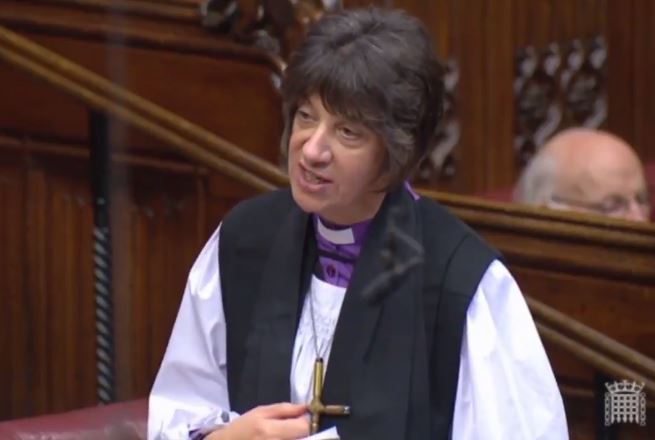
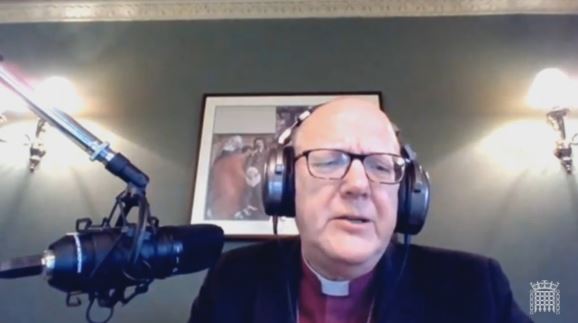
The Bishop of Gloucester asked Government about funding for its Female Offenders Strategy, and about support for children’s sport.

The Bishop of Durham supported amendments to the Government’s Immigration and Social Security Co-ordination (EU Withdrawal) Bill, on the social care workforce and on children in care.

Bishops voted on amendments to the Bill, and also on a motion to regret the use of the temporary provisions in the Government’s Coronavirus Act.

The Bishop of Rochester called for effective parliamentary scrutiny of coronavirus restrictions. He also asked Government whether it would restart the vulnerable person’s resettlement scheme.

The Bishop of St Albans asked questions of Government about Armenia and Azerbaijan, and the case of Asif Pervaiz, a Christian sentenced to death under blasphemy laws in Pakistan. He also supported amendments to the Government’s Trade Bill during its Committee Stage, about ensuring that future trade agreements are fully compliant with international environmental obligations, and meet standards on animal welfare and food safety.

Trade Bill: Bishop of St Albans supports amendments to ensure trade deals meet standards on climate, environment, food and animal welfare

On 1st October 2020 the House of Lords considered the Government’s Trade Bill in Committee. The Bishop of St Albans, Rt Revd Alan Smith, spoke in support of amendments to the Bill to ensure that future trade agreements are fully compliant with international environmental obligations, and meet standards on animal welfare and food safety.

The Lord Bishop of St Albans [V]: I plan to speak mainly on Amendment 12, but I also support Amendment 40 and, particularly, Amendment 69 in this group [texts below]. Leaving the European Union should not mean leaving our international obligations. Recognition of those conventions mentioned under Amendment 12 is, one would imagine, already accounted for in the existing trade agreements due to be transposed into UK law as a result of this Bill. However, without this amendment, these remain an expectation not an assurance.

Continue reading “Trade Bill: Bishop of St Albans supports amendments to ensure trade deals meet standards on climate, environment, food and animal welfare”

Bishop of Gloucester asks about Government support for children’s sport

On 1st October 2020 questions in the House of Lords were put to Government on support for professional and amateur sport. The Bishop of Gloucester, Rt Revd Rachel Treweek, asked a question: 

The Lord Bishop of Gloucester: My Lords, I was pleased to hear that the Government believes that sports clubs are the beating heart of their communities. As bishops we like to believe that is also true of our church communities, and indeed all communities of faith – and the Church of England is currently investing in pilot projects including my own diocese, focusing on sport and wellbeing underpinned by our Christian faith. Indeed the Bishop of Derby is the lead bishop for sport.

Can the government say what investment will the Government make into local provision for children and young people to engage in sports and physical activity that is shaped by them, given the research of the Children’s Society highlighting the importance not only of chosen physical activity but also of positive time with peers, and the fact that that has all been horribly impacted by Covid-19?

Continue reading “Bishop of Gloucester asks about Government support for children’s sport”

Immigration and Social Security Co-ordination (EU Withdrawal) Bill: Bishop of Durham supports amendments on social care workforce and children in care

On Wednesday 30th September 2020 the House of Lords considered amendments to the Government’s Immigration and Social Security Co-ordination (EU Withdrawal) Bill during its Report Stage. The Bishop of Durham, Rt Revd Paul Butler, spoke in support of two amendments, on:

  • Researching and reporting on the impact on the social care workforce.
  • Ensuring that children of EEA and Swiss nationals, in care and entitled to care leaving support, do not become undocumented by receiving automatic Indefinite Leave to Remain under the EU Settlement Scheme.

Votes on the amendments were deferred until the following week due to technical problems.

Continue reading “Immigration and Social Security Co-ordination (EU Withdrawal) Bill: Bishop of Durham supports amendments on social care workforce and children in care”

Vote: Immigration and Social Security Co-ordination (EU Withdrawal) Bill

On 30th September 2020 a vote was held on an amendment to the Government’s Immigration and Social Security Co-ordination (EU Withdrawal) Bill. The Bishop of Durham took part:
Continue reading “Vote: Immigration and Social Security Co-ordination (EU Withdrawal) Bill”

Bishop of St Albans asks Government if it will mediate in conflict between Armenia and Azerbaijan

On Wednesday 30th September the House of Lords put questions to Government on violence in the Nagorno-Karabakh region, and what representations they have made to the governments of Armenia and Azerbaijan. The Bishop of St Albans, Rt Revd Alan Smith, asked a question:

The Lord Bishop of St Albans [V]:  Does the Minister agree with the interventions made by Pope Francis and the most reverend Primate the Archbishop of Canterbury that call on all parties in the conflict to take concrete steps to resolve this latest clash? Specifically, have Her Majesty’s Government offered to be part of that mediating process? I ask this because we need to find new partners who can offer that mediation if we are to find a way through after so many years of deadlock. Continue reading “Bishop of St Albans asks Government if it will mediate in conflict between Armenia and Azerbaijan”

Bishop of Gloucester asks Government about funding for Female Offender Strategy

On Tuesday 29th September the Bishop of Gloucester, Rt Revd Rachel Treweek, asked a question she had tabled to Government on its Female Offenders Strategy. The exchanges are below, with the follow-up questions asked by other Members.

Female Offender Strategy

The Lord Bishop of Gloucester: To ask Her Majesty’s Government what assessment they have made of (1) the level of funding that has been provided to the Female Offender Strategy launched in June 2018, and (2) whether such funding is sufficient to implement the Strategy fully.

Baroness Scott of Bybrook (Con): My Lords, we are committed to ensuring sufficient funding for the female offender strategy, which we keep under review. To date, we have invested £5.1 million in the strategy in 30 different women’s services across England and Wales. In 2021, we will invest a further £2.5 million to meet ​core costs in the women’s community sector. In addition, we have been allocated up to £800,000 to support the development of our first residential women’s centre in Wales.

The Lord Bishop of Gloucester: I thank the noble Baroness for her Answer. Given the amount of money that the MoJ spends each year, the high cost of reoffending and the relatively small number of female offenders, why have the Government seemingly invested so little in their own strategy? When will we hear details of the implementation of the strategy, given that it all seems to have gone very quiet? Continue reading “Bishop of Gloucester asks Government about funding for Female Offender Strategy”

Vote: Coronavirus Act 2020: temporary provisions

On 28th September 2020 a vote was held in the House of Lords on a motion to regret the use of the temporary provisions in the Government’s Coronavirus Act 2020. The Bishop of St Albans took part.
Continue reading “Vote: Coronavirus Act 2020: temporary provisions”