

On 10th & 13th February 2020 the Bishop of St Albans, Rt Revd Alan Smith, received written answers to questions on the gambling industry and sport:
The Lord Bishop of St Albans: HL1452
To ask Her Majesty’s Government what plans they have to establish a publicly accessible central record of the number of people who commit suicide for reasons connected with problem gambling.
Continue reading “Bishop of St Albans asks Government about gamblification of sport”
 The Lord Bishop of Southwark:
  On 13th February 2020 the Second Church Estates Commissioner, Andrew Selous MP, answered written questions from Jim Shannon MP, on carbon emissions, religious freedom, strategic development funding, church planting, green investments, the Democratic Republic of Congo and South Sudan, the Primates’ Meeting, new technologies, marriage and family life.
 The Lord Bishop of Oxford: My Lords, I declare an interest as a board member of the CDEI and a member of the Ada Lovelace Institute’s new Rethinking Data project. I am also a graduate of the AI Select Committee. I am grateful to the noble Lord, Lord Clement-Jones, for this important debate.
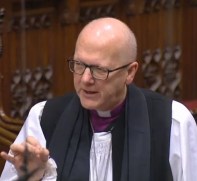 The Lord Bishop of St Albans: My Lords, in this important area Britain is proud to be a leader in many ways—in technology, computing and so on—and many of these projects, which are transforming the lives of some people with certain kinds of disabilities, have been run across Europe, so there are worries that some of these projects may not continue. Can the Minister assure the House that priority will be given to helping this world-leading development continue? It is making an impact on people with disabilities not only in our own country but right across the world as the technology is rolled out.
 The Lord Bishop of Durham: My Lords, perhaps we might return to the north-east. The noble Lord, Lord Shipley, and I, along with many others, have argued previously that this infrastructure should have begun in the north and the south at the same time. In the review, can we please ensure that we are working not just south to north but north to south? This would help speed up the process. Can the Minister also answer a question on the production of the trains and
  The Lord Bishop of Leeds: My Lords, there are some wonderful examples of how old mills being rejuvenated and given new life, such as Salts Mill in Saltaire and Manningham Mills, although there is a vast amount of empty space there. If they were icons of the old northern powerhouse, they are now becoming icons of dereliction. Does the Minister agree that if nothing is going to happen, then it would be better to knock them down? I do not favour that, but there needs to be a strategy that allows these wonderful buildings to be brought back into life, to be given a sort of resurrection.
 The Lord Bishop of Winchester:
  The Lord Bishop of Southwark: My Lords, following on from the previous question*, will the Minister consider whether or not it is appropriate for this country to seek to deal with the offences and aftermath of those brought up here as children, rather than expel them to countries of which they know little, save in the most exceptional circumstances?

You must be logged in to post a comment.