
 On 25th January 2018 the Second Church Estates Commissioner, Rt Hon Dame Caroline Spelman MP, answered questions from MPs on marriage registration, vocations, gay conversion therapy, Christians in the Middle East, and counter terrorism measures at York Minster and other religious premises. The full transcript is below:
Bishop of Durham asks Government about impact on families of two-child limit on tax credits
On 25th January 2018 the Bishop of Durham, Rt Revd Paul Butler, received written answers to three questions about the impact on families of the two-child limit on tax credits:
 The Lord Bishop of Durham: To ask Her Majesty’s Government how many families have had their tax credits reduced by the two -child limit in each month since the introduction of the limit in April 2017; how many of those families had one or more parents in work; how many families were (1) lone parent families or (2) two -parent families; and what was the number of children per family involved.
Church Commissioners’ written answer – Fracking
On 25th January 2018 the Second Church Estates Commissioner, Rt Hon Dame Caroline Spelman MP, answered a written question from Rosie Cooper MP on fracking:
Rosie Cooper (West Lancashire): To ask the Rt. Hon. Member for Meriden representing the Church Commissioners what the policy of the Church of England is on fracking on land owned by the Church of England.
Continue reading “Church Commissioners’ written answer – Fracking”
Church Commissioners’ written answer – Religious Education
On 25th January 2018 the Second Church Estates Commissioner, Rt Hon Dame Caroline Spelman MP, replied to a written question on religious education:
Rehman Chishti(Gillingham and Rainham): To ask the right hon. Member for Meriden, representing the Church Commissioners, what discussions the Church of England has had with the Department for Education on ensuring that religious studies remains a priority in schools. Continue reading “Church Commissioners’ written answer – Religious Education”
Bishop of Chester call for balance in way prison system is discussed and reported
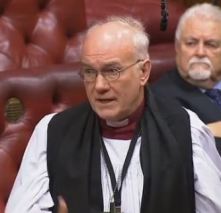 On 24th January 2018 Lord Ramsbotham asked Her Majesty’s Government “how many prisons have been given action plans, or are in special measures, following inspection reports.” The Bishop of Chester, Rt Revd Peter Forster, asked a follow-up question:
The Lord Bishop of Chester: My Lords, bishops go into prison more often than most Members of your Lordships’ House. There are two prisons in my diocese. The Liverpool prison report is an absolute scandal, so far as I can judge. However, does the Minister agree that many prisons are functioning rather well in the circumstances they face and that there is a good deal that can be celebrated alongside the horror stories, which are indeed dreadful?
Continue reading “Bishop of Chester call for balance in way prison system is discussed and reported”
Bishop of Derby asks government about access to water in developing countries
 On the 24th January 2018 Lord Cameron of Dillington held a debate about sustainable water management in developing countries. The Bishop of Derby, the Rt Revd Alistair Redfern spoke in the debate and highlighted the work of a local charity in Derbyshire who send aid boxes containing hydration units to areas of conflict or natural disaster:
The Lord Bishop of Derby: I too thank the noble Lord, Lord Cameron, for introducing this vital issue. The timeframe is pressing and getting shorter. It is wonderful to hear the testimony of colleagues about Nepal and the inspiring story of the noble Lord, Lord Freeman, on what can be done with commitment. However, it is the scale of the problem that we have to mark.
Continue reading “Bishop of Derby asks government about access to water in developing countries”
Bishop of Durham asks government about development aid to Burundi
 On the 23rd January 2018 Lord Bruce of Bennachie asked the Government “how much Official Development Assistance they will spend on supporting sustainable public services and good governance in sub-Saharan Africa over the next two years.” The Bishop of Durham, Rt Revd Paul Butler, asked a follow up question about the recent instability in Burundi.
The Lord Bishop of Durham: My Lords, given both the recent political instability and the current consultation on reforming the constitution in Burundi, and the forced displacement of more than 400,000 people, how do the Government intend to support sustainable public service through ODA in countries such as Burundi where conflict is preventing the basic functions of governance? Continue reading “Bishop of Durham asks government about development aid to Burundi”
Bishop of Durham asks Government about impact of benefit cap on larger families
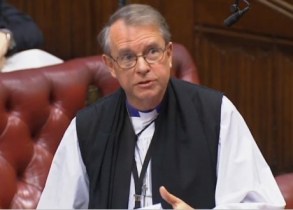 On the 23rd January 2018 the Bishop of Durham, the Rt Revd Paul Butler received a written answer to a question about the impact of the benefit cap on larger families:
The Lord Bishop of Durham: To ask Her Majesty’s Government how many families with three or more children have been affected by the benefit cap in each month since April 2017; how many children were included in each affected family; how many families were (1) lone parent families or (2) two-parent families; and how many of those families had one or more parents in work. [HL4636]
Continue reading “Bishop of Durham asks Government about impact of benefit cap on larger families”
Bishop of St Albans asks how much food consumed in UK is imported
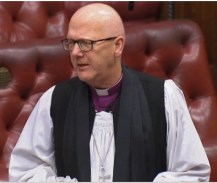 On the 23 January 2018 the Bishop of St Albans, Rt Revd Alan Smith, received a written answer to a question about food security:
The Lord Bishop of St Albans : To ask Her Majesty’s Government what proportion of food consumed in the UK was imported from the EU in (1) 1990, (2) 1995, (3) 2000, (4) 2005, (5) 2010, (6) 2015, and (7) 2017. [HL4655]
Continue reading “Bishop of St Albans asks how much food consumed in UK is imported”
Bishop of Peterborough asks Government to review anonymity in cases of criminal accusation
 On the 22nd January 2017 Lord Lexden asked the Government “whether they intend to review the law governing the naming of deceased individuals against whom criminal allegations have been made.” In his follow up question Lord Lexden raised the case of the deceased Bishop George Bell and the recent Carlile Review. The Bishop of Peterborough, Rt Revd Donald Allister, also asked a follow up question:
The Lord Bishop of Peterborough: My Lords, this has been a very difficult case, but Bishop Bell is not the only person whose reputation has been severely damaged by such accusations—some are dead and some still alive. I urge the Minister and the Government to take very seriously the call for a major review of anonymity. In all cases where the complainant has a right to be anonymous, there seems to be a case for the respondent also to be anonymous, and in cases until there is overwhelming evidence to suggest guilt, it seems reasonable for people’s reputations not to be damaged in this public way. Continue reading “Bishop of Peterborough asks Government to review anonymity in cases of criminal accusation”


You must be logged in to post a comment.