Bishop of Leicester calls for greater access to renewable heating technologies for those most in need

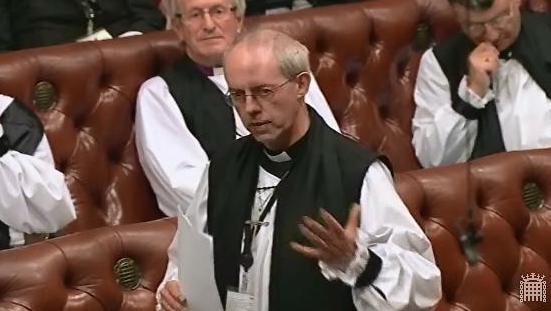
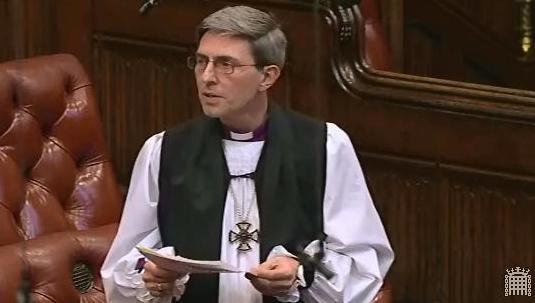
On 29th January 2015, The Earl of Courtown asked Her Majesty’s Government what they are doing to ensure that the benefits of lower oil prices are passed on to consumers, particularly in rural areas. The Bishop of Leicester, the Rt Revd Tim Stevens, asked a supplementary question:

14.04.01 Bishop of Leicester
The Lord Bishop of Leicester: My Lords, will the Minister tell us what Her Majesty’s Government are doing to ensure that those on low incomes and living in the coldest homes are able to benefit from renewable heating technologies?
The Parliamentary Under-Secretary of State, Department of Energy and Climate Change (Baroness Verma): I am grateful to the right reverend Prelate for his question, because this Government have, through many measures, not only tried to respond to people living in very inefficient homes in urban areas, but also looked at how to reach out to people who are often off grid and help support them through the renewable heat incentive and other measures. I am very happy to write to the right reverend Prelate about a number of measures undertaken by this Government.

Questions to the Church Commissioners on the Archbishop of York’s Book ‘On Rock Or Sand’, Medical Ethics, the Anglican Communion, Financial Eduation, Women Bishops and Bats

Church Commissioners

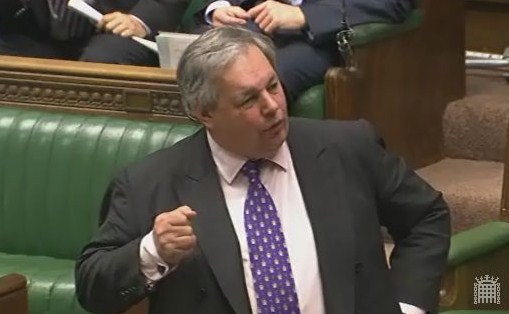
In Church Commissioners Question TIme on Thursday 29th January 2015, the Rt Hon. Sir Tony Baldry MP answered questions on the Archbishop of York’s Book ‘On Rock Or Sand’, Medical Ethics of Mitochondrial Transfer, the Anglican Communion, Financial Education, Women Bishops and Bats in Churches

Continue reading “Questions to the Church Commissioners on the Archbishop of York’s Book ‘On Rock Or Sand’, Medical Ethics, the Anglican Communion, Financial Eduation, Women Bishops and Bats”

Bishop of St Albans – Flood Control (Written Answer)

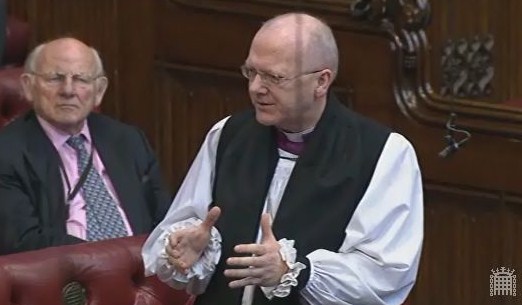
On 29th January 2015, the Bishop of St Albans, the Rt Revd Alan Smith, received an answer to a written question on flood control.

Bishop of St AlbansThe Lord Bishop of St Albans: To ask Her Majesty’s Government what plans they have to ensure long-term support and funding for flood prevention schemes. [HL3997]

The Parliamentary Under-Secretary Department for Environment, Food and Rural Affairs (Lord De Mauley): This Government has developed a six-year programme of work, involving over 1,400 projects, to improve defences throughout the country between 2015 and 2021. This has been made possible by our record level of commitment by investing £2.3 billion in improving defences over the coming six years. Efficiency gains will ensure this funding goes even further. This work is projected to reduce the risk of flooding or erosion to at least 300,000 households by 2021, and avoid around £30 billion in economic damages.

(via Parliament.uk)

Bishop of Chester takes part in debate on Counter-Terrorism and Security Bill

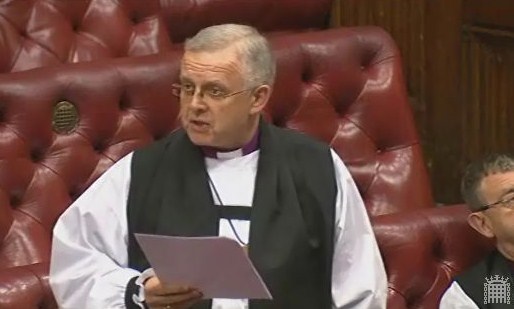
On 28th January 2015, the Bishop of Chester, the Rt Revd Peter Forster, took part in the debate on amendments to the Government’s Counter-Terrorism and Security Bill, during its Committee Stage. Speaking during the debate on the duties of higher education institutions under the Bill, the Bishop raised the point that places of religious instruction and education did not appear to fall under the remit of the Bill. Following the debate, the amendments were withdrawn.

14.03 Bishop of ChesterThe Lord Bishop of Chester: I will speak very briefly as we come to the end of this debate. As I was listening to it, I realised that there is a whole area to which we have not referred but which is entirely relevant; that is, religious institutions and places of religious instruction and education. Those are missing from the Bill. The application of the Bill to universities will have very uncertain benefits and be extremely impractical to apply in as much as universities are independent institutions. They do not always appear so to the heads of those institutions when they deal with Governments but they are independent institutions. That is a really important feature. Most of the authorities listed here are not independent in that way, although other educational establishments are included. Continue reading “Bishop of Chester takes part in debate on Counter-Terrorism and Security Bill”

Education Minister praises Church school record on inclusion and community cohesion

On 28th January, Baroness Massey of Darwen asked Her Majesty’s Government what are the conditions which must be met before a new state-funded faith school or free school is allowed to be established; who sets and agrees the conditions; and how the conditions must guarantee a broad and balanced curriculum for pupils. The Bishop of Leicester, the Rt Revd Tim Stevens, asked a supplementary question:

14.04.01 Bishop of LeicesterThe Lord Bishop of Leicester: My Lords, does the Minister agree that “faith school” covers a variety of different kinds of institution? Church of England schools are not faith schools in the narrow sense of providing an education for people of just one faith. In places such as Leicester they provide a rounded education for the whole community, including many of other faiths who value highly what they have to offer.

Lord Nash: I agree entirely with the right reverend Prelate. Many church schools are highly inclusive. A study by the University of York undertaken in 2009 praised the record of church schools on community cohesion.

(via Parliament.uk)

House of Commons Consideration of Church Measures, Simplification of the Faculty Process, Management of Church Pensions & Management of Parish Property

Tony Baldry MPOn Wednesday 28th January 2015 the Fourth Delegated Legislation Committee of the House of Commons met to consider three Church Measures relating to simplification of the faculty process, management of church pensions and management of parish property. The committee approved all the Measures which now proceed to the floor of the House of Commons to receive final approval and be sent for Royal Assent

Continue reading “House of Commons Consideration of Church Measures, Simplification of the Faculty Process, Management of Church Pensions & Management of Parish Property”

Bishop of Derby calls for stronger partnerships to tackle human rights abuses in East Africa

On 27th January 2015, the Bishop of Derby, the Rt Revd Alastair Redfern, took part in a short debate in the House of Lords on Her Majesty’s Government’s assessment of recent events in Eritrea and Ethiopia, and of their impact on migration to western Europe. He called for strong partnerships with the EU and UN to tackle the issues in East Africa, including the limits on religious freedom, and suggested that faith and voluntary groups could be key partners in opening up opportunities in the region.

DerbyThe Lord Bishop of Derby: My Lords, I, too, thank the noble Lord, Lord Chidgey, for his comprehensive and challenging analysis and assessment. I will make some general remarks and then one or two specific points.

This complex situation is partly because the region is very unstable and there is a lot of movement from both of these countries to Saudi Arabia and the Yemen, as well as to Europe. Such an unstable context requires some big picture approaches. Then there is the conflict between Ethiopia and Eritrea, as the noble Lord, Lord Avebury, has clearly explained. That complexity makes a neat solution very difficult. Continue reading “Bishop of Derby calls for stronger partnerships to tackle human rights abuses in East Africa”

Bishop of Leicester commends community-building work of British Muslim

On 27th January 2015, Baroness Quin asked Her Majesty’s Government what recent assistance they have given to the rescue and recovery of the Nigerian girls abducted by Boko Haram. The Bishop of Leicester, the Rt Revd Tim Stevens, asked a supplementary question:
14.04.01 Bishop of LeicesterThe Lord Bishop of Leicester: My Lords, will the Minister join me in expressing his appreciation of those moderate Muslims who have spoken out in this country against Boko Haram and in emphasising the continuing need to be proactive in drawing together those communities that would easily find themselves pitched against each other in our towns and cities?
Lord Wallace of Saltaire: My Lords, I will happily join in that. Boko Haram has almost certainly killed more Muslims than it has Christians. It is very much a radical Muslim movement, which is as opposed to the Sultanate of Sokoto and the moderate Muslims in the north as it is to others.

Written Answer from the Second Church Commission – Employment Tribunals Service

On 27th January 2015, the Second Church Estates Commissioner, the Rt Hon Sir Tony Baldry MP, answered a written question on the subject of the Employment Tribunals Service:

Tony Baldry MPIan Murray (Edinburgh South, Labour): To ask the right hon. Member for Banbury, representing the Church Commissioners, how much the Commissioners have spent on the Employment Tribunal action by the Reverend Mark Sharpe against the Bishop of Worcester and the Worcester Diocesan Board of Finance.

The Second Church Estates Commissioner (Rt Hon Sir Tony Baldry): Owing to ongoing legal proceedings, the Church Commissioners are unable to comment on this case at present.

(via Parliament.uk)

Bishop of St Albans – Saudi Arabia (Written Answer)

On 26th January 2015, the Bishop of St Albans, the Rt Revd Alan Smith, received an answer to a written question on freedom of expression in Saudi Arabia.

Bishop of St AlbansThe Lord Bishop of St Albans: To ask Her Majesty’s Government what representations they have made to the government of Saudi Arabia on behalf of Raif Bedawi. [HL4076]

Baroness Anelay of St Johns (Minister of State, Foreign and Commonwealth Office): We are seriously concerned by Raif Badawi’s case. The UK condemns the use of cruel, inhuman or degrading punishment in all circumstances. The Secretary of State for Foreign and Commonwealth Affairs, my right hon. Friend the Member for Runnymede and Weybridge (Mr Hammond) has raised the matter with the Saudi Ambassador. We have previously raised the case at a senior level with the Saudi authorities. The UK is a strong supporter of freedom of expression around the world. We believe that people must be allowed to freely discuss and debate issues, peacefully challenge their governments, exercise the right to freedom of thought, conscience and religion, and speak out against violations of human rights wherever they occur.

(via Parliament.uk)