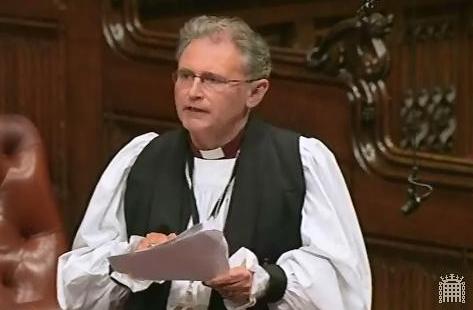
Bishop of Chester responds to Government Statement on energy bills

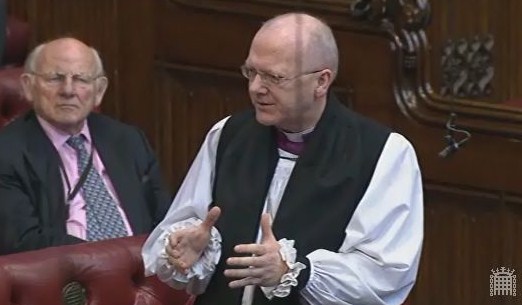
On 2nd December 2013, the Bishop of Chester asked a question in the House of Lords on energy bills, following a Governmnet Statement on the subject.

14.03 Bishop of ChesterThe Lord Bishop of Chester: My Lords, there is much in the Statement that I welcome, particularly a point that has not been commented on directly. The move in support for the social aspects of the programme from energy bills to general taxation will have some impact on the poorest and on fuel poverty and is entirely to be welcomed. The renewables obligation payments are still going to be collected through energy bills. When will the expected increases in those precepts on bills eat up the £50 which has been announced today?

Continue reading “Bishop of Chester responds to Government Statement on energy bills”

Bishop of Derby takes part in debate on apprenticeships

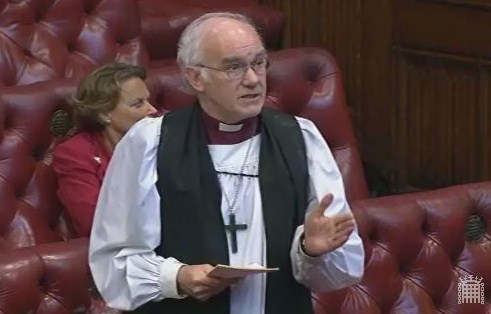
On 28th November 2013, the Bishop of Derby took part in Baroness Wilcox’ debate on what action the Government are taking to increase the take-up of apprenticeships among young people. In his speech, he spoke of the need for education to assist in the development of good citizens and a high-calibre workforce based on vocation. He also raised the importance of employees being bale to train the right people for the right roles and the need to ensure that all young people have access to employment.
Bishop of DerbyThe Lord Bishop of Derby: My Lords, I, too, congratulate the noble Baroness, Lady Wilcox, on securing this debate on this very important theme. The Richards review and the statement by the Minister of State for Skills and Enterprise make clear that there are three areas that we need to look at and hold together.

The first is the big context about the importance of using education and training, of which apprenticeship is part, to make good citizens and a proper workforce for the 21st century. That is the theme of vocation: developing people to have a sustainable working life. The second area is the need for employers to be able to train and recruit the kind of people they need for their particular industry. The third area is the fact that there are a large number of young people who lack the opportunity to engage with the world of work. Those three themes frame this debate. Continue reading “Bishop of Derby takes part in debate on apprenticeships”

Bishop of Ripon and Leeds calls for positive vision for role of police in serving the common good

“The College of Policing would do well to get on to the front foot in its ethical work so that our police see it as their duty not simply to avoid wrongdoing but to pursue values that will make them still more a force for the common good” – Bishop of Ripon and Leeds, 28/11/13

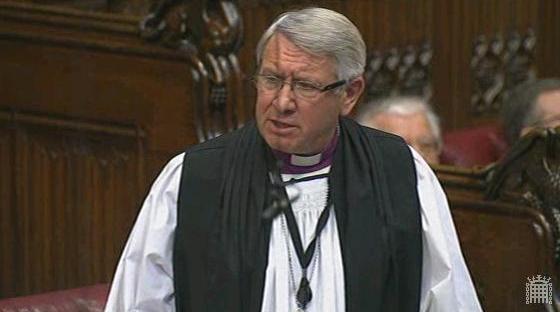
On 28th November 2013, the Bishop of Ripon and Leeds, the Rt Revd John Packer, took part in Lord Paddick’s take-note debate on public trust in the police, its role in effective policing, and the system for investigating complaints into police conduct. In his speech, the Bishop spoke of the importance of trust in fostering positive relationships between police and communities, and welcomed the College of Policing’s draft code of ethics, whilst calling for it to be bolder in its promotion of a positive role for the police in promoting the common good.

R_LThe Lord Bishop of Ripon and Leeds: My Lords, I, too, am grateful to the noble Lord, Lord Paddick, both for leading this debate and for his powerful and serious introduction to it. I also look forward to the first of many contributions to the work of this House from the noble Baroness, Lady Jones of Moulsecoomb.

Continue reading “Bishop of Ripon and Leeds calls for positive vision for role of police in serving the common good”

Bishop of Wakefield asks question on Syria peace talks

On 28th November 2013, Lord Dykes asked Her Majesty’s Government what is their assessment of the outcome of the talks held earlier this month regarding the proposed Geneva II peace conference on the conflict in Syria.

The Bishop of Wakefield asked a supplementary question:

Bishop Stephen Platten

The Lord Bishop of Wakefield: My Lords, much as I am encouraged by the recent UN announcement that the Geneva talks are to take place on 22 January, I would welcome the Minister’s reassurance that this was born not out of an understandable desperation and frustration, but that there is a real and clear diplomatic plan for progress. Am I right in assuming that the Free Syrian Army, which is one of the largest rebel groups taking part in the war in the moment, will be represented at those talks?

Lord Ahmad of Wimbledon: Our view is that it is important that the date for Geneva II was set, and I am the sure that the whole House welcomes that it has been determined. Her Majesty’s Government’s view is that the national coalition and the current Syrian national coalition, led by President Ahmad Assi Jarba, will be central to the delegation representing the opposition at the talks.

(via Parliament.uk)

Bishop of Wakefield seeks government response to DRC peace initiative (Written Question)

On 27th November 2013, the Bishop of Wakefield, the Rt Revd Stephen Platten, received an answer to a written question on the Democratic Republic of Congo.

Bishop Stephen Platten

The Lord Bishop of Wakefield: To ask Her Majesty’s Government whether they intend to allocate additional resources to support the implementation of commitments outlined in the Peace, Security and Cooperation Framework for the Democratic Republic of the Congo; and, if so, what will be the main focus of those resources.

Baroness Northover: The UK is currently considering how best to support the Peace Security and Cooperation Framework (PSCF). DFID is engaging with the Democratic Republic of Congo’s National Oversight Mechanism for the PSCF to ensure those that represent local populations, such as civil society organisations, are consulted during implementation. This will include ensuring that there are on-going opportunities for these organisations to provide feedback from the Congolese people affected.

(via Parliament.uk)

VOTE – FINANCIAL SERVICES (BANKING REFORM) BILL

On 26th and 27th November 2013, the Archbishop of Canterbury, the Most Revd and Rt Hon. Justin Welby, the Bishop of Gloucester, the Rt Revd Michael Perham, and the Bishop of Birmingham, the Rt Revd David Urquhart, took part in divisions on the Government’s Financial Services (Banking Reform) Bill, during its Report Stage.

House of Lords Division Lobby

Labour Peer Lord Eatwell moved amendment 21, before clause 14, to insert the new clause Professional Standards. The Archbishop of Canterbury and the Bishop of Gloucester voted ‘content’. No bishop voted ‘not content’.

There were: Contents: 222 / Not Contents: 217 / Result: Government Defeat

(via Parliament.uk)

Continue reading “VOTE – FINANCIAL SERVICES (BANKING REFORM) BILL”

Archbishop of Canterbury takes part in Report Stage of Financial Services (Banking Reform) Bill

On 26th and 27th November 2013, the Archbishop of Canterbury, the Most Revd and Rt Hon Justin Welby, took part in both sittings of the Financial Services (Banking Reform) Bill’s Report Stage.  

Archbishop of CanterburyOn the first day of the Report Stage, he spoke about the need for the new ring-fencing structures to be supported by a ‘second reserve power’ which would give the regulator the power to fully separate all banks in the industry if one or more banks were gaming the new rules. He led a group of amendments on behalf of the Parliamentary Commission on Banking Standards, which would institute a rigorous licensing regime for significant bank employees who are not senior management. He also spoke about the need for specific measures to be developed to ensure that banks and their employees complied with anti-money laundering laws.

The Archbishop of Canterbury spoke twice during the second and final day of Report Stage. He spoke in support of Amendment 164, tabled by Lord Phillips of Sudbury, which would require a review to be undertaken into the current exemptions some banks and similar institutions enjoy from the Gaming Acts, on transactions which could be understood as gambling. He suggested that a review should examine what impact he current situation has on the culture in these institutions. He also led the debate on the Parliamentary Commission on Banking Standards’ amendment on leverage ratios. He highlighted the important role that the leverage ratio plays in the ‘tool-kit’ available to the Bank of England, and warmly welcomed the Government’s announcement that the Bank of England would undertake a review into its powers to set the leverage ratio and make recommendations on what further powers it may need.

Continue reading “Archbishop of Canterbury takes part in Report Stage of Financial Services (Banking Reform) Bill”

Second Church Estates Commissioner Answers Written Question on Churches in North Yorkshire

On 26th November 2013 Sir Tony Bladry MP answered a written question from Miss McIntosh concerning churches in North Yorkshire and the commissioners’ plans to visit them14.01 CCQ Baldry Continue reading “Second Church Estates Commissioner Answers Written Question on Churches in North Yorkshire”

Bishop of Wakefield raises concerns about human rights abuses in Tanzanian mine

On 26th of November 2013, the Bishop of Wakefield, the Rt Revd Stephen Platten, asked Her Majesty’s Government what representations they have made to the government of Tanzania regarding allegations of human rights violations at the North Mara Mine.

Bishop of Wakefield Platten

The Lord Bishop of Wakefield: My Lords, I beg leave to ask the Question standing in my name on the Order Paper. In doing so, I declare an interest as the joint leader of the Wakefield-Tanzania Diocesan Link.

Lord Ahmad of Wimbledon (Con): My Lords, the UK’s high commissioner to Tanzania visited the North Mara mine in March 2013 to raise concerns directly about the alleged human rights violations with African Barrick Gold, the mine owner, and also discussed a range of issues with the local authorities. We are, of course, working closely with the Tanzanian Government on improving respect for human rights and also encouraging them to sign up to the voluntary principles on security and human rights in the extractive sector. Continue reading “Bishop of Wakefield raises concerns about human rights abuses in Tanzanian mine”

Bishop of Wakefield calls for Government to implement UN conclusions on ending violence against women

On 25th November 2013, the Labour Peer Baroness Gould of Potternewton asked Her Majesty’s Government what steps they are taking to prevent rape and violence against women and girls. The Bishop of Wakefield, the Rt Revd Stephen Platten, asked a supplementary question.

Bishop of Wakefield PlattenThe Lord Bishop of Wakefield: My Lords, following a debate that I was able to secure on a related issue back in March, more than 60 bishops around the country are today supporting the campaign to end gender-based violence, and are visiting on this day a large number of projects up and down the country to support the cause. I apologise that, in the rush to get here, I have no white ribbon. Could the Minister inform the House what additional action the Government are taking to implement the agreed conclusion from this year’s UN Commission on the Status of Women, which focused on the ending of violence against women?

Lord Taylor of Holbeach: I congratulate my right honourable friend the Foreign Secretary on his role in ensuring that 135 countries have signed up to the agreement on the use of rape as a weapon of war. This is a significant development, and shows that these arguments are not just confined to this country. Discussions that we are having here have raised awareness throughout the world.

(via Parliament.uk)