King’s Speech Debate: Archbishop of York raises importance of faith and representation in public life

During the King’s Speech debate on 23rd July, 2024, the Archbishop of York gave a speech on the topic of the constitution, devolution and trust in democracy, raising the importance of faith in public life and the potential for other faith communities to be better represented in the House of Lords:
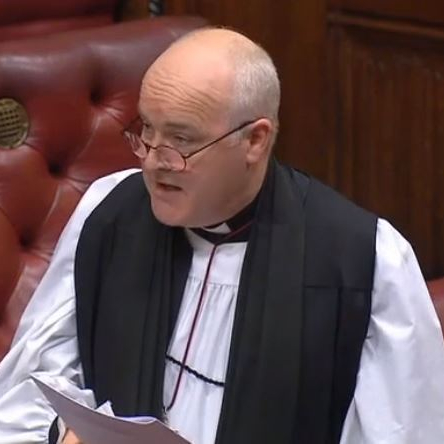
The Lord Archbishop of York: My Lords, it is an honour to respond to the gracious Speech. I, along with others on these Benches, welcome the noble and learned Lord, Lord Hermer, the Attorney-General, and thank him for a really moving maiden speech—not least his desire that we listen to and respect one another and work consensually.

Like others, I want to focus on one thing, which is rebuilding trust in democracy itself. The turnout on 4 July was shockingly low. Research also shows a 13% gap in turnout between constituencies with the highest and lowest proportions of home ownership. Furthermore, an estimated 400,000 people were turned away at the polling station because they did not have the right ID. These are alarming statistics, and I look forward to the changes outlined in the Government’s manifesto that could start to address them, including reducing the voting age to 16.

Continue reading “King’s Speech Debate: Archbishop of York raises importance of faith and representation in public life”
Archbishop of Canterbury asks about measures to ensure financial stability of water companies

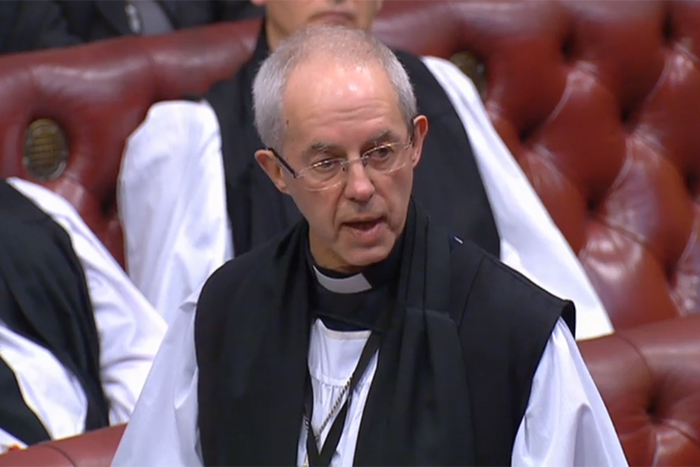
On 23rd July 2024, the Archbishop of Canterbury asked a question on over-return to shareholders in water companies and whether the government plans to put in place measures to prevent this, during a discussion on the financial resilience of England’s water industry:

The Lord Archbishop of Canterbury: I join in congratulating the noble Baroness on her appointment. Picking up on the previous question, which is very much the point, is it not true that the shareholders of Thames Water and others have made extraordinary returns by financial engineering, well in excess of what one would expect to make from a utility, which should be low risk and low reward? In looking at the future structure, will the Government put in place measures to prevent the over-return to shareholders by means of financial engineering, and limit the upside so that utilities are run basically for their customers and not simply for the short-term gain of those who have them?

Continue reading “Archbishop of Canterbury asks about measures to ensure financial stability of water companies”

Bishop of Leeds asks about plans to improve the transport network in the North of England

The Bishop of Leeds asked a question on plans to revitalise the transport network in the North of England on 23rd July 2024, particularly regarding rail connectivity:

The Lord Bishop of Leeds: My Lords, one of the mysteries of HS2 was that you could get to places like Leeds 16 minutes quicker, but you could not get anywhere else when you got there because of deficiencies in the northern network. What confidence can we have that any other plans that come forward will be realised and improve the situation in the north?

Continue reading “Bishop of Leeds asks about plans to improve the transport network in the North of England”

King’s Speech Debate: Bishop of Bristol encourages efforts to combat modern slavery

The Bishop of Bristol gave a speech on the topic of modern slavery during the King’s Speech debate on 22nd July 2024, emphasising the need to combat the growth in worker exploitation and applauding the government’s commitment to strengthening workers’ rights:

The Lord Bishop of Bristol: My Lords, it is a great pleasure to follow the noble Lords, Lord Howarth and Lord O’Neill, and to welcome and congratulate the noble Lord, Lord Vallance, and greet him as the granddaughter of a Cornish man and a Scilly woman, as my father rather cheekily determined it.

I preface my remarks by welcoming, in an adjunct to the gracious Speech, the Government’s proposal to renew the Lords Spiritual (Women) Act, and I should declare my interest as I am a Member who benefits from its current provisions. But it is on modern slavery that I wish to focus my remarks this evening as, in the labour exploitation that we have seen increasingly in the areas of agriculture, domestic work and social care, there is growth that we should not seek and indeed need to guard against. As your Lordships know, modern slavery is a crime which affects every community in the UK. It is not a niche issue. It is estimated that 130,000 people are held in modern slavery in our country today, and we are used to hearing about day-to-day transactions where there is exploitation in car washes, manicurists or, increasingly, in accessing social care.

Continue reading “King’s Speech Debate: Bishop of Bristol encourages efforts to combat modern slavery”

King’s Speech Debate: Bishop of Newcastle highlights importance of communities in economic growth

The Bishop of Newcastle gave a speech on the topic of the economy and economic growth during the King’s Speech debate on 22nd July 2024, highlighting the importance of local communities in relation to businesses and social enterprises:

The Lord Bishop of Newcastle: My Lords, I welcome the gracious Speech and the importance it places on economic growth. I congratulate the noble Lords, Lord Vallance and Lord Petitgas, on their excellent maiden speeches.

The Government’s bold articulation of fiscal reality, and the resistance to colluding with demands for short-term fixes, present a helpful foundation for next steps. One question is: when striving for growth, who will most feel its impact? The UK has some of the highest levels of geographic inequality in Europe. According to a survey conducted in 2022 by YouGov and the Resolution Foundation, 41% of those surveyed in the north-east felt that their region has generally declined in recent years—the highest out of any region in the UK. This feeling is not unfounded when real wages in half of the north-east’s local authorities are still below 2008 levels. The impact can be felt in take-home pay and on our high streets, and it is borne out in the investment decisions of businesses.

Continue reading “King’s Speech Debate: Bishop of Newcastle highlights importance of communities in economic growth”

King’s Speech Debate: Bishop of Leeds raises issues effecting the economy in the North of England

During the King’s Speech debate on 22nd July 2024, the Bishop of Leeds gave a speech on the topic of the economy, expressing admiration for the government’s ambition and commitment to a long term view, and raising issues affecting the economy in the North of England:

The Lord Bishop of Leeds: My Lords, I am not an economist, but I care deeply about the economy. I shall limit myself to a couple of observations, and I am sure that I can save a few minutes in the length of the debate.

First, I welcome the Minister and thank him for his illuminating and articulate speech. I admire the new Government’s ambitions, but I worry a bit that there is too much. Holding all this together in a coherent development framework will be challenging beyond words, but I wish the Government well in doing it.

Continue reading “King’s Speech Debate: Bishop of Leeds raises issues effecting the economy in the North of England”

King’s Speech Debate: Bishop of Lincoln speaks on impact of poverty in rural and coastal communities

The Bishop of Lincoln spoke in the King’s Speech debate on 19th July 2024, raising the issue of poverty in coastal and rural areas and the subsequent effects on children’s mental health and wellbeing:

The Lord Bishop of Lincoln: My Lords, I share your Lordships’ appreciation of the noble Baronesses, Lady Barran and Lady Jolly, and I welcome the appointment of our new Ministers. The noble Baroness, Lady Merron, will know as much as I do about Lincolnshire and that, particularly in its coastal towns and rural areas, Lincolnshire suffers from intergenerational poverty, which has a very direct impact on children. I think your Lordships’ House has received two reports in the last 15 years about the poverty in our coastal towns, but nothing much has changed. If I have heard the Government correctly, I am glad to hear them express their intention to pay more attention to rural and coastal poverty, which is often hidden away when it is not in our big cities.

Therefore, I also particularly look forward to the progress of the children’s well-being Bill and the work of the newly announced child poverty unit. In moving forward in this area, how do His Majesty’s Government plan to involve faith communities in addressing these needs, particularly considering the concentration of faith communities in areas of poverty and deprivation, as my right reverend friend the Bishop of London referred to earlier?

Continue reading “King’s Speech Debate: Bishop of Lincoln speaks on impact of poverty in rural and coastal communities”

King’s Speech Debate: Bishop of Oxford raises potential risks of new technologies

On 19th July 2024, the Bishop of Oxford spoke on developments in science and technology during the debate on the King’s Speech, encouraging the government to consider the potential risks of certain new technologies, particularly to children and security:

The Lord Bishop of Oxford: My Lords, it is a privilege to contribute to this debate. I congratulate the new Ministers and express appreciation to the noble Baroness, Lady Barran, and to the noble Baroness, Lady Jolly, for her valedictory speech. There is much to commend in the gracious Speech.

A few weeks ago, Pope Francis addressed the leaders of the G7 on the risks and opportunities of artificial intelligence. Francis spoke of the way in which AI arises from God-given human potential. He spoke of the excitement at the possibilities that these powerful tools bring, of the risks of greater inequalities and impersonation, and of the need for deep and humane wisdom and ethics and the right political leadership. I encourage noble Lords to read his address but also, if they have a moment, to watch the 10 minutes before his address. Pope Francis demonstrated a deep humanity, not only in his words but in the way he went right around the room, embracing each of the G7 leaders and lightening for a moment the heavy burdens that each carried.

Continue reading “King’s Speech Debate: Bishop of Oxford raises potential risks of new technologies”

King’s Speech Debate: Bishop of London calls for reform in the social care sector

The Bishop of London gave a speech during the debate on the King’s Speech on 19th July 2024, on the topic of health and social care, drawing attention to the need for reform in the social care sector:

The Lord Bishop of London: My Lords, it is an honour to respond to the gracious Speech. I welcome the Minister as she joins us in this House at the Dispatch Box. I also thank the noble Baroness, Lady Jolly, for her contribution to the House, not just on health and social care; those of us who are female priests and bishops thank her for her support.

I welcome many of the Government’s healthcare announcements, especially the two public health legislative measures. I too am glad to see the tobacco and vapes Bill continue. Smoking continues to be one of the leading causes of preventable deaths following the lines of inequality, so bringing forward this Bill will be a significant step forward in our public health agenda. The announcement that the Government will legislate to restrict the advertising of junk food to children and the sale of high-caffeine energy drinks is also welcome. As we have heard, obesity is one of the major health challenges that we face and, again, its impacts are hugely unequal.

Continue reading “King’s Speech Debate: Bishop of London calls for reform in the social care sector”

King’s Speech Debate: Bishop of Chelmsford urges action on housing crisis

During a debate on 18th July 2024 in response to the King’s Speech, the Bishop of Chelmsford spoke on the topic of housing, urging the government to take strong and long term action to address the need for new and high quality housing in the UK:

The Lord Bishop of Chelmsford: My Lords, I declare my interest as the Church of England’s lead Bishop for housing. Along with other noble Lords, I very much look forward to the maiden speech of the noble Lord, Lord Fuller.

It is undeniable that the UK is in the midst of a housing crisis—one with deep roots. Too often, housing has been viewed as a financial asset rather than a fundamental human need. I am grateful to the noble Lord, Lord Hunt, for the comments and commitments in his opening speech, but the housing crisis has been escalating for decades, so we should not underestimate just how long it will take to fix. Therefore, I cannot overstate the need for long-term thinking in tackling the housing crisis, a point well made by the noble Baroness, Lady Warwick.

A clear, long-term vision and a carefully thought-through strategy to provide decent, affordable homes for all can deliver three major goals of economic growth, social justice and environmental stewardship. That is why, along with my right reverend friend the Bishop of St Albans, I am pleased to support Homes for All—a vision for a long-term housing strategy supported by churches, charities, think tanks and others, which I commend to all noble Lords.

Continue reading “King’s Speech Debate: Bishop of Chelmsford urges action on housing crisis”