Bishop of Portsmouth responds to Chancellor’s Autumn Statement

portsmouth241016On 29th November 2016, Lord Young of Cookham moved that the House take note of the economy in the light of the Autumn Statement. The Bishop of Portsmouth, the Rt Revd Christopher Foster, spoke in the debate:

The Lord Bishop of Portsmouth My Lords, after nearly three years in this House, and having had the opportunity to speak in most of the debates responding to the Budget and Autumn Statements, it is not difficult to note the tendency for some contributors to applaud proposals they consider welcome; for others to criticise proposals they consider to have sectional interest or bias; and to have the expectation—or at least the hope—conveyed that the Chancellor and the Government will, and can, do even more when they are praised for welcome initiatives. I want to do a little of that this afternoon, though recognising the restrictions the Chancellor faces. I invite the Minister, and through him the Government, to reflect on what they ought to do—I introduce a moral note in using that phrase—to repair the fractures of trust, address growing injustices that are perceived as more hurtful than inequalities, and create not just a flourishing economy but a nation where people believe there is more that unites us than divides us. Indeed, my question to the Minister is whether the Government can better articulate their rationale and approach in the important area of inequality and injustice. Continue reading “Bishop of Portsmouth responds to Chancellor’s Autumn Statement”

2016 Autumn Statement – Response from Bishop of Birmingham

david-urquhartResponding today (23rd November 2016) to the Chancellor’s Autumn Statement, the Bishop of Birmingham, Rt. Revd David Urquhart, said:

The political turbulence of the past year and lower growth forecasts have meant the Chancellor has been given limited economic room for manoeuvre. But I welcome the emphasis in the Autumn Statement on long term stability, investment in innovation, in our national infrastructure and on supporting regional growth. To be a nation living within its means is an aspiration worth keeping, even if the revised figures for deficit reduction mean that the goal of its achievement has been moved slightly further away. Continue reading “2016 Autumn Statement – Response from Bishop of Birmingham”

Bishop of St Albans asks about growing pension deficits of FTSE100 companies

St AlbansOn 13th September 2016, Lord Haskell asked the Government whether the Pension Protection Fund will be able to meet its obligations to pensioners. The Lord Bishop of St Albans, the Rt Revd Alan Smith, asked a follow up question.


The Lord Bishop of St Albans: Perhaps I may push the Minister a little more. I totally accept that the value of pension funds goes up and down according to a number of factors, but recent statistics show that 56 of the FTSE 100 companies had a combined pension deficit of £42.3 billion, which was up from £25 billion in the previous year—so growing fairly steadily. Just last year those FTSE companies were able to pay out dividends of £53 billion—a sign of their success. Does the Minister think that those companies have the balance right between shareholders and employees? If not, will the Government consider doing something about it to ensure that their responsibilities are taken more seriously? Continue reading “Bishop of St Albans asks about growing pension deficits of FTSE100 companies”

Archbishop speaks on banking reform, culture and practice

On 8th September 2016 the Bishop of St Albans, Rt Revd Alan Smith, led a debate in the House of Lords: “To ask Her Majesty’s Government what is their assessment of progress towards implementing the recommendations contained within the report of the Parliamentary Commission on Banking Standards, Changing banking for good.” The Archbishop of Canterbury, Most Rev & Rt Hon Justin Welby spoke in the debate, having previously served on the Parliamentary Commission on Banking Standards.

The Bishop of St Albans’ opening speech and the response of the Minister can be read here.  
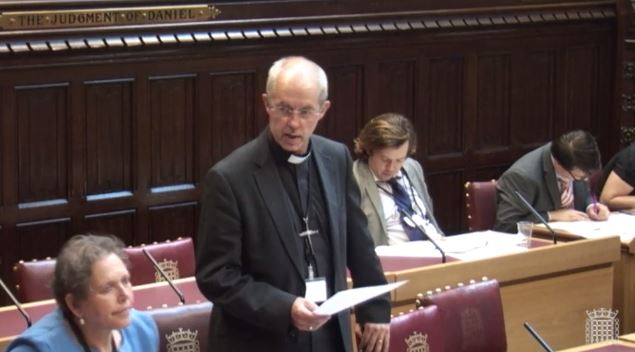
abcbankingstandardsThe Archbishop of Canterbury: My Lords, I add my congratulations to those of other noble Lords on the appointment of the noble Lord, Lord Ashton, as the Minister at DCMS. I have no doubt that we will come across each other again as “C”, “M” and “S” all seem to cover the Church in various forms. I should also say that I served on the Parliamentary Commission on Banking Standards and had the very good fortune to do so with the noble Baroness, Lady Kramer, from whom I learned a great deal. I am also chairman of the Church Commissioners, who were involved in seeking to buy some of the spin-off assets of the Royal Bank of Scotland.

I am grateful to the right reverend Prelate for arranging this debate. I agree entirely with his speech and indeed with the other four speakers that have been made before mine. I shall try to avoid repeating what they said. As we know, and as previous speakers have said, the key issue is banking culture. Culture comes from actions and decisions, and actions and decisions feed into culture. There is no doubt that changes introduced by the Government and the Bank of England have been extensive, and in many cases very effective. However, there are four linked areas, all of them around “too big to fail”, leading to what must be the long-term aim of ensuring that the Government do not have a contingent liability with respect to large banks that would result in them needing to provide support in the event of serious problems, as they had to do in 2008 at such cost. Continue reading “Archbishop speaks on banking reform, culture and practice”

Bishop of St Albans leads debate on banking reform

On 8th September 2016 the Bishop of St Albans, Rt Revd Alan Smith, led a debate in the House of Lords: “To ask Her Majesty’s Government what is their assessment of progress towards implementing the recommendations contained within the report of the Parliamentary Commission on Banking Standards, Changing banking for good.”

The Bishop’s opening speech is below, followed by the response of the Minister. Other members spoke in the debate, including the Archbishop of Canterbury (speech here) who had served on the Parliamentary Commission on Banking Standards.

Bishop St Albans June 2015The Lord Bishop of St Albans: My Lords, I start this debate by saying how pleased I am to see the Minister responding today in his last time in his present role, although I look forward to working with him when he takes up his new duties at DCMS.

We are now three years on from the publication of the parliamentary commission’s report Changing Banking for Good. Thanks to the decisions made by this and previous Governments, our banking system is taking tentative but important steps along the road to recovery. We must not forget, however, the blunt summary in the report which laid out the scale of the problems with banks over the previous decade:

“Banks in the UK have failed in many respects. They have failed taxpayers, who had to bail out a number of banks including some major institutions, with a cash outlay peaking at £133 billion, equivalent to more than £2,000 for every person in the UK. They have failed many retail customers, with widespread product mis-selling. They have failed their own shareholders, by delivering poor long-term returns and destroying shareholder value. They have failed in their basic function to finance economic growth, with businesses unable to obtain the loans that they need at an acceptable price”.

Continue reading “Bishop of St Albans leads debate on banking reform”

Bishop of St Albans questions government about executive pay

St Albans 2On 8th September 2016, the Bishop of St Albans, the Rt Revd Dr Alan Smith, asked Her Majesty’s Government “how they intend to address the gap between the remuneration of senior executives and their employees”. Baroness Neville-Rolfe responded for the Government. Her comments can be seen below, along with the follow up questions from other Members.

The Lord Bishop of St Albans: To ask Her Majesty’s Government how they intend to address the gap between the remuneration of senior executives and their employees.

Continue reading “Bishop of St Albans questions government about executive pay”

Queen’s Speech: Bishop of Portsmouth responds on the economy and life chances

On 25th May 2016 the House of Lords held the fourth and final debate on the Queen’s Speech. The Bishop of Portsmouth, Rt Revd Christopher Foster, spoke in the debate on the Government’s proposals for the economy and life chances.

BishPortsspeechtaxcreditsThe Lord Bishop of Portsmouth: My Lords, in responding to the gracious Speech, I am delighted to welcome, first, the maiden speech of the right reverend Prelate the Bishop of Newcastle and to congratulate her. To be in the House and on this Bench today is a pleasure. We are colleagues again here, as we were in St Albans diocese some years ago. We have a shared conviction that the work of the Church and of government is to support the welfare of all people, reminding ourselves that welfare is properly understood not in the restricted sense in which we so often use it in our debates about benefits and eligibility but as the well-being of all people in the whole of their lives. Bishop Christine has powerfully reminded us of the perspective from her diocese and the north-east. Continue reading “Queen’s Speech: Bishop of Portsmouth responds on the economy and life chances”

Bishop of St Albans on the importance of affordable housing, broadband and innovation to the rural economy

Bishop St Albans June 2015On the 27th April 2016, Baroness McItosh of Pickering led a Lords debate “to ask Her Majesty’s Government what is their assessment of the state of the rural economy.” The Bishop of St Albans, Rt Revd Alan Smith,  highlighted the need for more affordable housing, business innovation and greater access to broadband and mobile coverage

The Lord Bishop of St Albans: My Lords, my thanks go to the noble Baroness, Lady McIntosh, for securing the debate. I will focus on three areas that I believe are crucial to creating a strong, dynamic rural economy.

First, I underline the importance of affordable housing in creating sustainable rural communities at a time when rural house prices continue to be pushed well beyond the reach of many local residents. A failure to provide for local people and local families to live and work in rural areas leaves the rural economy seriously inhibited. An affordable housing supply, available to local workers on low and middle incomes, is an essential feature of the rural economy, providing homes, and, in many cases, workplaces for those who would work in rural areas. Continue reading “Bishop of St Albans on the importance of affordable housing, broadband and innovation to the rural economy”

Budget debate: Bishop of Portsmouth calls on Government to ‘set economic course with a stronger moral compass’

On 23rd March 2016 the House of Lords debated the 2016 Budget statement. The Bishop of Portsmouth, Rt Revd Christopher Foster, spoke in the debate:
Portsmouth budget 2The Lord Bishop of Portsmouth: My Lords, in contributing to this debate and responding to the Chancellor of the Exchequer’s Budget Statement last week, to the subsequent events and to the debate in the other place, I welcome some proposals, express some surprise, and register disappointment—indeed, shock—at some of the measures announced. First, it is good to congratulate the Chancellor and Government on the intention to raise the tax free personal allowance to £11,500 this time next year. Lifting about 1.3 million people out of income tax is, of itself, welcome, although there are some potential drawbacks to which I will return a little later. Continue reading “Budget debate: Bishop of Portsmouth calls on Government to ‘set economic course with a stronger moral compass’”

Bishop of Portsmouth responds to Autumn Statement on the economy

On 3rd December 2015 the House of Lords debated the Chancellor’s Spending Review and Autumn Statement. The Bishop of Portsmouth, Rt Revd Christopher Foster, spoke in the debate.


14.04.09 Portsmouth maiden speech 2

The Lord Bishop of Portsmouth: My Lords, the Chancellor in his Statement in the other place described this as a Government who do big things. I begin by acknowledging with gratitude the big decision to retract the proposals to alter the tax credit thresholds and taper rate. I spoke from these Benches not many weeks ago when we were assured that the Chancellor was listening. It would be possible to say more about that journey of listening leading to this big decision, but that might be churlish. I simply welcome the announcement. Continue reading “Bishop of Portsmouth responds to Autumn Statement on the economy”