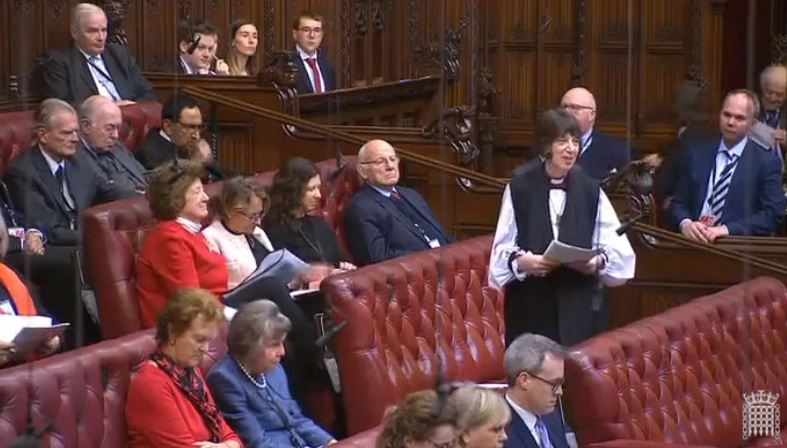
Bishop of Gloucester asks about release of prisoners on temporary licence

The Bishop of Gloucester asked a question on steps being taken to increase release of prisoners on temporary licence to encourage rehabilitation and help with finding work, during a discussion on employment of people with criminal convictions on 26th February 2024:
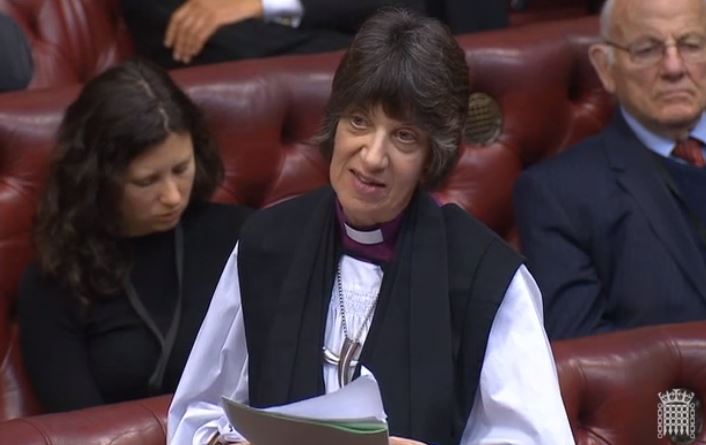
The Lord Bishop of Gloucester: My Lords, from these Benches I add our own sadness at the death of Lord Cormack. His contributions to this House and to the Church will be sorely missed.

As has been said, there has been a serious decline in rehabilitation and release planning services in recent years. Prisoners need to be engaged with purposeful work; there needs to be planning ahead of their release—including release on temporary licence—to secure employment, if we are to prevent reoffending. What steps are the Government taking to increase release on temporary licence?

Continue reading “Bishop of Gloucester asks about release of prisoners on temporary licence”
Bishop of Gloucester asks about rate of reoffending among those released from prison

The Bishop of Gloucester received the following written answers on 30th January 2024:

The Lord Bishop of Gloucester asked His Majesty’s Government how many, and what proportion of, people reoffended within one year of release from prison by accommodation status at (1) release, and (2) three months post-release, in each of the last three years.

Continue reading “Bishop of Gloucester asks about rate of reoffending among those released from prison”

Bishop of Gloucester asks about applications for mother-and-baby units in prisons

The Bishop of Gloucester received the following written answer on 30th January 2024:

The Lord Bishop of Gloucester asked His Majesty’s Government how many applications were received for a Mother and Baby Unit place in prison in the past five years; and of those, how many were (1) accepted, or (2) refused, broken down by reason for refusal.

Lord Bellamy (Con, Ministry of Justice): Total figures for applications received, approved and refused are provided in the table below.

As decisions are made on a case-by-case basis and the reasons can be complex, reasons for refusal are not currently collated, and could not be provided without incurring disproportionate cost.

Continue reading “Bishop of Gloucester asks about applications for mother-and-baby units in prisons”

Bishop of Gloucester asks about availability of video-calls in prisons

The Bishop of Gloucester received the following written answer on 29th January 2024:

The Lord Bishop of Gloucester asked His Majesty’s Government (1) how many, and (2) what proportion, of prisons in England and Wales currently provide secure video calls for prisoners.

Lord Bellamy (Con, Ministry of Justice): All prisons (100%) across England and Wales have the capability to offer secure video calls with approved family members and friends, responding to demand from prisoners.

Hansard

Bishop of Gloucester asks about mother and baby units in prisons

The Bishop of Gloucester received the following written answer on 25th January 2024:

The Lord Bishop of Gloucester asked His Majesty’s Government how many mothers and babies residing in a prison Mother and Baby Unit were separated upon the child reaching 18 months of age in each of the last three years.

Lord Bellamy (Con, Ministry of Justice): Over the last three years, 110 applications to Mother and Baby Units (MBUs) have been approved. In the year to March 2023, 51 women and 44 babies were received into MBUs; compared with 39 women and 40 babies in the previous reporting year. Not all mother and babies that move onto a Mother & Baby Unit will be separated due to the child reaching 18 months old. As it would be necessary to review, individually, the records of each of the women accommodated on MBUs over the last three years to determine this, the information requested could not be provided without incurring disproportionate cost.

Continue reading “Bishop of Gloucester asks about mother and baby units in prisons”

Victims & Prisoners Bill: Bishop of Gloucester speaks in support of amendments providing support for children of modern slavery victims

On 24th January 2024, the Bishop of Gloucester spoke in support of amendments 7 and 11 to the Victims & Prisoners Bill, which would provide provision for support given to children of victims of modern slavery:

The Lord Bishop of Gloucester: My Lords, my right reverend friend the Bishop of Bristol, as has been said, regrets that she cannot be in the Chamber today but along with her, I support Amendments 7 and 11. The children of victims of modern slavery are currently underserved by support services, despite that lasting and intergenerational trauma which witnessing the crime of modern slavery can cause. We have already heard about the organisation Hestia. In 2021, it estimated that as many as 5,000 vulnerable children could be identified within the NRM as children of victims of modern slavery. I want to add that there is an urgent need to extend victims’ rights to this group, and I am glad to see these amendments.

Hansard

Bishop of Gloucester calls for greater support for children with parents in prison

The Bishop of Gloucester asked a question on the need for statutory mechanisms to identify and support children with a parent in prison, during a discussion on persistent absenteeism in schools on 24th January 2024:

The Lord Bishop of Gloucester: My Lords, when a parent goes into prison, no one is notified if they have a child. The charity Children Heard and Seen, which works with children who have a parent in prison, has shown that, with its support, those children’s attendance has significantly improved. Will the Government put in place a statutory mechanism to identify and support children with a parent in prison, as this would significantly reduce school absenteeism for those families?

Continue reading “Bishop of Gloucester calls for greater support for children with parents in prison”

Bishop of Gloucester asks about prison telephone services

The Bishop of Gloucester received the following written answers on 24th January 2024:

The Lord Bishop of Gloucester asked His Majesty’s Government what proportion of cells in (1) the female prison estate, and (2) the male prison estate, have in-cell telephony; and what proportion of cells in each prison have that facility.

Lord Bellamy (Con): There are a total of 10 Women’s Public Sector Prisons (8 closed and 2 open) in England which are run by His Majesty’s Prison & Probation Service.

Continue reading “Bishop of Gloucester asks about prison telephone services”

Votes: UK-Rwanda Asylum Agreement

On 22nd January 2024, the House of Lords debated a motion on whether the government should ratify the UK-Rwanda Asylum partnership. A vote was held on the motion, in which a Bishop took part:

Continue reading “Votes: UK-Rwanda Asylum Agreement”

Bishop of Gloucester questions decision to legislate over safety of Rwanda

The Bishop of Gloucester spoke in a debate on the government’s asylum agreement with Rwanda on 22nd January 2024, questioning the government’s decision to declare Rwanda a safe country would provide adequate protection to asylum seekers facing deportation:

The Lord Bishop of Gloucester: My Lords, I welcome the opportunity to speak today and thank the International Agreements Committee for its excellent report. I will just say that as Lord Bishops we take no position on this Bench based on tribal loyalty and we are not whipped. Instead, because of what our Christian faith teaches us about care for the stranger, we have spoken with one voice on these Benches.

I am focusing on the issues before us today; friends on this Bench will speak to wider points in the coming weeks, as the Bill is discussed. As has been said, this treaty is the central plank of the Government’s case that Rwanda is a safe country for asylum seekers. As others have commented, it is remarkable for the Executive to request that parliamentarians declare another nation state safe, and safe ad infinitum, on the basis that one drafted international agreement answers all the concerns of the Supreme Court. If Parliament proceeds to, in effect, substitute its judgment for that of the Supreme Court, where does that leave the constitutional principle of the separation of functions and what precedent is this setting?

Continue reading “Bishop of Gloucester questions decision to legislate over safety of Rwanda”