Bishop of Rochester calls for greater security in tenancies for pensioners

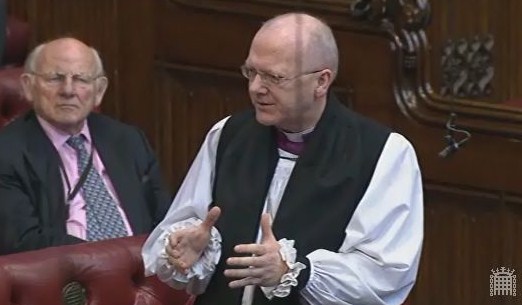
On 14th October 2014, Lord McKenzie of Luton asked Her Majesty’s Government what steps they will take to improve housing stability for those renting in the private sector, particularly families. The Bishop of Rochester, the Rt Revd James Langstaff, asked a supplementary question:

Bishop of RochesterThe Lord Bishop of Rochester: My Lords, I am grateful to the Minister for his assurance that the Government are aware of the needs of families in relation to the length of tenure for tenancies. Is the Minister also cognisant of the needs of retired persons, where length and stability of tenancy are important not only for their well-being in old age but also for their contribution to the communities where they are living in a sustainable way?

Lord Ahmad of Wimbledon: The right reverend Prelate again raises an important point at the other end of the age spectrum, and the Government are very much cognisant of ensuring stability for residents and that their needs are met. One thing on which we are clear is our approach to the private rented sector, through landlords, through providing greater protection and a greater sense of professionalism for both landlords and agents. We are also helping provide an increased level of guidance to tackle any perceived rogue landlords and making more help available to tenants in this particular sector.

(via Parliament.uk)

Bishop of Derby – Housing Benefit, Human Trafficking, Forced Labour (Written Answers)

On 18th August 2014, the Bishop of Derby, the Rt Revd Alastair Redfern, received answers to five written questions on the topics of housing benefit, human trafficking and forced labour.

Housing Benefit: Social Rented Housing

Bishop of DerbyThe Lord Bishop of Derby: To ask Her Majesty’s Government what plans they have to increase the availability of suitable housing for housing benefit claimants eligible for the under-occupancy charge who are willing but unable to move to smaller accommodation due to a lack of social housing available.

The Parliamentary Under-Secretary of State, Department for Communities and Local Government (Lord Ahmad of Wimbledon): The 2015-18 Affordable Housing Programme encourages housing providers to build social homes of sizes that match local household needs. Of the successful bids so far, 77% have been for 1 and 2 bedroom homes. This will make more housing available for households in social housing who wish to downsize.

The Government has also taken steps to support mobility among tenants in the social rented sector. Our social housing reforms have given councils and social landlords much more flexibility in the allocation of housing. Our statutory guidance on social housing allocations encourages local authorities to prioritise under-occupying tenants wishing to move, and to consider whether there are provisions in their allocation scheme that might make it difficult for under-occupiers to move. In February, we issued a guide to help landlords facilitate mutual exchanges; the guide highlights various steps landlords can take to make mutual exchange a more attractive and viable proposition for tenants. The introduction of the national HomeSwap Direct scheme has made it easier for tenants wanting to move to find a suitable property. Since its launch in October 2011, tenants have carried out over 18 million searches of the property data held on HomeSwap Direct. The Government has also made clear its intention to introduce a Right to Move for social tenants who need to move to take up a job or be closer to work – we intend to consult soon on proposals.

In addition, many social landlords (both housing associations and councils) are helping affected tenants to move to more suitable accommodation by holding “mutual exchange fairs” (where tenants who want to downsize can meet with tenants who want a larger property), running transfer incentive schemes, and repairing properties which are being swapped through mutual exchange.

(via Parliament.uk) Continue reading “Bishop of Derby – Housing Benefit, Human Trafficking, Forced Labour (Written Answers)”

Bishop of St Albans asks Government about impact of the under-occupancy charge on household debt and child poverty

On 30th July 2014, the Bishop of St Albans, Rt Rev Alan Smith, received answers to two written questions on the impact of the under-occupancy charge, on household debt and child poverty.

The questions and answers are reproduced in full below:

Bishop of St Albans

The Lord Bishop of St Albans: To ask Her Majesty’s Government what plans they have to mitigate the impact of the under-occupancy charge on household debt.[HL1588]

The Parliamentary Under-Secretary of State, Department for Work and Pensions (Lord Freud) (Con): The removal of the spare room subsidy was a necessary change in order to get the housing benefit bill under control, return fairness to the system and make better use of social housing stock. Continue reading “Bishop of St Albans asks Government about impact of the under-occupancy charge on household debt and child poverty”

Bishop of Chester highlights impact of built environment on well-being of society

On 28th July 2014, the Bishop of Chester, the Rt Revd Peter Forster, took part in a short debate in the House of Lords on the Government’s response to the Farrell Review of architecture and the built environment. He supported the relaxing of planning laws, to enable people to have a greater say in the built environment in which they live. He also argued that architects should play a more significant role in issues of planning, cautioning that houses built in the past 20 years risked becoming the slums of the future.

14.03 Bishop of ChesterThe Lord Bishop of Chester: My Lords, reference to the Tower of Babel earlier stimulated me to speak in the gap, and I believe that there is time to do so. Skyscrapers are quite ambiguous—they work in some places but not in others. Why does the Shard work but the Cheesegrater look completely out of place? Maybe that is just my own subjective judgment. Why do some cities that have no need of skyscrapers feel they want them? Some cities in Australia that have all the space they could possibly want still have an instinct to build skyscrapers. It indicates how important the environment is for us. We see no skyscrapers in Paris or Rome. The urban planners there do not allow them. Continue reading “Bishop of Chester highlights impact of built environment on well-being of society”

Bishop of St Albans calls for multi-agency co-ordination for effective response to challenges faced by vulnerable women


“It is vital that councils and the NHS maintain a basic level of support, not least because a lot of money going into this area is matched by funding from companies, charities and churches. We cannot solve the problem with just the voluntary sector being expected to pick up these extraordinarily complex problems” – Bishop of St Albans, 26.6.14

Bishop of St AlbansOn 26th June 2014, Liberal Democrat peer Baroness Tyler of Enfield led a short debate to ask Her Majesty’s Government whether they have plans to improve how local services respond to women with multiple and complex needs including homelessness, domestic violence, drug and alcohol abuse and physical and mental health problems. The Bishop of St Albans, the Rt Rev Alan Smith, spoke in the debate. He focused his speech on three areas – the need for mutli-agency coordination in light of financial constraints, the need for a greater availability of affordable housing and the vital role of key workers to support those with multiple and complex needs. He also highlighted the issue of domestic violence and called for greater efforts to be made in improving rates of prosecution.

The Lord Bishop of St Albans: My Lords, I, too, am grateful to the noble Baroness, Lady Tyler, for keeping this vitally important area high on the agenda. I confess that I was slightly reticent in putting my name down to speak today because it is not an area in which I am an expert. However, I find myself regularly bumping into people who are involved in it and come across it as a matter of real concern for us. Certainly we are discussing a complex subject which affects women in many different ways and impacts on a wide range of agencies—police, health professionals, probation services and statutory and voluntary groups which are working in homelessness, substance use and abuse, human trafficking and so on. Continue reading “Bishop of St Albans calls for multi-agency co-ordination for effective response to challenges faced by vulnerable women”

Bishop of St Albans asks Government to consider link between under-occupancy charge and rent arrears in housing associations

On 24th June 2014, Baroness Quin asked Her Majesty’s Government when they expect to publish their interim review on the under-occupancy charge.The Bishop of St Albans, the Rt Revd Alan Smith, asked a supplementary question:

Bishop of St AlbansThe Lord Bishop of St Albans: My Lords, the Ipsos MORI report, undertaken by the National Housing Federation in February this year looked at 183 housing associations. It found that two-thirds of tenants affected by the underoccupancy charge were in rent arrears and 38% indicated that they were in debt. That is the equivalent of 72,000 tenants in housing associations in debt in England alone, which seems to be allied in some way to the underoccupancy charge. What assessment have Her Majesty’s Government made of the impact on housing associations of rent arrears because of the underoccupancy charge?

Lord Freud: We have a general look at the level of arrears through the Homes and Communities Agency, whose statistics show that arrears have fallen—not risen—for the past two quarters in a row. The average rent collection rate for associations remains at 99%, a very high figure, which is very much at variance with some of the stories that we hear and the data that the right reverend Prelate referred to.

(via Parliament.uk)

Bishop of Norwich presses Government on lack of affordable new homes in rural areas

On 12th June 2014 Lord Dubs asked Her Majesty’s Government ‘what action they are taking to increase the supply of affordable housing.’ The Bishop of Norwich, Rt Rev Graham James, asked a supplementary question:14.06.12 Bishop of Norwich

The Lord Bishop of Norwich: My Lords, eight years ago the Affordable Rural Housing Commission estimated that we needed at least 11,000 affordable new homes every year in rural areas. We have scarcely ever managed more than a third of that number, and the proportion is falling. That means that those who need such homes in rural areas move to urban areas, adding to the numbers of the urban homeless and further obscuring the rural problem. What remedy does the Minister have for this state of affairs? Continue reading “Bishop of Norwich presses Government on lack of affordable new homes in rural areas”

Queen’s Speech 2014: Bishop of St Albans on the rural economy

“Subsidiarity must be a key principle in any reforms—working towards a more participatory democracy, in which all people feel that they have a stake in a shared society and want to engage in the democratic process….We have to insist that people do not retreat into an unthinking, uncaring nimbyism that refuses to address the real problems facing us”- Bishop of St Albans 05/06/14

On 5th June 2014 in the third contribution from the Bishop’s Benches in response to the Queen’s Speech, the Bishop of St Albans, the Rt Revd Alan Smith, spoke about the rural economy and the impact that a wide range of issues, including housing, energy security and the Government’s plans for forestry, would have on its future. 

Bishop of St Albans

The Lord Bishop of St Albans: My Lords, I, too, congratulate my colleague the right reverend Prelate the Bishop of Rochester on his maiden speech. From these Benches, I can say that we are delighted that he will bring a great deal of insight and experience, not least into housing and prisons, into our debates. Continue reading “Queen’s Speech 2014: Bishop of St Albans on the rural economy”

Maiden speech of the Bishop of Rochester: Housing and the Queen’s Speech

“I cannot rest content for as long as there are those without somewhere to call home and, more sharply, without security in relation to the shelter over their head” – Bishop of Rochester, 5/6/14

In the second response to the Queen’s Speech by the Lords Spiritual, Rt Rev James Langstaff, Bishop of Rochester delivered a maiden speech about housing. Welcoming some of the provisions in the Queen’s Speech about new home building, the Bishop voiced concern about supply and affordability and raised the work of Housing Justice and the Faith in Affordable Housing project. 

Hear an interview with the Bishop about his maiden speech and his thoughts on joining the House of Lords here

14.04.01 Rochester intro 2

The Lord Bishop of Rochester (Maiden Speech): My Lords, I thought that your Lordships might welcome a maiden speech as a kind of interlude in the midst of today’s business. I am most grateful for the welcome that I have received in your Lordships’ House since my introduction on, of all auspicious days, April Fools’ Day. I am particularly grateful for the courtesy, kindness and helpfulness shown by the Lord Speaker, Black Rod, the Clerk of the Parliaments and their staff. Continue reading “Maiden speech of the Bishop of Rochester: Housing and the Queen’s Speech”

Bishop of St Albans receives answers to written questions on benefits, electricity and housing

On 12th May 2014, the Rt Revd Alan Smith, Bishop of St Albans, received answers to three written questions on benefits, electricity and housing.

Benefits

14.03 Bishop of St AlbansThe Lord Bishop of St Albans: To ask Her Majesty’s Government what assessment they have made of the financial impact on people on low incomes of uprating most cash benefits and tax credits by one per cent from April 2013 rather than in line with inflation.

The Parliamentary Under-Secretary of State, Department for Work and Pensions (Lord Freud): For 2013/14, the main rates of working-age benefits, statutory payments and tax credits were up-rated by one per cent in the Social Security Benefits Up-rating Order 2013. The Welfare Benefits Up-rating Act 2013 provided for the one per cent increase to apply for 2014/15 and 2015/16. Both of these were accompanied by Impact Assessments.

As part of his ongoing public sector equality duty under the Equality Act 2010 to monitor impacts on “protected groups”, the Secretary of State continues to monitor the impacts of the Welfare Benefits Up-rating Act 2013 in light of any changes to the underlying rate of inflation. The underlying rate of inflation for increases in 2014/15 is similar to that forecast by the Office for Budget Responsibility and used in the Impact Assessment. It is therefore likely that the impacts on affected households will be broadly similar to those detailed in the Impact Assessment.

(via Parliament.uk)

Continue reading “Bishop of St Albans receives answers to written questions on benefits, electricity and housing”