
On Wednesday 15th June 2016 the House of Lords debated the Report from the European Union Committee The EU Action Plan against migrant smuggling (4th Report, Session 2015–16, HL Paper 46). The Bishop of Sheffield, Rt Revd Steven Croft, spoke in the debate:
 The Lord Bishop of Sheffield: My Lords, I welcome the two reports before us in all their complexity and I thank the members of the European Union Committee for their expertise, which is already evident in this debate. I particularly welcome the committee’s recommendation in paragraph 8 that the mandate of Operation Sophia is reviewed and renewed, along with the EU’s subsequent decisions. Clearly, this operation alone cannot be the complete answer to the challenges that we face. However, the European Union must not return to the position that it held before the Lampedusa tragedy of apparent indifference to those who seek to cross the Mediterranean in danger of their lives. Nor can we neglect the spread of people-smuggling on and across our borders. Continue reading “Bishop of Sheffield speaks on Church response to the migrant crisis”
 On 25th May, Baroness Jones of Moulsecoomb asked Her Majesty’s Government “whether they will make it their policy routinely to publish statistical information on the detention of pregnant women under the Immigration Act 2014.” The Bishop of Southwark, Rt Rev Christopher Chessun, asked a follow-up question:
 On 21st March the House of Lords considered the Government’s Immigration Bill at Report Stage. Lord Hylton tabled an amendment, co-sponsored by the Bishop of Southwark, that would expand the rules on family reunion and asylum. The Bishop of Norwich, the Rt Revd Graham James, spoke in support of the amendment, and Lord Bates responded on behalf of the Government. The amendment was withdrawn after debate.
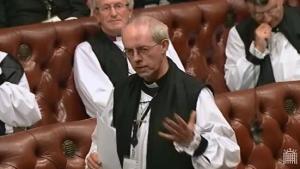 The Archbishop of Canterbury: My Lords, while we would all agree that the situation is difficult for the French authorities, I am sure we also feel that it is significantly more difficult for the 300 unaccompanied children. I recently visited the Marsh Academy near Romney Marsh and saw a school and community fostering and caring with the utmost compassion for significant numbers of unaccompanied children. Given that example, does the Minister agree that issues of compassion should easily trump those of administrative efficiency and tidiness, and narrow definitions of family links, and that we should, therefore, take more children very quickly?
 The Lord Bishop of Rochester: My Lords, as one of the bishops from Kent, may I take the Minister back to his previous answer? In fact, some 1,300 unaccompanied refugee children are housed in Kent, and the local authorities and the voluntary agencies are under very significant pressure. May I push him a little as to whether, in the light of the somewhat unencouraging response from other local authorities, Her Majesty’s Government intend to do anything else to ensure a more effective national dispersal programme—given that we are talking not just about this moment, but about the likely 10 years that will be needed to get a young person from the point of arrival to full integration, with all the work in education, language and healthcare needed to go with that, and the considerable investment required? Some assurance would help my colleagues in Kent.
  The Lord Bishop of Norwich: My Lords, I support Amendment 230 in this group. My colleague, the right reverend Prelate the Bishop of Southwark, spoke at Second Reading of his concern about the architecture of Clause 37 and Schedule 8. I share his belief that the reduced weekly support of £36.95 per person, to which the noble Lord, Lord Rosser, referred, for an asylum seeker under the current system is inadequate. Where that financial provision is refused, it is subject to a right of appeal. I note that in nearly two-thirds of such appeal cases, the appeal is successful or the refusal is withdrawn.
  The Church of England in Parliament
You must be logged in to post a comment.