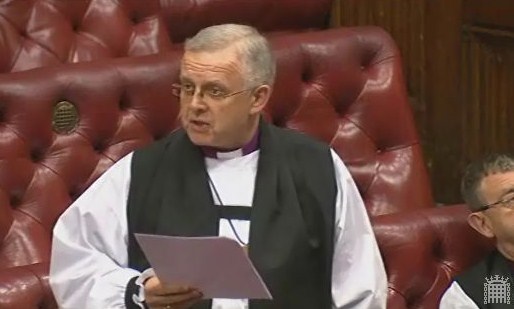
Prisons and the problem of indeterminate sentences – speech by Bishop of Lichfield

“I spent some time recently with an intelligent and engaging Somali prisoner …This man was given an 18-month tariff, but last Christmas was his ninth in prison. What an injustice, and what a huge expense.” – Bishop of Lichfield

On 27th March 2014 the Bishop of Lichfield took part in a debate tabled by Lord Wigley, ‘to ask Her Majesty’s Government what steps they are taking to address the position of individuals serving indeterminate sentences on public protection grounds who have already passed their tariff’.

The Lord Bishop of Lichfield: My Lords, I am most grateful to the noble Lord, Lord Wigley, for his initiative and to the noble Lord, Lord Dholakia, and the noble and learned Lord, Lord Phillips, for their very helpful introductions.14.03.27 Bishop of Lichfield

As a general principle, it is accepted in this country that people should be sent to prison because they have been convicted of an offence rather than because of the risk that they will offend. Indeterminate tariffs are even now available for the most serious offences, in the form of life sentences, and extended sentences now provide a way to manage and contain risk in relation to those convicted of serious violent and sexual offences which do not call for a life sentence. Continue reading “Prisons and the problem of indeterminate sentences – speech by Bishop of Lichfield”

Restorative Justice: Bishop of Peterborough Calls For Greater Use

Baroness Gardner of Parkes asked Her Majesty’s Government how many offenders received multiple cautions in the past year; and what plans they have to review the guidance to the police on the use of cautions for serious crimes.

The Bishop of Peterborough asked a supplementary question:14.02 Peterborough

The Lord Bishop of Peterborough: My Lords, the Minister mentioned restorative justice. Does he agree that, alongside limited use of cautions, a greater use of restorative justice interventions could be of great help, both in reducing reoffending and in supporting victims?

Lord Faulks: My Lords, I agree with the right reverent Prelate. There is a great case for restorative justice in appropriate cases, and it is indeed an option for it to be part of the conditional caution. There is increasing approval in this House and outside of its use.

(via Parliament.uk)

Bishop of Derby: housing people leaving prison in the interests of all

“It seems to me that the connection between housing and a lower reoffending rate is clear and it would be in the interests of government, society and prisoners if we could maximise the enabling of people leaving prison to be housed, giving stability of place and of relationship” – The Bishop of Derby

Bishop of DerbyOn 5th December 2013, the Bishop of Derby took part in a debate on the what assessment the Government have made of the impact on reoffending rates of providing stable accommodation for those leaving prison. Continue reading “Bishop of Derby: housing people leaving prison in the interests of all”

Bishop of Birmingham raises concern over the care children of offenders recieve

On 21st November 2013, Liberal Democrat Peer Baroness Benjamin asked Her Majesty’s Government what plans they have to record whether or not an individual remanded in custody, or sentenced to prison, has any children. The Bishop of Birmingham, the Rt Revd David Urquhart asked a supplementary question.

01.04.14 Bishop of BirminghamThe Lord Bishop of Birmingham: My Lords, perhaps I may press the Minister a little further. When a court is aware of a child whose parent is imprisoned and that child is in a vulnerable state, will he ensure that the court refers the child to the proper care of the local authority or a charity in the region where that child is living?

Lord McNally: I go back to what I would expect to be common sense in these areas. Courts already have a duty, in every case, to take account of any mitigating factors, including that the offender has primary care responsibilities for children or other dependants. However, it is important that the presence of such dependants is brought to the attention of the court. Again, I can only emphasise that the direction of travel we are going in is to try to make sure that the prison and court authorities are aware of their responsibilities and that they link up with the supporting organisations needed in these cases.

(via Parliament.uk)

Bishop of Guildford presses Government on use of force in juvenile prisons

On 29th July 2013, Lord Sheldon asked Her Majesty’s Government what steps they are taking to reduce the number of suicides of children in prisons. The Bishop of Guildford, the Rt Revd Christopher Hill, asked a supplementary question:

guildfordThe Lord Bishop of Guildford: Would the Minister care to comment, in the light of the reports of HM Inspectorate of Prisons of May this year on the increased violence at Ashfield and Feltham—it is 10 years to this month since the Commission for Racial Equality produced its report on Feltham—on the desirability of the elimination of the use of batons and routine strip searches in juvenile prisons?

Lord McNally: Every inclination I have is in that direction. Carrying on the policy of the previous Administration, we have tried to make sure that order and discipline in young people’s institutions of various kinds are maintained with the minimum of physical intervention and with the maximum attention on trying to manage difficult situations. A lot of the training addresses how the staff themselves are able to manage down situations before they become violent. However, we also have a duty of care to our staff and a duty of care to other inmates in these institutions, who may become victims of uncontrolled violence.

(via Parliament.uk)