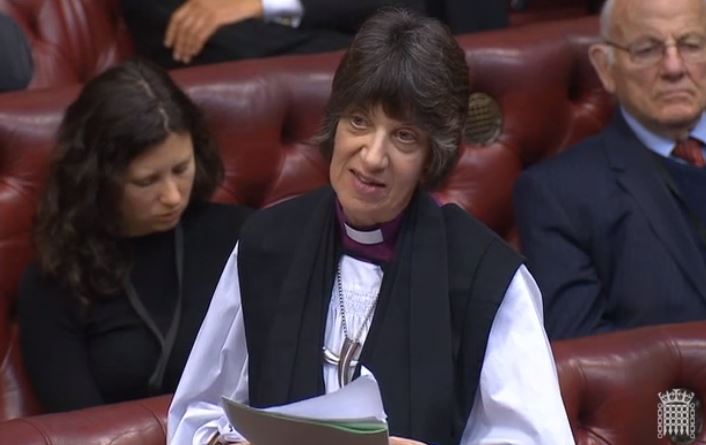
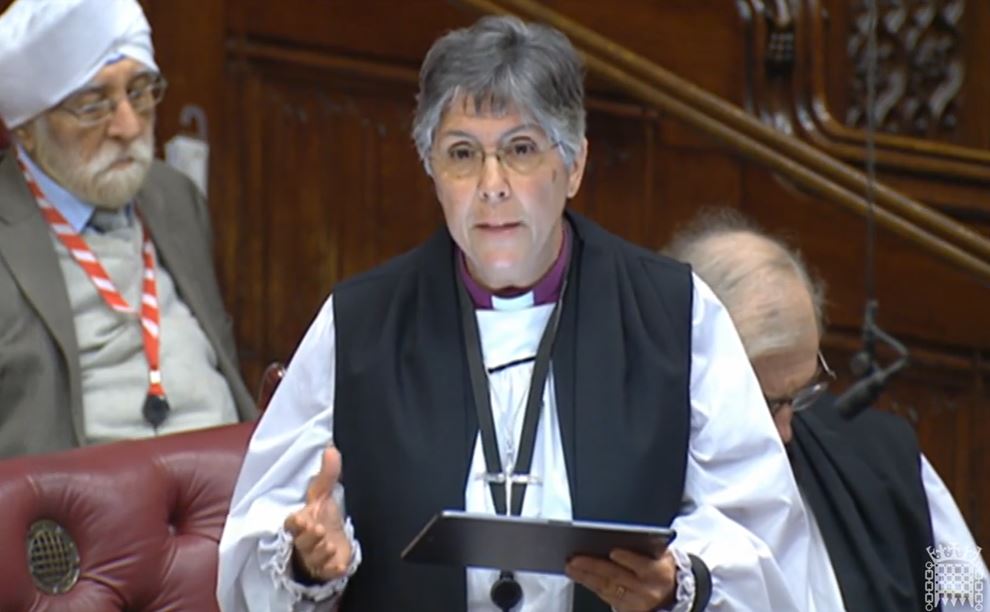
Bishop of Gloucester asks about conditions for those under Imprisonment for Public Protection

The Bishop of Gloucester received the following written answers on 17th March 2023:

The Lord Bishop of Gloucester asked His Majesty’s Government:

  • what emotional support and spiritual provision is available to prisoners under Imprisonment for Public Protection.
  • what assessment they have made of the increase in the numbers of prisoners under Imprisonment for Public Protection serving ten or more years beyond their original tariff.
  • what steps they are taking to reduce the number of women serving sentences under Imprisonment for Public Protection.
Continue reading “Bishop of Gloucester asks about conditions for those under Imprisonment for Public Protection”

Bishop of Derby asks about sport opportunities for women in prison

The Bishop of Derby received the following written answer on 22nd March 2023:

The Lord Bishop of Derby asked His Majesty’s Government:

  • what steps they have taken to improve the opportunities for sport and physical activity for women and girls in the criminal justice system.
  • what progress they have made in improving the availability of sport and physical activity for women and girls in the criminal justice system; and what plans they have to expand provision.

Lord Bellamy (Con): Encouraging engagement in sport and exercise amongst women and girls in contact with the criminal justice system can have a significant impact on reducing reoffending through both early intervention and diversionary activities, as well as rehabilitation for those sentenced.

Continue reading “Bishop of Derby asks about sport opportunities for women in prison”

Bishop of Gloucester asks about female prisoners categorised as a serious risk to the public

The Bishop of Gloucester received the following written answer on 6th March 2023:

The Lord Bishop of Gloucester asked His Majesty’s Government how many restricted status prisoners were held in the female estate in each of the last 10 years.

Lord Bellamy (Con): A Restricted Status (RS) prisoner is any female, young person or young adult prisoner, convicted or on remand, whose escape would present a serious risk to the public and who is required to be held in designated secure accommodation.

Continue reading “Bishop of Gloucester asks about female prisoners categorised as a serious risk to the public”

Bishop of Chelmsford asks about funding for chaplaincy support for prisoners re-entering the community

The Bishop of Chelmsford asked about support for prisoners re-entering the community on 10th January 2022, during a debate on prison chaplaincy:

The Lord Bishop of Chelmsford: My Lords, on Christmas Day, I was pleased to be able to visit my local prison and young offenders’ institute in Chelmsford, where I was taking a service. I had several conversations with both prisoners and members of staff who expressed concern about ensuring continued support for those who are leaving prison and re-entering the community. As the work of multifaith community chaplaincy and indeed the Welcome Directory continues to be developed to support those leaving prison, can the Minister say what discussions there have been, if any, regarding possible funding support from HMG?

Continue reading “Bishop of Chelmsford asks about funding for chaplaincy support for prisoners re-entering the community”

Bishop of Carlisle asks about alternatives to prison sentences

The Lord Bishop of Carlilse asked a question on what the government is doing to promote alternatives to prison sentences, during a debate on prison capacity on 6th December 2022:

The Lord Bishop of Carlisle: My Lords, my friend the right reverend Prelate the Bishop of Gloucester much regrets that she is not able to be present today. I know she shares my concern over this Statement since we, like others who have spoken, believe that the emergency use of police cells for prisoners is deeply worrying. We greatly welcome the increase in the number of police officers but feel that it is connected to the larger number of people going to prison, and that that should not be the case. Initially I wanted to ask about rehabilitation, but that question has already been addressed. I accept that the question of sentences is for the courts, but can the Minister help us by saying what the Government are doing to promote community and non-custodial sentences, rather than people simply going to prison?

Continue reading “Bishop of Carlisle asks about alternatives to prison sentences”

Bishop of Gloucester responds to Chancellor’s Autumn Statement

The House of Lords debated the Chancellor’s Autumn Statement on 29th November 2022

The Lord Bishop of Gloucester: My Lords, growth is good and necessary, and it is clear that money does not grow on those proverbial trees. We find ourselves in extremely challenging times, and it seems to me that some of the measures that are set out in the Autumn Statement are prudent and necessary to rebalance the budget. I thank the Government for their desire to focus on supporting the poorest households, which is right and just, including their decision to increase benefits in line with inflation. Yet I have a number of concerns. I want to use my time to focus on just two key issues: first, food and feeding people, and, secondly, the criminal justice system. I declare an interest both as a trustee of Feeding Britain and as Anglican Bishop for prisons in England and Wales.

Continue reading “Bishop of Gloucester responds to Chancellor’s Autumn Statement”

Bishop of Durham asks about indeterminate prison sentences

The Bishop of Durham asked a question about the impact of prison sentences on children and families during a debate on prisoners serving indeterminate sentences for public protection (IPP) on 27th October 2022:

The Lord Bishop of Durham: My Lords, as it happens, I was confirming in His Majesty’s Prison Holme House on Monday. One of the people I confirmed was an IPP prisoner. We talked about the desperate impact on family and children of the uncertainty that he has faced. He had been recalled, not for having committed an offence but for breaking conditions. It is very complicated. In looking at this, will His Majesty’s Government look at the impact on children and family and the support from not just the probation service but other organisations, such as, in the north-east, Nepacs and Junction 42?

Continue reading “Bishop of Durham asks about indeterminate prison sentences”

Bishop of Southwark asks about prison sentences

The Bishop of Southwark received the following written answer on 27th October 2022:

The Lord Bishop of Southwark asked His Majesty’s Government, what steps they are taking to resolve the situation that 608 prisoners under Imprisonment for Public Protection are at least 10 years over their original tariff.

Continue reading “Bishop of Southwark asks about prison sentences”

Bishop of Gloucester asks about life imprisonment

The Bishop of Gloucester received the following written answers on 5th September 2022:

The Lord Bishop of Gloucester asked Her Majesty’s Government:

  • how many people received a life sentence and were (1) under 18, (2) 18 to 20, (3) 21 to 24, (4) 25 to 29, (5) 30 to 34, (6) 35 to 39, (7) 40 to 49, (8) 50 to 59, (9) 60 to 69, and (10) 70 and older, at the time of sentencing in each year since 2002.
  • how many people received a life sentence with a tariff of between 10 years to less than 15 years, and were (1) under 18, (2) 18 to 20, (3) 21 to 24, (4) 25 to 29, (5) 30 to 34, (6) 35 to 39, (7) 40–49, (8) 50 to 59, (9) 60 to 69, and (10) 70 and older, at the time of sentencing in each year since 2002.
  • how many people received a life sentence with a tariff of between 15 years to less than 20 years, and were (1) under 18, (2) 18 to 20, (3) 21 to 24, (4) 25 to 29, (5) 30 to 34, (6) 35 to 39, (7) 40 to 49, (8) 50 to 59, (9) 60 to 69, and (10) 70 and older, at the time of sentencing in each year since 2002.
  • how many people received a life sentence with a tariff of between 20 years to less than 25 years, and were (1) under 18, (2) 18 to 20, (3) 21 to 24, (4) 25 to 29, (5) 30 to 34, (6) 35 to 39, (7) 40 to 49, (8) 50 to 59, (9) 60 to 69, and (10) 70 and older, at the time of sentencing in each year since 2002.
Continue reading “Bishop of Gloucester asks about life imprisonment”

Bishop of Gloucester speaks in a debate on crime and rehabilitation

The Bishop of Gloucester spoke in a debate on crime, reoffending and rehabilitation on 30th June 2022:

The Lord Bishop of Gloucester: My Lords, I am very grateful to the noble Lord, Lord Farmer, for introducing this debate. His work is inspiring; I want to say “yes” to all that he has said and am sorry that I have only six minutes. I too welcome the noble and learned Lord, Lord Bellamy, and look forward to his maiden speech. I refer to my interests stated in the register as Anglican Bishop to Prisons and president of the Nelson Trust. Last week, I visited HMP Wakefield. In reflecting with the governor on long sentences, he said that he had asked a group of prisoners whether, if they had known the tariff for their crime, it would have been a deterrent. For all but one, the answer was no. Most crimes are rarely planned in a calculated way.

Earlier this month, the Independent Commission into the Experience of Victims and Long-Term Prisoners published a report with a comprehensive set of recommendations, holding together for the first time the perspectives of the offender and the victim. The report highlighted that the number of people in England and Wales given a prison sentence of more than 10 years has more than doubled in a decade, at an ever greater cost. Where is the evidence that greater severity equates to greater deterrence, or a safer society? We need to curb the unhelpful and inaccurate rhetoric about keeping the public safer through longer, tougher sentencing. What matters more than longer and longer sentences is how people are spending their time while in prison, in terms of not only education and purposeful work but meaningful interventions which prevent reoffending and someone else becoming another victim. Holding together justice and restoration is central to Christian theology; I believe it is vital for us to rediscover how those two dwell side by side.

Continue reading “Bishop of Gloucester speaks in a debate on crime and rehabilitation”