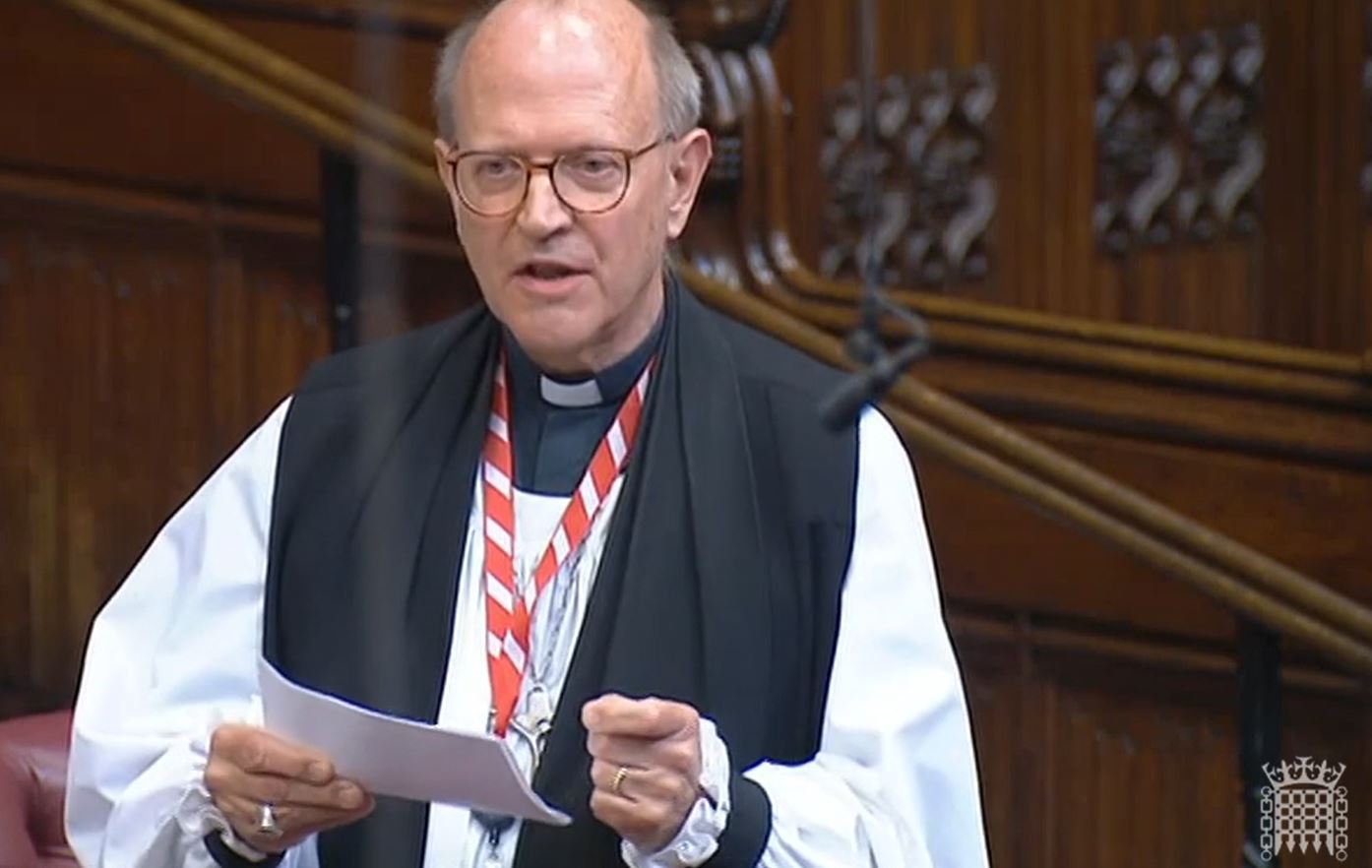
Illegal Migration Bill: Bishop of Durham requests clarification on use of digital methods such as video conferencing in immigration procedures

During a committee debate on the Illegal Migration Bill on 12th June 2023, the Bishop of Durham raised a point of clarification to Lord Murray of Blidworth (the Parliamentary Undersecretary of State for Migration & Borders), on the use of remote methods such as video-conferencing to conduct immigration procedures, asking whether such methods were as effective as in person interviewing and interventions:

Lord Murray of Blidworth (Con, Home Office): Amendment 90, spoken to by my noble friends Lord Randall and Lord McColl, relates to the presumption that it is not necessary for a person to remain in the UK to co-operate with an investigation. It is one of the enduring legacies of the Covid pandemic that much more can now be done remotely. We all see this in the changes to the way we work. Even now, some Members of your Lordships’ House take part in debates by videolink. It is simply no longer the case that a victim of crime needs to be in face-to-face contact with police or others to assist with an investigation. There is no reason why, in the majority of cases, such co-operation cannot continue by email, messaging and videoconferencing. The presumption in Clause 21(5) is therefore perfectly proper.

(…)

The Lord Bishop of Durham: Sorry—it has taken me a little while to contemplate but is the Minister effectively saying that the use of video and email and so on is as good as in-person interviewing and in-person interventions? I really think that needs to be rethought.

Continue reading “Illegal Migration Bill: Bishop of Durham requests clarification on use of digital methods such as video conferencing in immigration procedures”

Online Safety Bill: Bishop of Chelmsford supports Bishop of Oxford’s amendments on safety and risk

On 25th May 2023, the House of Lords debated the Online Safety Bill in committee. The Bishop of Chelmsford spoke in support of amendments to the bill tabled by the Bishop of Oxford, Lord Clement Jones, and Lord Colville of Culross, which would introduce new duties to Ofcom to assess risk and monitor online safety:

My Lords, I shall speak in favour of Amendments 195, 239 and 263, tabled in the names of my right reverend friend the Bishop of Oxford, the noble Lord, Lord Clement-Jones, and the noble Viscount, Lord Colville of Culross, who I thank for his comments.

My right reverend friend the Bishop of Oxford regrets that he is unable to attend today’s debate. I know he would have liked to be here. My right reverend friend tells me that the Government’s Centre for Data Ethics and Innovation, of which he was a founding member, devoted considerable resource to horizon scanning in its early years, looking for the ways in which AI and tech would develop across the world. The centre’s analysis reflected a single common thread: new technologies are developing faster than we can track them and they bring with them the risk of significant harms.

This Bill has also changed over time. It now sets out two main duties: the illegal content duty and the children duty. These duties have been examined and debated for years, including by the joint scrutiny committee. They are refined and comprehensive. Risk assessments are required to be “suitable and sufficient”, which is traditional language from 20 years of risk-based regulation. It ensures that the duties are fit for purpose and proportionate. The duties must be kept up to date and in line with any service changes. Recent government amendments now helpfully require companies to report to Ofcom and publish summaries of their findings.

Continue reading “Online Safety Bill: Bishop of Chelmsford supports Bishop of Oxford’s amendments on safety and risk”

Bishop of Southwark asks about use of facial recognition by the Israeli military

The Bishop of Southwark received the following written answer on 23rd May 2023:

The Lord Bishop of Southwark asked His Majesty’s Government what assessment they have made of the report by Amnesty International published on 2 May into the use of the Israeli military facial recognition system, Red Wolf, in mass surveillance and whether they support the call by Amnesty International for an end to mass and targeted surveillance in the Occupied Palestinian Territories.

Continue reading “Bishop of Southwark asks about use of facial recognition by the Israeli military”

Bishop of St Albans asks about piracy in relation to automated ships

The Bishop of St Albans received the following written answer on 11th May 2023:

The Lord Bishop of St Albans asked His Majesty’s Government what assessment they have made of their ability to combat piracy once fully automated ships have been brought into service, and of how fully automated ships and their cargo can be protected from illegal boarding in the absence of a crew.

Continue reading “Bishop of St Albans asks about piracy in relation to automated ships”

Bishop of St Edmundsbury & Ipswich asks about training and skills for installation of low carbon technology

The Bishop of St Edmundsbury & Ipswich asked a question on training for installation of low carbon technology during a debate on the government’s net-zero strategy on 3rd May 2023:

The Lord Bishop of St Edmundsbury & Ipswich: My Lords, as I understand it, one of the barriers to installing new low-carbon technology is the shortage of skilled labour to carry out this work. Can the Minister tell us what plans there are to invest in and expand training and skills programmes for the installation of low-carbon technology such as heat pumps, EV chargers and solar panels?

Continue reading “Bishop of St Edmundsbury & Ipswich asks about training and skills for installation of low carbon technology”

Bishop of St Albans asks about duty to render assistance at sea for automated ships

The Bishop of St Albans received the following written answer on 3rd May 2023:

The Lord Bishop of St Albans asked His Majesty’s Government what steps they will take to uphold the obligation “to render assistance to any person found at sea in danger of being lost” under the United Nations Convention on the Law of the Sea once fully automated ships are brought into service.

Continue reading “Bishop of St Albans asks about duty to render assistance at sea for automated ships”

Bishop of Oxford and Bishop of Leeds support statements of purpose for Online Safety Bill

On 19th April 2023, the House of Lords debated the Online Safety Bill in its first day of the committee stage. The Bishop of Oxford and the Bishop of Leeds each spoke in support of an amendment to the bill tabled by Lord Stevenson of Balmacara, setting out seven main purposes of the bill:

The Lord Bishop of Oxford: My Lords, it is a pleasure to follow other noble Lords who have spoken. I too support this key first amendment. Clarity of purpose is essential in any endeavour. The amendment overall sets out the Bill’s aims and enhances what will be vital legislation for the world, I hope, as well as for the United Kingdom. The Government have the very welcome ambition of making Britain the safest country in the world to go online. The OSB is a giant step in that direction.

As has been said, there has been remarkable consensus across the Committee on what further measures may still be needed to improve the Bill and on this first amendment, setting out these seven key purposes. Noble Lords may be aware that in the Christian tradition the number seven is significant: in the medieval period the Church taught the dangers of the seven deadly sins, the merits of the seven virtues and the seven acts of mercy. Please speak to me later if a refresher course is needed.

Amendment 1 identifies seven deadly dangers—I think they are really deadly. They are key risks which we all acknowledge are unwelcome and destructive companions of the new technologies which bring so many benefits: risks to public health or national security; the risk of serious harm to children; the risk of new developments and technologies not currently in scope; the disproportionate risk to those who manifest one or more protected characteristics; risks that occur through poor design; risks to freedom of expression and privacy; and risks that come with low transparency and low accountability. Safety and security are surely one of the primary duties of government, especially the safety and security of children and the vulnerable. There is much that is good and helpful in new technology but much that can be oppressive and destructive. These seven risks are real and present dangers. The Bill is needed because of actual and devastating harm caused to people and communities.

Continue reading “Bishop of Oxford and Bishop of Leeds support statements of purpose for Online Safety Bill”

Bishop of Leeds asks about role of Fujitsu company in UK Emergency Alert Procedures:

The Bishop of Leeds asked a question on the nature of the Japanese company Fujitsu’s role in the UK’s emergency alert procedures on 19th April 2023, during a debate on the suitability of the company’s involvement with these procedures following previous incidences of IT errors and defects in its systems:

The Lord Bishop of Leeds: My Lords, I understand the point about following procurement procedures, but can we try a different tack? What would Fujitsu have to do to make it excludable from these procedures?

Continue reading “Bishop of Leeds asks about role of Fujitsu company in UK Emergency Alert Procedures:”

Bishop of Exeter asks about broadband supply to rural and unconnected areas

The Bishop of Exeter received the following written answers on 24th March 2023:

The Lord Bishop of Exeter asked His Majesty’s Government what plans they have to ensure that the 500,000 properties currently unable to access a broadband service running at a minimum of 10Mbps via a fixed line will be able to access broadband.

Viscount Camrose (Con): The Government has set out its plan to deliver Project Gigabit, our £5 billion mission to deliver fast, reliable broadband across the UK, and we are making good progress. Our target is for 85% of UK premises to have access to gigabit-capable broadband by 2025, and over 99% by 2030. This will include some premises currently unable to access more than 10Mbps.

Continue reading “Bishop of Exeter asks about broadband supply to rural and unconnected areas”

Bishop of St Albans asks about access to phones and broadband in rural areas

The Bishop of St Albans received the following written answer on 9th Febraury 2023:

The Lord Bishop of St Albans asked His Majesty’s Government what estimate they have made of how many people in rural areas do not have access to (1) landline phones, (2) mobile telephone coverage, (3) wireless coverage, (4) broadband, and (5) satellite internet.

Lord Parkinson of Whitley Bay (Con): Ofcom collects coverage as part of its reporting requirements, most recently in its Connected Nations Report, with data for the period to September 2022.

Ofcom reports that 96% of rural premises have indoor 4G coverage from at least one operator, rising to 99% for outdoor coverage. This equates to c.195,000 rural premises not having 4G indoor coverage, with c.26,500 not having outdoor 4G coverage.

Continue reading “Bishop of St Albans asks about access to phones and broadband in rural areas”