Welfare Reform Bill – Bishop of Portsmouth tables amendment about impact on families and faith communities of two-child limit

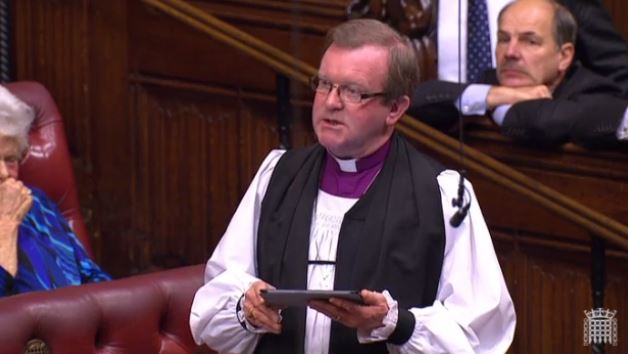
On Monday 7th December, the House of Lords debated the Government’s Welfare Reform and Work Bill during its first day of Committee. The Bishop of Portsmouth, Rt Revd Christopher Foster, spoke to an amendment he had tabled to require Government to assess the impact of the proposed two-child limit for new claimants on families and faith communities. His speeches opening and closing the debate on his amendment are included below, along with an extract of the Minister’s reply. The full debate, including speeches by other Members, can be seen at: Parliament.uk

BishPortsspeechtaxcreditsThe Lord Bishop of Portsmouth: My Lords, I tabled Amendment 21 to highlight the impact of this measure on different faith communities who share our concerns with this part of the Bill in particular. Noble Lords who attended the special briefing we organised two weeks ago will have heard Chaya Spitz, chief executive of the Interlink Foundation, speak passionately about the implications for the Orthodox Jewish community that she represents and is a member of. For her community, larger families are the norm and the central pivot around which everything else revolves. There is a positive, faith-based imperative to have children, to create the next generation in service of God. There is also a commonly held conscientious objection to the use of artificial contraception, except in prescribed circumstances, and to abortion, except in rare circumstances. By limiting financial support to the first two children, this policy is making a judgment that touches on deeply personal and strongly held religious and cultural beliefs about the family, and that threatens the viability of whole faith communities.

Continue reading “Welfare Reform Bill – Bishop of Portsmouth tables amendment about impact on families and faith communities of two-child limit”

Welfare Reform Bill – Bishop of Portsmouth opposes two-child limit for new claimants

On Monday 7th December, the House of Lords debated the Government’s Welfare Reform and Work Bill during its first day of Committee. The Bishop of Portsmouth, Rt Revd Christopher Foster, spoke in support of a motion from Baroness Sherlock and Lord McKenzie opposing the question that clauses 11 and 12 (limiting child tax credits to the first two children) should stand part of the bill. His speech is included below, along with an extract of the Minister’s reply. The full debate, including speeches by other Members, can be seen at: Parliament.uk

BishPortsspeechtaxcreditsThe Lord Bishop of Portsmouth: My Lords, I express my strong concern about these clauses remaining part of the Bill. I offer three straightforward and, I hope, succinct comments: first, about the implications of these clauses; secondly, about the motivation of parents that is implied; and, thirdly, about where responsibility lies.

First, the Government place great emphasis on choice and personal responsibility for family size. I have to say that that assumes a remarkable assumption about the fail-safe effectiveness of contraception—or, if not, an apparent willingness for abortion to be appropriate as a sort of emergency contraception to keep family size to two children. I doubt the assumption, and would deeply regret driving people to seek termination on economic grounds. Is that really what the Government wish? Continue reading “Welfare Reform Bill – Bishop of Portsmouth opposes two-child limit for new claimants”

Archbishop of Canterbury asks Government about link between food bank use and benefit changes

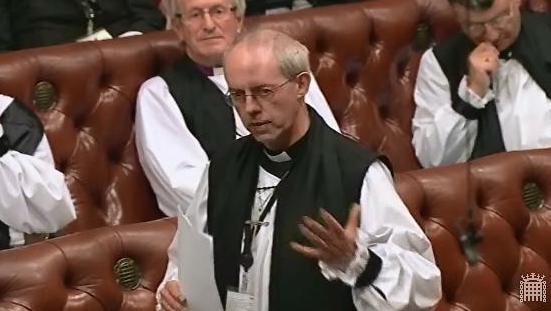
On 26th November 2015 Lord Beecham asked Her Majesty’s Government “what assessment they have made of the provision of food banks at, and the distribution of food to people in need by, NHS hospitals.” The Archbishop of Canterbury, Most Rev & Rt Hon Justin Welby, asked a supplementary question:


Archbishop of CanterburyThe Archbishop of Canterbury: Does the Minister recognise that the comments at the time of the previous Government about there being no link between benefit changes and food banks was significantly challenged at the time and that our experience in Church of England, which is involved in the vast majority of food banks across the country, is that between 35% and 45% of people coming to get support from food banks report that the reason for running out of food is to do with changes to the benefit system and sanctions?


Lord Prior of Brampton:All I can do is repeat what I said before which is that, as Ed Davey said, there is no statistical link, in his view, between the Government’s benefits reforms and the provision of food banks. I think that the issue is much more complex than the most reverend Primate is suggesting.


(via Parliament.uk)


Bishop of Derby asks questions about benefit fraud

On 26th & 27th October 2015 the Bishop of Derby, Rt Revd Alastair Redfern, received written answers from Government to questions on benefit fraud. 


Bishop of Derby The Lord Bishop of Derby: To ask Her Majesty’s Government how many reports of benefit fraud have been submitted to the Department for Work and Pensions between 2010 and the most

recent date for which figures are available. Continue reading “Bishop of Derby asks questions about benefit fraud”

Bishops of Truro and Portsmouth receive Written Answers to Questions about Short Term Benefit Advances

On 19th and 20th October 2015 the Bishop of Truro, Rt Revd Tim Thornton, and the Bishop of Portsmouth, Rt Revd Richard Foster, received written answers to questions on short term benefit advances.


Bishop of Truro 20.6.13

The Lord Bishop of Truro: To ask Her Majesty’s Government what proportion of those applying for a Short Term Benefit Advance (STBA) in 2014–15 were rejected because (1) they were not considered likely to be entitled to the benefit for which they required an STBA, (2) they were not considered to be in sufficient financial need to warrant an STBA, (3) they were not expected to be able to repay the loan arising from an STBA, (4) a benefit payment could be made in a timeframe that negated the need for an STBA, or (5) for other reasons. Continue reading “Bishops of Truro and Portsmouth receive Written Answers to Questions about Short Term Benefit Advances”

Bishop of Truro asks Government for figures on numbers of short term benefit advances awarded

On 15th October 2015 the Bishop of Truro, Rt Revd Tim Thornton, received a written answer to a question on short term benefit advances.


Bishop of Truro 20.6.13

The Lord Bishop of Truro: To ask Her Majesty’s Government whether they intend to publish data on the number of claims and
awards of Short Term Benefit Advances and Universal
Credit Short Term Advances. Continue reading “Bishop of Truro asks Government for figures on numbers of short term benefit advances awarded”

Bishop of Derby asks Government about procedures for identifying benefit fraud

On 15th October 2015 the Bishop of Derby, Rt Revd Alastair Redfern, received answers to three written questions on how Jobcentre Plus deals with benefit fraud.


Bishop of DerbyThe Lord Bishop of Derby: To ask Her Majesty’s Government

(i) what policy is in place to enable Jobcentre Plus officers to identify benefit fraud.

(ii) how Jobcentre Plus officers report suspected benefit fraud.

(iii)  whether there is a statutory obligation for Jobcentre Plus officers to report suspected benefit fraud.  Continue reading “Bishop of Derby asks Government about procedures for identifying benefit fraud”

Bishop of Peterborough asks the Government about benefits sanctions

On the 10th September 2015 Baroness Sherlock asked the government what plans they have to review the operation of sanctions on benefits. The Bishop of Peterborough, Rt Revd. Donald Allister, asked a supplementary question about the impact the cost of travel has on people in rural areas when they are required to attend appointments at JobCentre Plus.

14.02 PeterboroughThe Lord Bishop of Peterborough: My Lords, the Feeding Britain report showed that some people have been sanctioned for missing or being late for appointments when it is not their own fault. Is it not possible for the staff at Jobcentre Plus to be given some discretion in whether or not to apply sanctions? Along the same lines, is it fair that some people in rural communities have to spend £7 or more on bus fares to get to routine appointments when the likes of me, who can well afford bus fares, are entitled to a free bus pass?

Continue reading “Bishop of Peterborough asks the Government about benefits sanctions”

Bishop of Birmingham responds to the Budget

“The test of the success of this and future Budgets for a country living within its means will be the growing number of households that are equipped and completely free to earn the means to live.” Bishop of Birmingham 21/07/15

01.04.14 Bishop of BirminghamOn the 21st July 2015 the Bishop of Birmingham, the Rt Revd David Urquhart, responded to the  Budget Statement, during a debate in the House of Lords. The Bishop called for an inclusive capitalism and questioned Lord O’Neill the Commercial Secretary for the Treasury about the impact of the changes to working age benefits. The Bishop also spoke about the need to improve productivity via energising the local economy alongside investing in infrastructure, skills, training and apprenticeships.

Continue reading “Bishop of Birmingham responds to the Budget”

Bishop of Portsmouth argues for delay to plan to extend waiting period for universal credit payments

On 13th July 2015 the House of Lords debated Government proposals to introduce seven waiting days for applicants for universal credit, prior to receipt of payment. Two motions were put to the House – the first, from Lord German, to exempt the housing element of universal credit from that; the second, from Baroness Sherlock, to delay enactment until universal credit had been fully rolled out. The Bishop of Portsmouth, Rt Revd Christopher Foster, spoke in support of Baroness Sherlock’s amendment and voted for it in the subsequent Division of the House. Baroness Sherlock’s amendment was passed by 135 to 124 votes. The Bishop’s speech and an extract of the Minister’s response is below:

14.04.09 Portsmouth maiden speech 2My Lords, I and others from these Benches have welcomed the principle of universal credit, and I readily do so again. However, the best of policies and principles have practical consequences which make all the difference to the effectiveness of policy. In that constructive spirit, wishing universal credit to be successful in simplifying the complexity faced by benefit claimants and confirming the dignity of work at a decent rate of pay, I add some reservations to the extension of waiting time to seven days. Continue reading “Bishop of Portsmouth argues for delay to plan to extend waiting period for universal credit payments”