Bishop of Worcester commends the living wage as tool to tackle inequality

Lord Giddens asks Her Majesty’s Government what policies they have to address economic inequalities in British society.

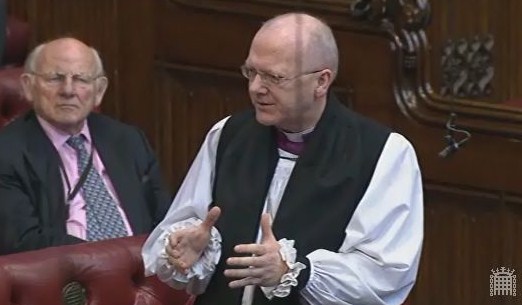
The Bishop of Worcester asked a supplementary question:

The Lord Bishop of Worcester: My Lords, is the Minister aware of the first report published today by the Living Wage Commission, chaired by my friend the most reverend Primate the Archbishop of York, which found that emerging economic recovery will have no effect on more than 5 million workers unless employers pay a living wage. It found furthermore that 6.7 million of the 13 million people in poverty in the UK are in a family where someone works—which, for the first time, is more than half the total. Will the Minister tell the House what steps the Government are taking to address this real concern?

Lord Newby: My Lords, the Government are encouraging employers to pay the living wage where they can. One of the key things about people in work on very low incomes is that a large proportion of them are working a small number of hours or a smaller number of hours than they would like. Economic growth will mean that more of those people are able to work longer hours, which will help deal with their household circumstances.

(via parliament.uk)

The Bishop of St Albans raises concerns about growing regional economic inequality

Baroness Wilcox asked Her Majesty’s Government what recent assessment they have made of the levels of manufacturing activity in the United Kingdom.

The Bishop of St Albans asked a supplementary question:

The Lord Bishop of St Albans: My Lords, I am sure we all want to encourage a much more robust manufacturing base in this country. An article in the Economist last week pointed out that, unlike the rest of the country, the north-east and south-west regions still saw an increase in unemployment up to the year ending November 2013. There are huge problems at the moment in the south-west, which was already facing a downturn in its tourist industry and now has floods and difficulties with trains. Is there anything the Government can do to encourage a more long-term, stronger economic and, indeed, manufacturing base in the south-west of England?

Viscount Younger of Leckie: Our industrial strategy focuses on the whole country. I note the right reverend Prelate’s point about the south-west where they are suffering so terribly from the floods. The industrial strategy has five main strands which are bearing fruit, particularly in places such as Liverpool and Tyneside, and the south-west is just as important.

(via parliament.uk)

Bishop of Derby’s speech on inequality and social mobility

The Lord Bishop of Derby: My Lords, I, too, thank the noble Lord, Lord McFall, for his analysis, not least his observation that growth is not the answer and the unintended consequences of marketisation, as he called it. I probably want to explore what he might have meant by “the social, stupid”—there is an important clue in that.

I am engaged in this issue. In the City of Derby, where I work, I chair the inner city renewal project. That is the local authority and all kinds of voluntary and faith groups looking at how we can tackle this at grass-roots level, where there are a lot of people who are disadvantaged, with no social mobility and no equality in terms of finance, environment or opportunity. There are two ways of doing this. One is a needs-based approach—what are the needs and what resources can you put in to try to improve things?—and there is what they call an asset-based approach, which means asking what these people have in their own potential, as the noble Baroness, Lady Eaton, said—what do they have that can be grown so that they can contribute? Continue reading “Bishop of Derby’s speech on inequality and social mobility”

Bishop of Chester receives answer to question on electricity market (Written Question)

The Lord Bishop of Chester asked Her Majesty’s Government what amount and proportion of the United Kingdom’s electricity requirement in 2013 was met by inputs through interconnectors with other countries; and how much electricity the United Kingdom exported during 2013.

The Parliamentary Under-Secretary of State, Department of Energy and Climate Change (Baroness Verma) (Con): The table below shows UK imports and exports of electricity, in GWh, January 2013 to September 2013. Data for 2013 as a whole will be available on 28th March 2014.

Imports and Exports in the UK for January-September 2013 in GWh
Imports 13,084
Exports 2,065
Net Imports 11,019
-as % of electricity supply 4.00%
Electricity Supplied 275,523

Source: Energy Trends table 5.2 available at: https://www.gov.uk/government/publications/electricity-section-5-energy-trends

(via parliament.uk)

Bishop of Wakefield urges Government to support pupils in areas of rural deprivation

Lord Horam asked Her Majesty’s Government what plans they have to increase the Pupil Premium for the most disadvantaged primary school children.

The Bishop of Wakefield asked a supplementary question:

The Lord Bishop of Wakefield: My Lords, can the Minister tell us whether the Government are considering ways in which an increase in the pupil premium can be targeted at the forms of deprivation most difficult to address? Rural deprivation, for example, particularly in church schools, is very significant in our part of West Yorkshire, in the Diocese of Wakefield.

Lord Nash: The right reverend Prelate is quite right to point out the problems with rural deprivation; it is similar to coastal deprivation. There are particular schemes that schools follow: mentoring; systemic feedback; much more involvement of parents; early intervention, particularly using the better teachers; and peer tutoring. Much can be learnt from groups like Ark, whose academy in Portsmouth, for instance, which is in a classic coastal town, has improved results in four years from 24% to 68%.

(via parliament.uk)

Bishop of Ripon and Leeds uses final speech to speak about economic and climatic challenges in the UK

R_LIn a wide-ranging debate, the Bishop of Ripon and Leeds focused his remarks on the need for a clear and coherent national strategy for responding to natural disasters such as the recent extreme flooding in parts of the country. He also urged the Government to link such a strategy with a long-term and international strategy for tackling climate change. He also commented on the role of the Church of England in education and its commitment to ensuring that there is adequate provision as the population grows. Continue reading “Bishop of Ripon and Leeds uses final speech to speak about economic and climatic challenges in the UK”

Bishop of Ripon and Leeds speaks about affordable housing in rural communities

R_LOn 22nd January, 2014, the Bishop of Ripon and Leeds took part in a short debate, led by Baroness Ford, on increasing the supply of affordable housing, focusing his remarks on delivering housing in rural areas. Continue reading “Bishop of Ripon and Leeds speaks about affordable housing in rural communities”

Bishop of St Albans makes maiden speech in eduation debate

On 5th December 2013, the Rt Revd Alan Smith, Lord Bishop of St Albans, made his maiden speech in the House of Lords, during Baroness Morgan of Huyton’s take note debate on the contribution of high-quality education to economic growth.

14.03 Bishop of St Albans Continue reading “Bishop of St Albans makes maiden speech in eduation debate”

Archbishop of Canterbury leads debate on the work of the Parliamentary Commission on Banking Standards

On 5th December 2013, the Archbishop of Canterbury led a debate on the work of the Parliamentary Commission on Banking Standards, of which he was a member from 2012-2013. The Bishop of Birmingham also took part in the debate, and his remarks can be read here.

Archbishop of Canterbury

The Archbishop of Canterbury: My Lords, your Lordships are asked to take note of the work of the Parliamentary Commission on Banking Standards. I speak not only on my behalf but on that of some of the commissioners who, for various reasons, cannot be here. I should add that it is coincidental and owing to constraints of the diary that this debate falls so neatly between Report and the Third Reading next week of the Financial Services (Banking Reform) Bill. I am particularly looking forward to the maiden speech of the noble Lord, Lord Carrington of Fulham. I am sure his contribution will be significant given his vast experience in another place, especially on the Treasury Select Committee.

Continue reading “Archbishop of Canterbury leads debate on the work of the Parliamentary Commission on Banking Standards”

Bishop of Chester takes part in debate on Autumn Statement

On 5th December, the Bishop of Chester took part in the debate on the Autumn Statement, which was repeated in the House of Lords by the Commercial Secretary to the Treasury, Lord Deighton.

14.03 Bishop of Chester Continue reading “Bishop of Chester takes part in debate on Autumn Statement”