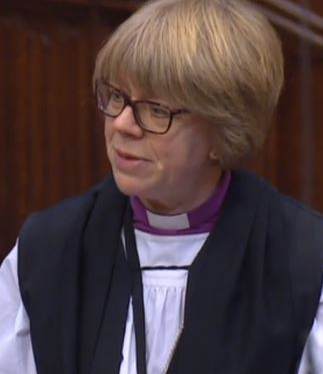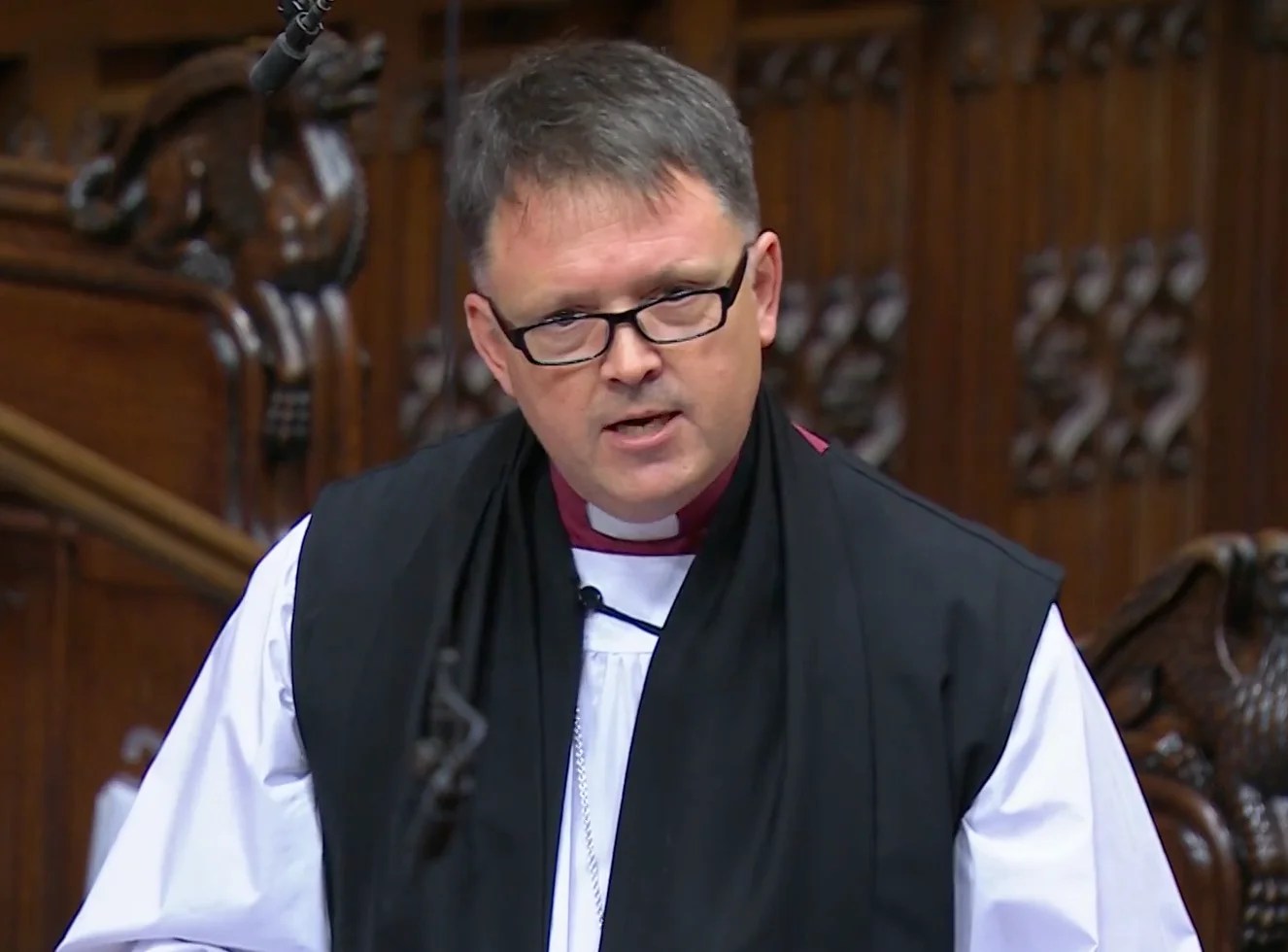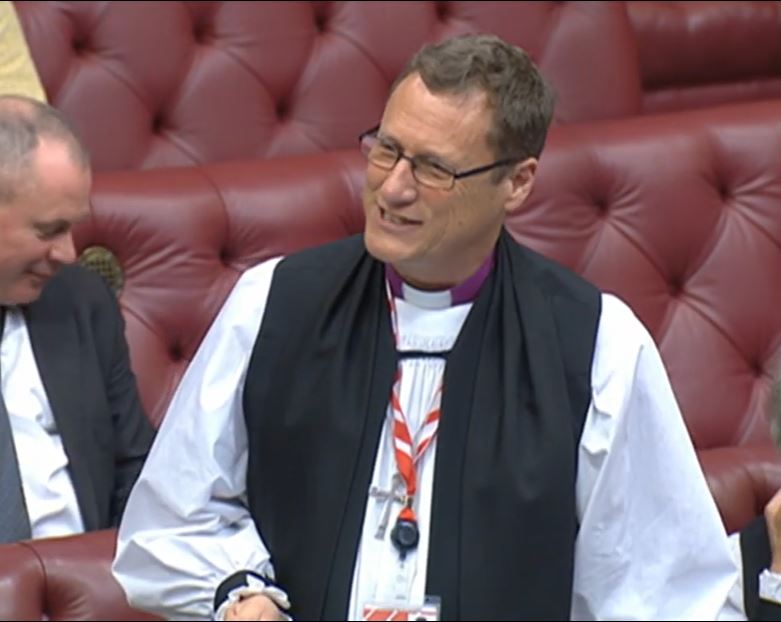
Bishop of Leeds asks about treatment for brain tumours

The Bishop of Leeds asked a question on treatment for brain tumours on 24th November 2025:

The Lord Bishop of Leeds: My Lords, would the Minister agree that it is important to recognise and praise the treatment that is already available while challenging to do more? I was diagnosed with a benign tumour and the treatment was exemplary. On the real upside of this, I have a lot of documentary evidence that I have a brain.

Continue reading “Bishop of Leeds asks about treatment for brain tumours”

Terminally Ill Adults (End of Life) Bill: Bishop of London supports further safeguards

The Bishop of London spoke during a committee debate on the Terminally Ill Adults (End of Life) Bill on 21st November 2025, supporting amendments aimed at introducing further safeguards and monitoring into the bill:

The Lord Bishop of London: My Lords, I will speak particularly in support of Amendments 181, 45 to 49, 58 and 222. It is a privilege to follow the noble Baroness, Lady Hollins, and the noble Lord, Lord Griffiths, whom I thank for sharing their personal stories. They are a reminder to us that this debate touches some of the deepest things within us, and not only should we be kind to each other but we ought also to be kind to ourselves.

I declare my interests as set out in the register, and particularly that I am vice-president of Exeter Hospice Care, chair of the UK Commission on Bereavement, and patron of AtaLoss. Your Lordships will know that, however many amendments there are to this Bill, I do not feel it will ever be safe. But I want to speak on this group because I believe that these amendments are at the heart of the issue of motivation. I remain concerned about the fact that there is currently no real, deep investigation of the motivation for assisted dying.

Continue reading “Terminally Ill Adults (End of Life) Bill: Bishop of London supports further safeguards”

Bishop of London asks about data collection on telemedical abortions

The Bishop of London asked a question on collection of data on the provision of telemedical abortions on 12th November 2025:

The Lord Bishop of London: My Lords, the extension of the regulations to enable early medical abortion to be provided without requiring in-person medical consultation was a significant change. We have heard about the tragic cases of early medical abortion pills being provided outside the law and women being put at risk as a result. We are now three years on from this change. What data has been collected in that time and what does it tell us about the workability of the new system in providing safe abortions within the law?

Baroness Merron (Lab, DHSC): The data available does not point to concerns about the provision of telemedicine. I should emphasise that, of course, abortions can take place only in an NHS hospital, in a place approved by the Secretary of State, or via telemedicine at the woman’s usual place of residence. Approval has to be given by the Secretary of State, and there is inspection by the Care Quality Commission, which inspects providers. The data thus far does not flag a difficulty in respect of telemedicine. In fact, all aspects of this are saying that this ensures that this safe procedure is assisting the situation for the women concerned.

Hansard

Bishop of Manchester asks about protection of health services in Gaza

The Bishop of Manchester asked a question on ensuring protection of health services in Gaza, following a government statement on the situation in the Gaza Strip on 3rd November 2025:

The Lord Bishop of Manchester: My Lords, the last three functioning ICU beds in Gaza are in the Al-Ahli Anglican Hospital. In a time of transition, as we see, I hope, the elimination of Hamas, that will of course get rid of the Hamas-run health ministry. How can we ensure that health services are protected and indeed improved during any transition?

Continue reading “Bishop of Manchester asks about protection of health services in Gaza”

Bishop of Sheffield asks about provision of medical supplies in Gaza

The Bishop of Sheffield asked a question on the need to ensure financial support and medical supplies reach the Anglican Al-Ahli Hospital in Gaza on 16th October 2025:

The Lord Bishop of Sheffield: My Lords, from these Benches, I join others in expressing deep appreciation and thanks to the Lord Speaker for his service to this House and assure him of our continued support in the coming months. Noble Lords may be aware that efforts are under way to rebuild the Al-Ahli hospital, managed by the Anglican diocese of Jerusalem. It remains the only hospital in operation in the north of Gaza, but most of its buildings are in ruins following multiple airstrikes earlier this year. Hospital staff have remained in place throughout the conflict. They are now in urgent need of medical supplies to continue to deliver life-saving treatment. I ask the Minister to bring her influence urgently to bear to ensure that financial support and medical supplies reach the hospital so that it can continue to serve the people of north Gaza.

Continue reading “Bishop of Sheffield asks about provision of medical supplies in Gaza”

Bishop of Sheffield asks about regional transport and healthcare infrastructure

The Bishop of Sheffield received the following written answers on 13th October 2025:

The Lord Bishop of Sheffield asked His Majesty’s Government what assessment they have made of the safety, security, and resilience of national and regional transport infrastructure, with particular reference to South Yorkshire.

Continue reading “Bishop of Sheffield asks about regional transport and healthcare infrastructure”

Bishop of Chelmsford asks about potential debate on implications of whole-genome sequencing of infants

The Bishop of Chelmsford asked a question on the opportunity for the House to debate the implications of whole genome-sequencing on 18th September 2025:

The Lord Bishop of Chelmsford: When will the House have the opportunity to debate this policy for whole-genome sequencing with all its details, given that it has such weighty and far-reaching implications for healthcare, prevention and a number of ethical issues, as we have already heard?

Continue reading “Bishop of Chelmsford asks about potential debate on implications of whole-genome sequencing of infants”

Terminally Ill Adults (End of Life) Bill: Bishop of London opposes legislation and calls for comprehensive funding of palliative care system

The Bishop of London spoke at the second reading of the Terminally Ill Adults (End of Life) Bill, opposing the bill and outlining the need for fully funded palliative and social care services in the UK:

The Lord Bishop of London: My Lords, as the noble Lord, Lord Kamall, has already pointed out, we in this Chamber share the same goal: for people to die with dignity and compassion. They are critical concerns for those who, like me, believe that the Bill is deeply flawed. Noble Lords will know that I am a former government Chief Nursing Officer, and I chaired the UK Commission on Bereavement. As a nurse, a priest, a daughter and a granddaughter, I have had the privilege to be with many people as they die. Most people die well although, as we have heard and will continue to hear, that is not always the case. I have known people to experience some of the most valuable days of their life as it comes to an end, including those with terminal illnesses.

Continue reading “Terminally Ill Adults (End of Life) Bill: Bishop of London opposes legislation and calls for comprehensive funding of palliative care system”

Still-Birth (Definition) Bill: Bishop of Guildford welcomes legislation

On 4th July 2025, the Bishop of Guildford spoke at the second reading of the Still-Birth (Definition) Bill [HL], a private members bill tabled by Baroness Benjamin, supporting the bill and welcoming its principles behind it:

The Lord Bishop of Guildford: My Lords, I will speak in support of the principles of this Bill, and I am very grateful to the noble Baroness, Lady Benjamin, for having brought it to the House. One of the best traits in human nature is using the difficult experiences that we ourselves encounter to speak up for others facing similar situations. I applaud the noble Baroness for using her experience and her voice in this way, and especially for the achievement of the introduction of certificates of loss last year.

During my time as a vicar in south-west London, another inspiring woman from within my then congregation came to me with the idea of starting a listening service for women who had miscarried or were facing difficult or unintended pregnancies. This was partly born out of her own experience and partly out of the fact that she lived around the corner from a large BPAS abortion clinic, where a constant trickle of women, sometimes accompanied by their partners or their mums and sometimes quite alone, would make their way to the front door, often in considerable distress, with very little time or opportunity to think through what was for some a desperately difficult decision. It was not long before my congregation member had assembled a small group of other people—about six in all—who were enthused by the vision. They undertook substantial training, not least given the extreme sensitivity of what they would be doing and the need to ensure that they were both professional and non-directive in their approach.

Continue reading “Still-Birth (Definition) Bill: Bishop of Guildford welcomes legislation”

Bishop of London asks about growing workforce in disability nursing field

The Bishop of London asked a question on growing the workforce in the field of learning disability nursing on 17th June 2025: 

The Lord Bishop of London: My Lords, the NHS England 2025 best practice guide has a number of suggestions for growing the learning disability nursing workforce, including requiring CQC-registered providers to provide staff with training for learning disabilities and autism. Can the Minister say what the Government are doing to ensure that this is implemented equitably across the integrated care systems?

Continue reading “Bishop of London asks about growing workforce in disability nursing field”