Archbishop of York: ‘working poor’ “a stain on the conscience of this country”

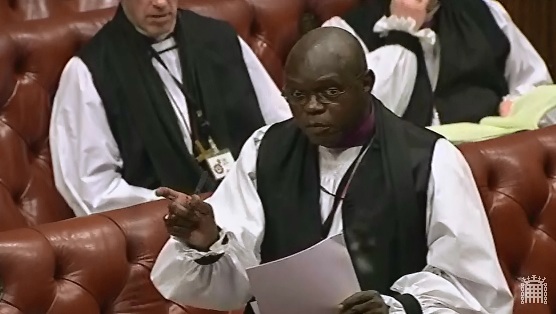
On 25th June 2014, Labour Peer Baroness Thornton asked Her Majesty’s Government what measures they are taking to address any fall in wages of women in the United Kingdom. The Archbishop of York, the Most Revd and Rt Hon John Sentamu,asked a supplementary question:

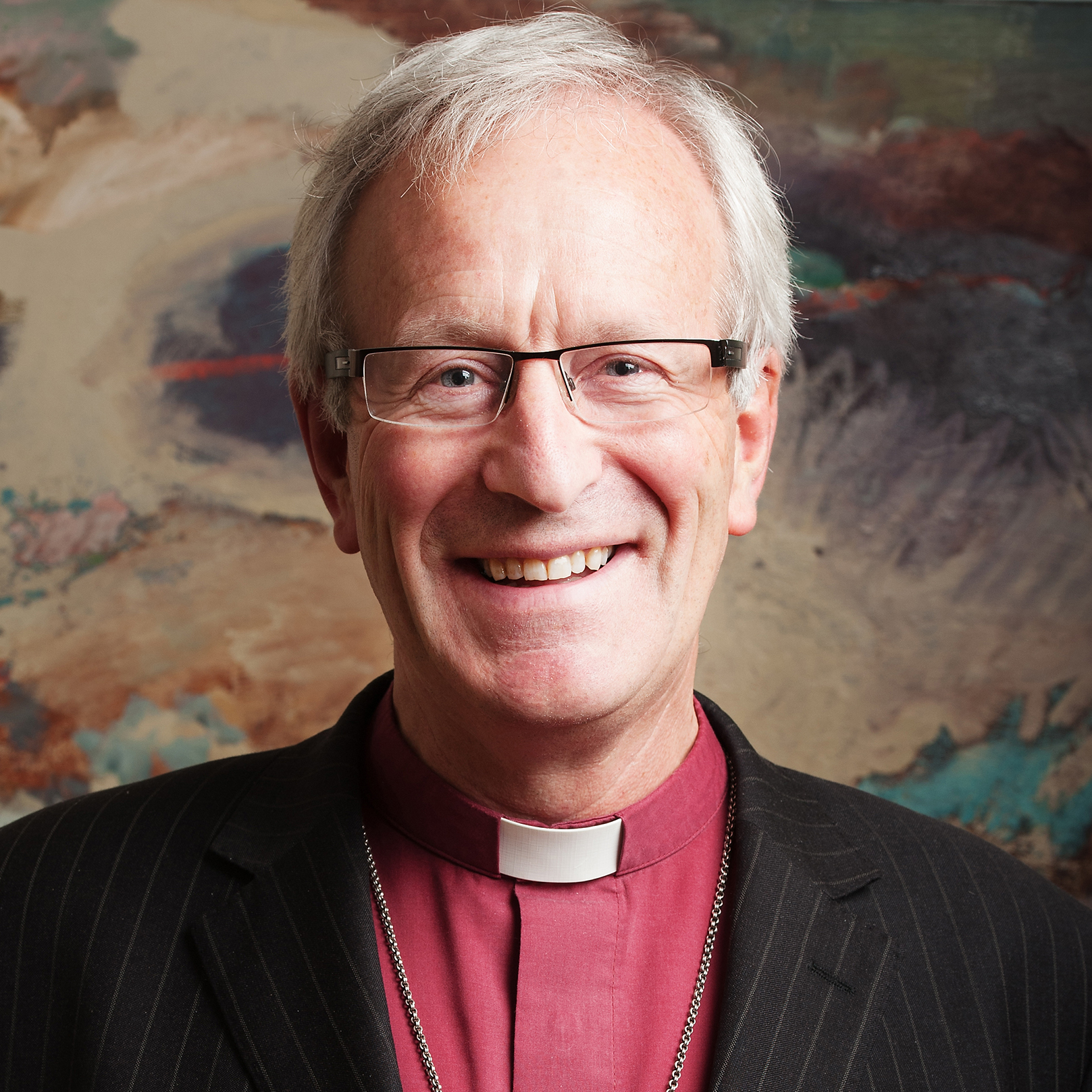
Archbishop of YorkThe Archbishop of York: My Lords, the Living Wage Commission published its final report yesterday. It makes it clear that people in the care industry are paid very poorly—and the majority happen to be women. Will the Government take a reality check and recognise that people in the care professions are paid poorly? Will they make sure that, in terms of procurement, local authorities encourage those in the care profession to pay at least the living wage, which we wanted to be voluntary and not compulsory? If that does not happen, concern about women being paid poorly will continue. It is a stain on the conscience of this country that people work hard and are still in poverty.

Baroness Northover: I read the report of the most reverend Primate’s commission with enormous interest. I note that he has just said that he is looking for a voluntary approach rather than regulation, but he challenges responsible employers to pay a fair wage. He is right to identify the difference in pay between men and women.

(via Parliament.uk)

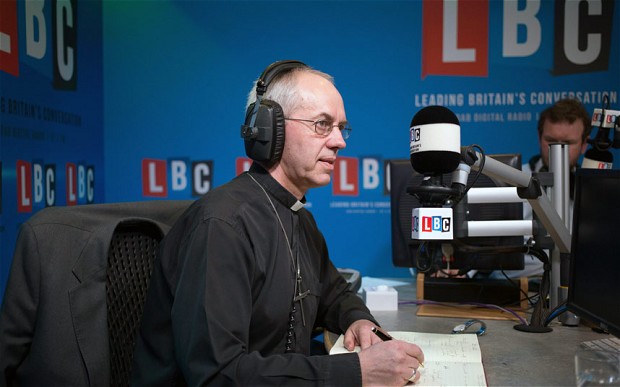
Archbishop’s phone-in on LBC radio: transcript

Justin-Welby_2873342b

On Friday 4th April 2014 the Archbishop of Canterbury took questions from callers to LBC’s James O’Brien radio show. Topics covered included same-sex marriage, the nature of God, climate change, economics and investments, female bishops, welfare reform and relations within the Anglican Communion. A transcript is below. The full recording can also be heard here.

Update: On 6th April the Archbishop gave a joint interview to BBC Radio 4’s Sunday Programme, with Cardinal Vincent Nichols. In it he was asked to expand on the final answer he gave during the LBC interview. The Sunday Programme recording can be heard here (27 mins 55 secs in)

Continue reading “Archbishop’s phone-in on LBC radio: transcript”

Living Wage Call by the Bishop of Leicester

In the House of Lords on 1st April 2014 Lord Young of Norwood Green asked Her Majesty’s Government ‘what plans they have to mark the 15-year anniversary of the minimum wage, which took effect on 1 April 1999.’ The Bishop of Leicester asked a supplementary question: 

14.04.01 Bishop of Leicester

The Lord Bishop of Leicester: My Lords, in view of what the Minister has said about there being much work to do on the living wage, does he agree that a good way to mark this anniversary would be to commission an independent inquiry into the actual effects of raising the minimum wage to the living wage for everyone? Continue reading “Living Wage Call by the Bishop of Leicester”

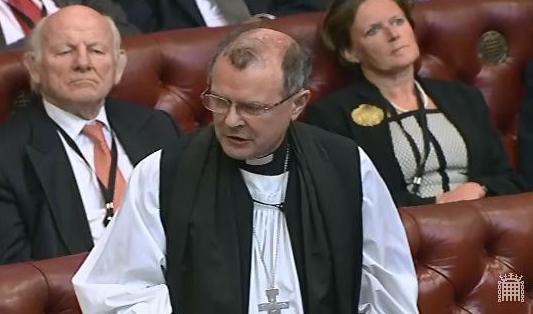
Bishop of Gloucester – evidence that food bank use linked to benefit sanctions and delay

In the House of Lords on 20th March 2014 Lord Beecham asked Her Majesty’s Government ‘what assessment they have made of the number and role of food banks in the United Kingdom.’

The Bishop of Gloucester, Rt Rev Michael Perham, asked a supplementary question:14.03.20 Bishop of Gloucester

The Lord Bishop of Gloucester: My Lords, research by Citizens Advice shows that the main reason people are referred to food banks is delay in the payment of benefits and benefit sanctions; anecdotally, this is also the church’s own experience from its involvement in the many food banks it helps to run across the country. Will the Minister tell us whether the Government are persuaded by this evidence and, if they are not, will he share with us what plans they have to carry out their own research into the reasons leading so many people to seek food aid?

Lord De Mauley: My Lords, I very much acknowledge the right reverend Prelate’s question. While it is right to expect that claimants who are able to look for or prepare for work should do so, a sanction will never be imposed if a claimant has good reason for failing to meet requirements. If claimants demonstrate that they cannot buy essential items, including food, as a result of their sanction, they can claim a hardship payment. No claimant should ever have to go without essentials as a result of a sanction.

(via Parliament.uk)

Bishop of Birmingham Responds to the Budget

Responding today to the Chancellor’s 2014 Budget statement, the Bishop of Birmingham, Rt Rev David Urquhart[1] said: david-urquhart

“There is much to welcome in today’s Budget announcement, not least the news that economic growth is strengthening, the long awaited transferable tax allowance for married couples, and the new funds to help restore the fabric of some our nation’s great cathedrals.

The increasingly confident economic outlook is good news. The crucial challenge will be to ensure that the stewardship of the economy takes into account the need for those at the lower end of the income scale or at the margins of society to share fully in the proceeds of growth.

The reaffirmation by the Chancellor of our country’s commitment to spend 0.7% of our national income on overseas development assistance is an important demonstration of our national commitment to those in the greatest need. Continue reading “Bishop of Birmingham Responds to the Budget”

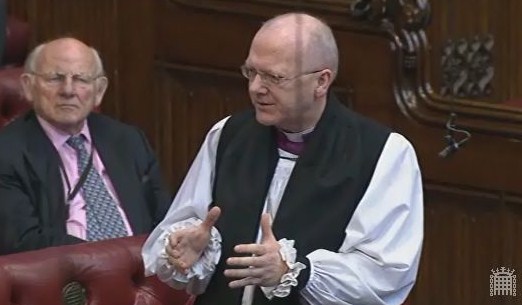
The Bishop of Peterborough makes his maiden speech in the House of Lords

The Bishop of Peterborough delivered his maiden speech to the House of Lords on 25th February 2014, during the debate tabled by Lord Low of Dalston: ‘To ask Her Majesty’s Government what is their response to Tackling the Advice Deficit, the report of the Low Commission on the future of advice and legal support on social welfare law in England and Wales’.

The Lord Bishop of Peterborough: My Lords, as I make this m14.02 Peterboroughaiden speech I am delighted to have the opportunity to thank the many Members and staff of your Lordships’ House who have made me so very welcome here. I am also most grateful to the noble Lord, Lord Low, for initiating this debate, and for producing with his colleagues this excellent, wide-ranging and challenging report.

I suppose it to be inevitable that cuts in government spending, however necessary they may be, will always hit the poorest most. It is therefore all the more important to give attention to ways of helping the most vulnerable to claim and receive the support to which they are entitled and the professional advice they may need. This report does that: I welcome it most warmly and hope that Her Majesty’s Government can do so too. Continue reading “The Bishop of Peterborough makes his maiden speech in the House of Lords”

Bishop of Worcester commends the living wage as tool to tackle inequality

Lord Giddens asks Her Majesty’s Government what policies they have to address economic inequalities in British society.

The Bishop of Worcester asked a supplementary question:

The Lord Bishop of Worcester: My Lords, is the Minister aware of the first report published today by the Living Wage Commission, chaired by my friend the most reverend Primate the Archbishop of York, which found that emerging economic recovery will have no effect on more than 5 million workers unless employers pay a living wage. It found furthermore that 6.7 million of the 13 million people in poverty in the UK are in a family where someone works—which, for the first time, is more than half the total. Will the Minister tell the House what steps the Government are taking to address this real concern?

Lord Newby: My Lords, the Government are encouraging employers to pay the living wage where they can. One of the key things about people in work on very low incomes is that a large proportion of them are working a small number of hours or a smaller number of hours than they would like. Economic growth will mean that more of those people are able to work longer hours, which will help deal with their household circumstances.

(via parliament.uk)

Bishop of Wakefield urges Government to support pupils in areas of rural deprivation

Lord Horam asked Her Majesty’s Government what plans they have to increase the Pupil Premium for the most disadvantaged primary school children.

The Bishop of Wakefield asked a supplementary question:

The Lord Bishop of Wakefield: My Lords, can the Minister tell us whether the Government are considering ways in which an increase in the pupil premium can be targeted at the forms of deprivation most difficult to address? Rural deprivation, for example, particularly in church schools, is very significant in our part of West Yorkshire, in the Diocese of Wakefield.

Lord Nash: The right reverend Prelate is quite right to point out the problems with rural deprivation; it is similar to coastal deprivation. There are particular schemes that schools follow: mentoring; systemic feedback; much more involvement of parents; early intervention, particularly using the better teachers; and peer tutoring. Much can be learnt from groups like Ark, whose academy in Portsmouth, for instance, which is in a classic coastal town, has improved results in four years from 24% to 68%.

(via parliament.uk)

Bishop of Chester responds to Government Statement on energy bills

On 2nd December 2013, the Bishop of Chester asked a question in the House of Lords on energy bills, following a Governmnet Statement on the subject.

14.03 Bishop of ChesterThe Lord Bishop of Chester: My Lords, there is much in the Statement that I welcome, particularly a point that has not been commented on directly. The move in support for the social aspects of the programme from energy bills to general taxation will have some impact on the poorest and on fuel poverty and is entirely to be welcomed. The renewables obligation payments are still going to be collected through energy bills. When will the expected increases in those precepts on bills eat up the £50 which has been announced today?

Continue reading “Bishop of Chester responds to Government Statement on energy bills”

Bishop of Birmingham questions Government over Child Poverty figures

Birmingham 171115On the 14th May 2013 Lord Dubs asked the Government a question about child poverty, the Bishop of Birmingham, the Rt Revd David Urquhart asked a supplementary question regarding the ways in which the Government could close the gap.

Continue reading “Bishop of Birmingham questions Government over Child Poverty figures”