
Bishop of Durham raises global human rights, poverty, development and climate change in Queen’s Speech debate

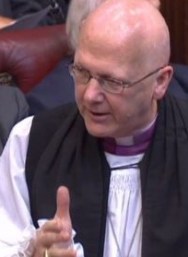
On the 7th January the Bishop of Durham, the Rt Revd Paul Butler, spoke during the second day of debate on the Queen’s Speech, on the topics of child poverty, climate change sustainable development and immigration:

The Lord Bishop of Durham: My Lords, initially I want to note how little reference there is in the gracious Speech to the needs of children, except in the realm of education. There is nothing about children’s first 1,000 days, nor any firm commitment to tackle the iniquity of child poverty. How we treat children speaks volumes for where our priorities lie. Could the Minister please comment on this omission?
Continue reading “Bishop of Durham raises global human rights, poverty, development and climate change in Queen’s Speech debate”

Bishop of St Albans raises religious persecution in Queen’s Speech debate

St Albans 2On 7th January 2020 the Bishop of St Albans, Rt Revd Alan Smith, spoke during the second day of debate on the Queen’s Speech, on the topic of the integrated security, defence and foreign policy review:
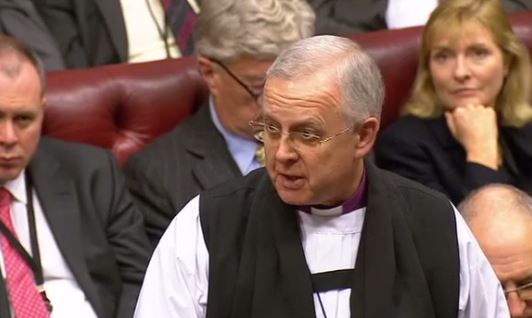
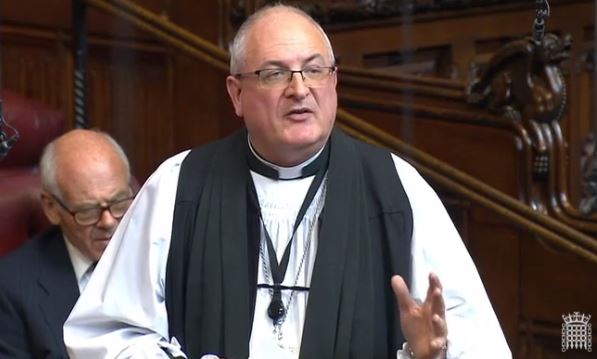
The Lord Bishop of St Albans: My Lords, I want to make a few comments on the integrated security, defence and foreign policy review, which is a welcome development in the Government’s plans for the next five years.

I note that the Government will consider the,

“freedom of speech, human rights and the rule of law”

of foreign nations and how this interacts with our own interests. I hope that the Minister will agree with these Benches that any such review should also include religious persecution, drawing on the work and recent report of the Foreign Office, assisted by the Bishop of Truro, on the persecution of Christians.

Continue reading “Bishop of St Albans raises religious persecution in Queen’s Speech debate”

Bishop of Oxford responds to Queen’s Speech debate, warns of”environmental catastrophe”

On 7th January 2020 the Bishop of Oxford, Rt Revd Steven Croft, spoke during the second day of debate on the Queen’s Speech, on the topic of the environment and climate change:

The Lord Bishop of Oxford: My Lords, I rise to speak about the climate emergency and declare an interest as a member of the advisory board of the Environmental Change Institute in the University of Oxford. It is a privilege to share in this debate and particularly to welcome the maiden speech of the noble Baroness, Lady Ritchie of Downpatrick. Her commitment to her local community and depth of wisdom are very clear.

The Minister said in his opening address that climate change will test us all, and it will.

David Wallace-Wells’s book, The Uninhabitable Earth, should be required reading for every Member of this House as we move forward. Wallace-Wells begins his graphic description of the future of the earth with the unforgettable words:

“It is much, much worse than you think.”

Continue reading “Bishop of Oxford responds to Queen’s Speech debate, warns of”environmental catastrophe””

Bishop of Leeds responds to Queen’s Speech on inter-connectedness in foreign policy

On 7th January 2020 the Bishop of Leeds, Rt Revd Nick Baines, opened the second day of debate on the Queen’s Speech, on the subjects of culture, language and foreign affairs:

The Lord Bishop of Leeds: My Lords, following the last debate on Iran, I think it is wise to take a step back from the detail, to which we shall shortly return, to consider culture and principle.

Twenty-twenty vision is something that, if claimed, proves only that the claimant is deluded. However, leaving fantasists to one side for a moment, we might take some wisdom from the late former Chancellor of the Federal Republic of Germany, Helmut Schmidt. At the age of 91, he wrote a book called Ausser Dienst, or “out of office”, in which he advises young Germans considering a career in politics not to do so unless they speak at least two foreign languages to a competent degree. His reason? You can only understand your own culture if you look at it through the eyes of another culture, and to do that you need language; some things cannot be translated.

Continue reading “Bishop of Leeds responds to Queen’s Speech on inter-connectedness in foreign policy”

Bishop of Peterborough calls for more effective delivery of mental health services

On 29th June 2017 the Bishop of Peterborough, Rt Revd Donald Allister, spoke during the final day’s debate on the Queen’s Speech, highlighting the need for a more effective approach to delivery of mental health services:

The Lord Bishop of Peterborough: My Lords, it is perplexing, given Mrs May’s commitment to mental health, that there is no mental health Bill in the Queen’s Speech, not least given the very strong commitments that were made about the need for legislation and the fact that this would happen. What there is in the Queen’s Speech about mental health is good, though it is vague. I hope that it is translated into more money for mental health, but it also needs to be translated into better delivery and accountability. That is what is lacking and what I want to think about for a moment. Continue reading “Bishop of Peterborough calls for more effective delivery of mental health services”

Bishop of Ely on importance of life skills and character education

On 29th June 2017 the House of Lords held the final day of debate on the Queen’s Speech. The Bishop of Ely, Rt Revd Stephen Conway, spoke in the debate about countering extremism and the importance of character education.

The Lord Bishop of Ely: My Lords, like many in this House, I am sure, the events of the past few weeks have been very much on my heart and in my prayers, and in the aftermath of the terror attacks in London and Manchester, it is unsurprising that the Government have placed such an emphasis on counterterrorism and counterextremism measures in the gracious Speech. The Government are right to look at reviewing specific measures to tackle extremism and the places where extremist ideology is able to spread, but stopping extremist ideology where it already exists cannot be all that we do. Although we in this House may divide debates into topics and the Government into departments, as we know, in reality society is not just a series of policy areas, it is a rich fabric of connected life experiences of which education is formative for all. Its value in developing and defining the kind of society we want to become should never be underestimated. Continue reading “Bishop of Ely on importance of life skills and character education”

Vote: Queen’s Speech Motion on Brexit and single market

On 28th June 2017 the House of Lords voted on a motion to add an amendment to the Queen’s Speech, following a debate on exiting the European Union. The Archbishop of York took part.

Continue reading “Vote: Queen’s Speech Motion on Brexit and single market”

Queen’s Speech 2017: Archbishop of York calls for a Brexit that serves the common good

Archbishop of YorkOn 28th June, the Archbishop of York, the Most Revd and Rt Hon John Sentamu contributed to the ongoing debate on the Queen’s Speech. The Archbishop’s speech addressed Brexit and he called for cross-party work to secure a Brexit that serves the common good.
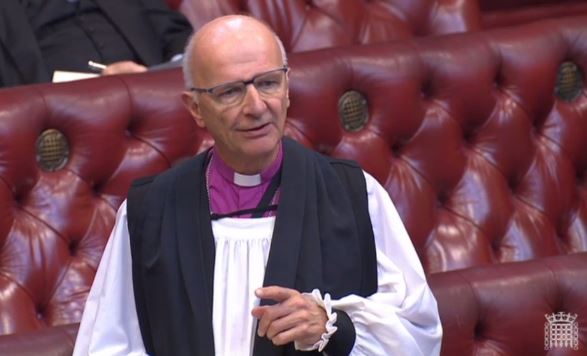
The Archbishop of York My Lords, I have followed with interest the debates on the Queen’s Speech over the past week. I have been encouraged to hear assurances from the Leader of your Lordships’ House and various Ministers of the Government who seek to govern with humility and to forge cross-party agreement where they can. That is as it should be, regardless of the numerical strength or weakness of the Government.

Many issues raised in the Queen’s Speech and the Government’s agenda give us the best opportunity to have that wider consensus. No area is more important than that when it comes to negotiating Britain’s departure from the European Union and to forging a new relationship—a deep and special partnership—with the EU. Indeed, the reality is that there is no way in which a minority Government can hope to get all their legislation relating to Britain leaving the EU through Parliament without the help of others. The Government need to make a virtue out of that necessity.

Continue reading “Queen’s Speech 2017: Archbishop of York calls for a Brexit that serves the common good”

Queen’s Speech 2017: Bishop of Bristol welcomes inclusion of measures on domestic violence

On 27th June 2017 the House of Lords debated the measures in the Queen’s Speech for justice and home affairs. The Bishop of Bristol, Rt Revd Mike Hill, spoke in the debate, on mental health, domestic violence and prisons.

The Lord Bishop of Bristol: My Lords, I welcome the opportunity to contribute to this important debate on the gracious Speech. I thank the noble Lords who have spoken thus far in what has been an interesting debate today.

I would like to draw attention to two or three things. The first is the fairly well hidden-away commitment in the gracious Speech to reform mental health legislation in order that mental health services might be prioritised in the NHS. Like much in the speech, the detail is particularly lacking at this point but I hope that noble Lords will join me in saying that that is an important and welcome development. Continue reading “Queen’s Speech 2017: Bishop of Bristol welcomes inclusion of measures on domestic violence”

Queen’s Speech 2017: Bishop of Southwark praises community response to tragedies, calls for better funding of prison and emergency services

southwark-20feb17On 27th June 2017, the Bishop of Southwark, Rt Rev. Christopher Chessun, contributed to the ongoing debate on the Queen’s Speech. The Bishop’s speech addressed the strong response from volunteers and emergency services to recent events, and called for a re-examination of current resources. Government Minister Lord Bourne of Aberystwyth responded to the Bishop of Southwark’s speech at the end of the debate.

The Lord Bishop of Southwark: My Lords, I too wish to contribute to your Lordships’ debate on the humble Address. Last Thursday, the most reverend Primate the Archbishop of Canterbury observed in this House that the gracious Speech spoke of taking British values around the world, but for that to happen we need to know what we mean by British values. That applies equally to the measures under discussion today. Traditionally, these values have expressed themselves in a respect for the rule of law, local and national institutions, our liberties and freedoms, and parliamentary democracy. They were born of a society in which people participate, not a consumer society. From them spring mutual obligations, not merely contractual ones. Mutuality issues from civic virtue of the sort we have seen on our streets in response to calamity and terror in recent months in London and Manchester.

Continue reading “Queen’s Speech 2017: Bishop of Southwark praises community response to tragedies, calls for better funding of prison and emergency services”