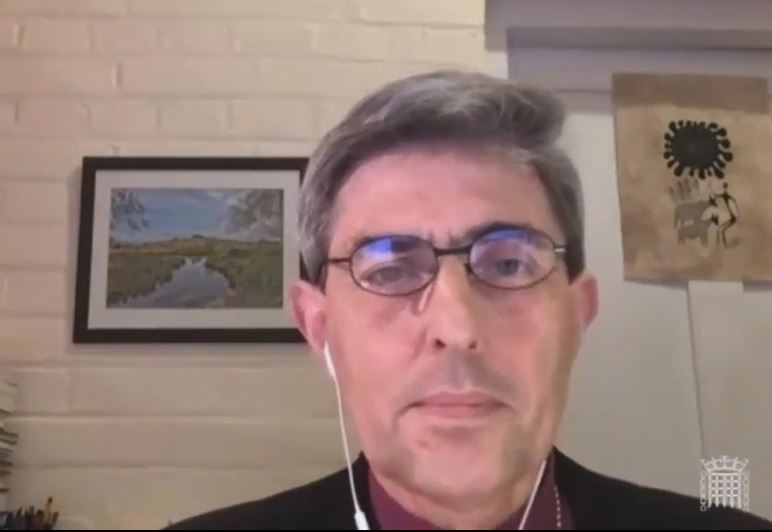
Domestic Abuse Bill: Bishop of Gloucester speaks in favour of amendments on use of data and communications between official bodies

The Bishop of Gloucester spoke during a committee debate on the Domestic Abuse Bill on 27th January 2021, supporting amendments on the use of data regarding domestic abuse by public authorities and communication between official bodies when handling that data:

The Lord Bishop of Gloucester: My Lords, I am hugely encouraged by listening to all these debates around this Bill, because I know that every single one of us wants this Bill to be as good as it possibly can be. I will keep my comments brief.

In relation to Amendment 54, the issue of data is critical. We have to take time to remember that behind statistics are precious individuals—women and men. I support a duty on public authorities to notify the Home Office and the domestic abuse commissioner in cases of death where domestic abuse has been identified as a contributory factor.

Continue reading “Domestic Abuse Bill: Bishop of Gloucester speaks in favour of amendments on use of data and communications between official bodies”

Domestic Abuse Bill: Bishop of Manchester supports amendments on universal credit rules for victims of domestic violence

The Bishop of Manchester spoke during a debate on the Domestic Abuse Bill on 27th January 2021, supporting an amendment which would aim to disapply the benefit cap for those fleeing domestic abuse:

The Lord Bishop of Manchester [V]: My Lords, I am very grateful to the noble Baroness, Lady Lister, for proposing Amendment 152, which it is my privilege to co-sponsor, and, indeed, for her excellent speech in opening the debate on this group of amendments. I also look forward to the speech from the noble Lord, Lord Best, who knows more about housing matters than anyone it has ever been my pleasure to work with.

This amendment concerns the application of universal credit, so perhaps I need to say at the outset that the notion of a unified benefits system is one that I and, I suspect, my right reverend and most reverend friends on these Benches will heartily endorse. The mix and mess of the separate systems that it replaced was well overdue for retirement. There are, of course, proper questions about the level of such benefits and what caps, if any, should generally apply if we are to maintain a proper incentive to find work. However, as the noble Baroness, Lady Lister, indicated, those are for another day.

The amendment is simply about how far rules designed for the general context can safely be applied to the very specific circumstances of victims of domestic abuse and their dependants without those rules themselves becoming abusive. As a priest and, for two decades, a bishop in the established Church and as chair of numerous housing associations and housing charities over many years, I have seen all too often the enormous obstacles that lie ahead for anyone, especially a woman with children, fleeing domestic abuse. Too many too often give up and return to a place of damage and danger. Too many who escape face long periods in temporary and unsuitable accommodation, often beyond the point when they need the particular support services offered there. Sadly, too many die at the hands of their abuser.

Continue reading “Domestic Abuse Bill: Bishop of Manchester supports amendments on universal credit rules for victims of domestic violence”

Church Commissioners Written Questions: Church Owned Land

On 27th January 2021, the Second Church Estates Commissioner, Andrew Selous MP, gave the following written answer to a question from an MP:

Church Commissioners: Land

Kerry McCarthy MP (Lab, Bristol East): To ask the Member for South West Bedfordshire, representing the Church Commissioners, what assessment he has made of the area of Church Commissioner-owned land tenancies, under the Agricultural Holdings Act 1986, that will come up for renewal in the next (a) five years and (b) 10 years.

Continue reading “Church Commissioners Written Questions: Church Owned Land”

Archbishop of Canterbury asks about increasing capacity and resilience of the Port of Dover

The Archbishop of Canterbury received the following written answer on 27th January 2021:

The Lord Archbishop of Canterbury asked Her Majesty’s Government what plans they have to increase the (1) capacity, and (2) resilience, of the Port of Dover.

Continue reading “Archbishop of Canterbury asks about increasing capacity and resilience of the Port of Dover”

Bishop of Gloucester asks about tackling crown court backlog

The Bishop of Gloucester asked a question on the importance of crime diversion and community police provision on 26th January 2021, during a discussion on the crown court backlog for serious criminal cases:

The Lord Bishop of Gloucester: I draw attention to my interest on the register as the Anglican bishop for Her Majesty’s prisons. The backlog of cases has a serious impact on offenders, victims and witnesses. On top of this, projections from the Ministry of Justice show that the prison population is expected to jump to almost 100,000 in 2026, which adversely affects prison staff as well as prisoners. Does the Minister agree that resources could be better spent on police-led diversion work and community-based provision, which could start now?

Continue reading “Bishop of Gloucester asks about tackling crown court backlog”

Archbishop of Canterbury asks about criteria for defining affordable housing

On 26th January 2021, the Archbishop of Canterbury asked a question on the criteria used by the government to define affordable housing, in advance of a Church of England report on housing and communities:

The Lord Archbishop of Canterbury: My Lords, I declare non-financial interests in various Church lands through numerous charities of which I am a member. The Church will be publishing a housing, church and communities report in February. Can the Minister tell us what criteria Her Majesty’s Government use to define affordable housing? Is it genuinely affordable in the sense that most people would use the word?

Continue reading “Archbishop of Canterbury asks about criteria for defining affordable housing”

Domestic Abuse Bill: Bishop of Gloucester supports amendment on impact of domestic abuse on children

The Bishop of Gloucester spoke during a debate on the Domestic Abuse Bill on 25th January 2021, supporting an amendment tabled by Baroness Stroud stipulating that the Bill should consider the impact of domestic violence on pregnant women and their unborn children:

The Lord Bishop of Gloucester: Following the informative speech of the noble Baroness, Lady Stroud, on these amendments I will be very brief. I simply would like an assurance from the Minister that all age groups will be included in this legislation, and that it will provide support and provision not only for pregnant women and the unborn child but for children of all ages whose trauma began in utero.

Hansard

Bishop of St Albans raises issue of housing in debate on intergenerational unfairness

The Bishop of St Albans took part in a debate on a report from the Select Committee on Intergenerational Unfairness on 25th January 2021, focusing on access to and provision of housing:

The Lord Bishop of St Albans [V]: My Lords, the decrease in the rates of home ownership for the younger generation is a major issue and not one of their own making. As this excellent report demonstrates, it is an important factor in addressing issues of intergenerational fairness. For many years, there has been a failure to supply housing adequately—an issue exacerbated by a cycle of stagnation fuelled by low market absorption rates and stalled developments.

The Letwin report suggests that one of the most important reasons for this is that developers will build new homes only at a rate that the market can absorb and that, by diversifying housing products, rates of absorption will increase. However, when I put down Written Questions to Her Majesty’s Government on this topic, never once has it been acknowledged that it might be in the interest of developers to land bank, as increased supply is likely to reduce house prices. While I believe that this has contributed to the lack of supply, I agree that low absorption remains a real issue. However, I do not think that diversification alone will solve it.

Continue reading “Bishop of St Albans raises issue of housing in debate on intergenerational unfairness”

Bishop of Oxford takes part in debate on report on tackling intergenerational unfairness

The Bishop of Oxford spoke in a debate on a report from the Select Committee on Tackling Intergenerational Unfairness on 25th January 2021, raising the issues of education, the gig economy, and all-age communities:

The Lord Bishop of Oxford [V]: My Lords, I welcome this key report on intergenerational unfairness and this debate. It is a privilege to take part. I want to focus my contribution on three issues.

The first concerns education and training. I welcome the report’s perspective and recommendations; as others have said, they are even more relevant now. However, as we know, the landscape is shifting significantly beneath our feet because of the immediate demands of the pandemic and the likely longer-term shifts in working patterns created by the fourth industrial revolution. We are sorely in need of creative, imaginative, cross-party and cross-society intergenerational thinking on education for life, not simply for work.

Continue reading “Bishop of Oxford takes part in debate on report on tackling intergenerational unfairness”

Bishop of Gloucester asks about prioritization of vaccines in schools and prisons

The Bishop of Gloucester asked a question on the need to prioritise vaccination in prisoners and schools on 25th January 2021, following a government statement on the COVID-19 vaccine rollout:

The Lord Bishop of Gloucester: I wish to make two points and I draw attention to my interests as listed in the register. First, I am very concerned about prisons. There are reports that about 71 prisoners have died, and the number of prison staff who have tested positive continues to rise alarmingly. There is great flux within a prison, with staff coming and going, and those being released from prison and those coming into prison. Will the Government consider prioritising the vaccinating of prisoners and those who work in prisons? Secondly, I add my voice to those calling for teachers and early years staff to be prioritised. Schools are open and our dedicated teachers and early years staff must be able to continue their work safely and not be off sick, if we are to do the right thing by our children.

Continue reading “Bishop of Gloucester asks about prioritization of vaccines in schools and prisons”