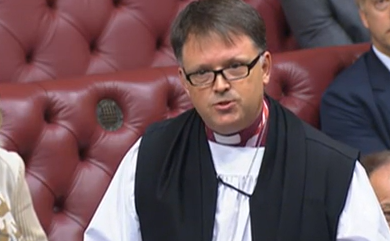
Children’s Wellbeing and Schools Bill: Bishop of Gloucester supports amendment to prohibit physical punishment of children

The Bishop of Gloucester spoke in support of an amendment to the Children’s Wellbeing and Schools Bill aimed at prohibiting the physical punishment of children on 14th January 2026:

The Lord Bishop of Gloucester: My Lords, I support Amendment 97. The abolition of the physical punishment of children is something that many of us on these Benches have long endorsed. My right reverend friends the Bishop of Manchester and the Bishop of Derby in particular wanted to reiterate that support alongside mine.

The amendment is eminently sensible, as we have just heard. I was pleased to read in the report from Wales that the introduction of the role of the out-of-court parenting support worker has significantly facilitated the implementation of this Act, as we have heard. My concern when we talk about legislation with penalties is always the unintended consequences, in this case for parents and wider families—we do not need any more children being impacted by parental imprisonment—but it is music to my ears that these parenting support workers in Wales have been instrumental in engaging with families, offering guidance on positive parenting strategies and providing early preventive support to resolve those issues, as we have heard, before they escalate to criminal proceedings. In short, I always support evidence-based policy-making, and this seems like a sensible step in the right direction on this issue. I support Amendment 97.

Hansard

Bishop of Gloucester asks abut investment in early years education

The Bishop of Gloucester tabled a question on investment in early years education on 14th January 2026:

The Lord Bishop of Gloucester: To ask His Majesty’s Government what assessment they have made of the impact of investment in early years education on children’s long-term outcomes, including attainment, employability, and wellbeing.

Continue reading “Bishop of Gloucester asks abut investment in early years education”

Bishop of Gloucester calls for return to commitments to Official Development Assistants

The Bishop of Gloucester spoke in a debate on planned reductions to Official Development Assistance on 13th February, calling on the government to publish a plan for a return to previous ODA commitments and highlighting the current situation and need for international aid in Gaza:

The Lord Bishop of Gloucester: My Lords, we on this Bench continue to lament the reduction in ODA. I call on the Government, as others have, to publish a clear road map for returning to previous commitments on international development, which affects so many people, particularly, as has already been said, women and girls.

In the short time I have, I will focus on Gaza. It is welcome that forecast humanitarian spend in Gaza is currently protected from cuts in ODA, but I am sure that noble Lords are aware that international NGOs face ongoing restrictions on aid and considerable obstacles to working in Gaza. I simply want to add my voice to those, including His Majesty’s Government, who are concerned that many established international NGO partners are at risk of being deregistered because of the Government of Israel’s restrictive new requirements. Given that the majority of the population in Gaza face high levels of acute food insecurity, will the Minister say what more can be done to encourage the Government of Israel to give international NGOs the access to the region that they need?

Hansard

Crime and Policing Bill: Bishop of Manchester speaks to amendments on policing of public gatherings

The Bishop of Manchester spoke to two groups of amendments on regulation of public gatherings during a debate on the Crime and Policing Bill on 13th January 2026, pointing out the possible unintended impact of religious processions and events:

The Lord Bishop of Manchester: My Lords, the more I listen to the debate this afternoon, the more worried I am getting. It seems to me that, over recent years, we have successively tightened up regulations around protests, including quite peaceful protests, making it harder and harder for people to express publicly their deep concerns around a whole range of issues. I am not sure that we need more clarity; that is for judges and juries to determine on the details of a particular case. The whole principle of the jury system is that we are judged by our peers and that, if we have undertaken some activity which has brought us before the courts, it is for other people like us to determine on the particular instances. They can take into account the culture and context, in a way that is impossible to do by way of legislation. I am quite wary about over- specifying here. Sometimes clarity is not necessarily the best thing to achieve.

Continue reading “Crime and Policing Bill: Bishop of Manchester speaks to amendments on policing of public gatherings”

Bishop of Southwark asks about humanitarian aid to Gaza

The Bishop of Southwark received the following written answer on 13th January 2026:

The Bishop of Southwark asked His Majesty’s Government:

  • what assessment they have made of the impact of recent registration measures by the government of Israel on the ability of international nongovernmental organisations to deliver humanitarian assistance in Gaza.
  • what assessment they have made of the humanitarian situation in Gaza; and what representations they have made to the government of Israel to lift the restrictions on international humanitarian assistance in that territory.
Continue reading “Bishop of Southwark asks about humanitarian aid to Gaza”

Votes: Diego Garcia Military Base and British Indian Ocean Territory Bill

On 12th January, the House of Lords debated the third reading of the Diego Garcia Military Base and British Indian Ocean Territory Bill. A vote was held on a regret motion associated with the bill, in which a Bishop took part:

Continue reading “Votes: Diego Garcia Military Base and British Indian Ocean Territory Bill”

Bishop of Gloucester asks about support for Iranians in the UK

The Bishop of Gloucester asked a question on support for Iranians in the UK to contact family and friends in Iran on 12th January 2026, during a discussion on recent protests and human rights abuses of protesters in the country:

The Lord Bishop of Gloucester: My Lords, following on from that question, we have a number of Iranians in our churches in the diocese of Gloucester who are desperately trying to make contact with loved ones. What update can the Minister give the House about the support being given to Iranians in this country who are endeavouring to contact family and friends in Iran?

Continue reading “Bishop of Gloucester asks about support for Iranians in the UK”

Bishop of Gloucester asks about efforts to combat use of AI as a tool of harassment

The Bishop of Gloucester asked a question on responsible use of AI and combatting its use in harassment of women and girls online on 12th January 2026:

The Lord Bishop of Gloucester: My Lords, following on from that question, I am very grateful for the action being taken by Ofcom to investigate X and the Grok AI chatbot, but what are the Government doing to create a robust framework so that AI will be used responsibly in this whole landscape of sexual harassment experienced by women and girls?

Continue reading “Bishop of Gloucester asks about efforts to combat use of AI as a tool of harassment”

Bishop of Norwich highlights work of the CofE Pensions Board during debate on historic mining pollution

The Bishop of Norwich spoke in a debate on the UK’s responsibility to address historic mining pollution in former British colonies on 8th January 2026, detailing the work of the Church of England Pensions Board in this area:

The Lord Bishop of Norwich: My Lords, I thank the noble Lord, Lord Oates, for his excellent introduction, because stories touch both the heart and the mind, harrowing as those stories of the people of Kabwe were that he shared with your Lordships.

This debate is timely because of the geopolitical tensions that we face currently, many of them connected to minerals needed to power our economies today as well as the economy of the future. Although much of the attention is focused on new mineral deposits, a key issue that is deeply relevant to the whole mining sector is how the legacy is addressed. Many companies that existed in the past no longer exist or have been subsumed into very different entities today. Some of these are still listed on the London Stock Exchange and therefore still have a relationship with their historic legacy, while others do not. The consequence is that many countries to which the UK has historic ties have legacy mine sites that can be anything from waste from a site, such as tailings waste, through to the old mine site itself.

Through the Church of England Pensions Board, which is a £3.6 billion pension fund serving the long-term interests of 44,000 members who have been members of the clergy or otherwise working for the Church, the role of mining has been a particular focus in recent years. The board recognises the systemic importance of mining to many of the other sectors upon which modern life depends and which the board is also invested in, such as aviation, shipping, construction, autos, technology and energy, to name but a few. But a particular focus of the board’s work has been on this issue of legacy, particularly related to mine waste, often contained in tailings dams, which, if not managed correctly, can cause significant social and environmental impacts. We have seen major disasters such as at Brumadinho in Brazil, killing 272 people, and at Jagersfontein in South Africa, killing two people and causing significant environmental damage.

Continue reading “Bishop of Norwich highlights work of the CofE Pensions Board during debate on historic mining pollution”

Bishop of Manchester speaks in debate on current state of broadcasting in the UK

The Bishop of Manchester spoke in a debate on recent developments in broadcasting in the UK on 8th January 2025, highlighting the value of public service broadcasting and the need to retain a strong BBC:

The Lord Bishop of Manchester: My Lords, I declare my interests as set out in the register. I am regularly commissioned to present “Thought for the Day” on the BBC, as well as weekday and Sunday services. I also occasionally work with a range of other UK and global broadcasters, from GB News to Times Radio and LBC, providing comment on religious and ethical news stories.

As the noble Lord, Lord Fowler, has reminded us, broadcasting operates in an international context of increasing polarisation against a background where the greatest global political powers are retreating rapidly into levels of imperialist control and expansionism not previously seen in most of our lifetimes. It is a context in which truth is subservient to expediency and honesty is sacrificed to personal or political advantage. Many broadcasting organisations, especially those which are politically aligned, have little interest or incentive, except where regulators require it, to do other than collude with the political masters of the age. In such a world, the place of broadcasters who seek to offer a balanced range of perspectives and prioritise facts over partisanship has never been more vital. Public service broadcasting—and in the UK that does mean particularly the BBC—with a funding mechanism not wholly dependent on courting advertisers or placating the government of the day, enables a level of impartiality, and thereby public trust, that exists both here and beyond these shores. Moreover, the BBC, uniquely among mainstream broadcasters, continues to afford a place for the religious and ethical input necessary to support our British values.

Continue reading “Bishop of Manchester speaks in debate on current state of broadcasting in the UK”