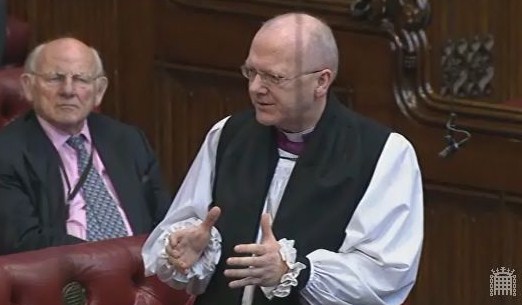
The Bishop of Wakefield speaks in debate on situation in Syria and the Middle East

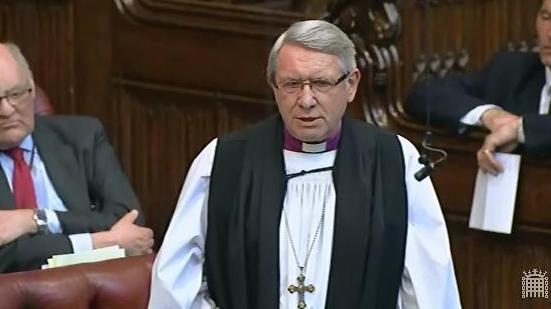
The Bishop of Wakefield spoke during the debate on Syria and the Middle East, highlighting the increasing complexity of the conflict in Syria, the difficulties facing outside countries such as the UK in responding appropriately and effectively, the huge displacement of the Syrian population, and the need to invest significant resources in the region to facilitate a peaceful solution to the conflict. He asked the Government to support efforts to bring about reconciliation between two key actors in the conflict – Iran and Saudi Arabia, and called for support of civil society within the refugee populations, particularly in Lebanon and Jordan.

The Lord Bishop of Wakefield: My Lords, I thank the Minister for her characteristically clear introduction to this debate and for setting the context so succinctly.
In December 2002, I was called to 10 Downing Street for a clandestine meeting with the Prime Minister’s appointments secretary to talk about the possibility of my going to the See of Wakefield. When I arrived, I was terrified that my cover might be blown, since television cameras surrounded us and, indeed, I followed Andrew Marr through the security gate. The cameras were, of course, not for us but for President Assad, who was paying an official visit to the then Prime Minister, Tony Blair. Indeed, there was even talk at the time of persuading the Queen to confer a knighthood on the Syrian leader. Continue reading “The Bishop of Wakefield speaks in debate on situation in Syria and the Middle East”

The Bishop of Peterborough makes his maiden speech in the House of Lords

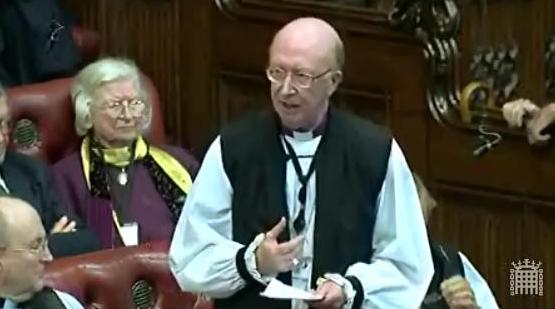
The Bishop of Peterborough delivered his maiden speech to the House of Lords on 25th February 2014, during the debate tabled by Lord Low of Dalston: ‘To ask Her Majesty’s Government what is their response to Tackling the Advice Deficit, the report of the Low Commission on the future of advice and legal support on social welfare law in England and Wales’.

The Lord Bishop of Peterborough: My Lords, as I make this m14.02 Peterboroughaiden speech I am delighted to have the opportunity to thank the many Members and staff of your Lordships’ House who have made me so very welcome here. I am also most grateful to the noble Lord, Lord Low, for initiating this debate, and for producing with his colleagues this excellent, wide-ranging and challenging report.

I suppose it to be inevitable that cuts in government spending, however necessary they may be, will always hit the poorest most. It is therefore all the more important to give attention to ways of helping the most vulnerable to claim and receive the support to which they are entitled and the professional advice they may need. This report does that: I welcome it most warmly and hope that Her Majesty’s Government can do so too. Continue reading “The Bishop of Peterborough makes his maiden speech in the House of Lords”

Bishop of Wakefield calls for close links with civil society to end violence against women

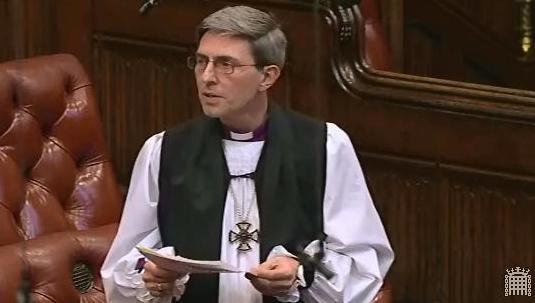
The Lord Bishop of Wakefield: My Lords, I, too, congratulate the noble Baroness, Lady Prosser, on securing this debate. I reassure noble Lords that I am not speaking simply to bring a modicum of gender balance to the Chamber.

Many years ago now, when we were living in the East Midlands, my wife was a volunteer at a women’s refuge. She was scrupulous in maintaining confidentiality about those who used the refuge. None the less, on occasion, she would return home shocked and distressed at the violence that women had experienced, even here in our own country. It was a phenomenon that did not relate to just one stratum of society. Continue reading “Bishop of Wakefield calls for close links with civil society to end violence against women”

Bishop of Wakefield responds to Government statement on the situation in Ukraine

The Lord Bishop of Wakefield: My Lords, perhaps I may focus my question on Ukraine. It seems to me that there are some senses—not exactly repetitions—in which we are seeing replayed some of the things that were not resolved in the early 1990s with the collapse of the Soviet Union. I remember that at that time I was working at Lambeth as the archbishop’s foreign secretary, as it were, and on one occasion the telephone was brought to me in the bath. There was a call from the gatekeeper telling me that Mr Gorbachev was in captivity in the Crimea and he thought that I ought to know so that I could do something about it. Some very good and quite low-key, and low-cost, initiatives were taken by Her Majesty’s Government at that time to support the development of democracy in the various republics that resulted from the collapse of the Soviet Union, including Ukraine. Can we be reassured that, once things become a little more stable, those sorts of initiatives might be looked at again? I am suggesting not carbon copies but that sort of thing.

My other point is that only the churches never recognised the division of Europe. The Conference of European Churches always worked across Europe. There are very serious divisions in the churches in the Ukraine, often reflecting some of the fragmentations that exist in the country as a whole. Again, that is another area where Her Majesty’s Government might work with others to see how one moves towards a more democratic situation.

Lord Wallace of Saltaire: My Lords, I continue to learn how close church links can be across national boundaries. I was in Armenia some months ago and was met by a very chatty archbishop, who seemed to know almost every bishop I had ever met in this country. However, we all know that the Orthodox Church in and across the former Soviet Union is a very complex and divided entity, and not all its branches are committed to anything that we would recognise as a liberal approach to organised religion. Sadly, the different branches of the church in Ukraine represent that rather well.

(via parliament.uk)

The Bishop of Worcester speaks in debate on Independent Panel on Forestry

My Lords, I am grateful to the noble Baroness, Lady Royall, for securing this debate. Like her, I am a great lover of the Forest of Dean, which until recently was part of the diocese of Worcester. When I say “recently”, I mean the 16th century, but what are a few centuries in the life of the church or, indeed, in the life of a forest? I pay tribute to her for her work, as I do, along with other noble Lords, to the recently retired Bishop of Liverpool for his significant contribution to the welfare of our forests made as chairman of the Independent Panel on Forestry. Continue reading “The Bishop of Worcester speaks in debate on Independent Panel on Forestry”

The Bishop of St Albans speaks in debate on Independent Panel on Forestry report

My Lords, I was eager to participate in this debate and I, too, thank the noble Baroness, Lady Royall, for raising this vital issue, which has touched the nerves of so many people right across the country, in every part of our nation. I want to pick up four details of the Government’s response. They are minor, not major, points but I hope that they will be helpful. The first is to build on the point made by the noble Baroness, Lady Parminter, about the unprecedented levels of flooding that we are having in the UK. Continue reading “The Bishop of St Albans speaks in debate on Independent Panel on Forestry report”

The Bishop of Worcester speaks on arts and culture in the ‘current financial climate’

My Lords, I am grateful to the noble Lord, Lord Mawson, for securing this debate and I pay tribute to the wonderful work that he has done in this area over many years, as I do to the noble Baroness, Lady Kidron, who has similarly done wonderful work. I claim no particular expertise, although I am passionate about the arts—perhaps that is something to do with the fact that it is sometimes said that many clergy are failed actors. Continue reading “The Bishop of Worcester speaks on arts and culture in the ‘current financial climate’”

Bishop of Worcester responds to Government statement on flooding

The Lord Bishop of Worcester: My Lords, I am grateful for the Minister’s Statement. As we all know, attention has rightly focused on the Somerset Levels and the terrible plight that people are enduring there, but when I left Worcester this morning the city was gridlocked as a result of the closure of the main bridge across the river and the situation remains acute. I do not want to apportion blame; I want to pay tribute to those who are working very hard and to the understanding and graciousness of the inhabitants of Worcester. However, it is true that the implications of this will be enormous, economically and from a human point of view. Can the Minister confirm that a coherent policy will be forthcoming for all the affected areas, not just those most terribly affected?

Lord De Mauley: The right reverend Prelate is absolutely right—I can confirm that. We have finite resources and must apportion them in a proper way, in accordance with priorities, and the priorities must be human life and property. While I am at the Dispatch Box, can I say that, although I have not given them credit, I know that the churches in Somerset in particular are playing a major part in helping people affected by this dreadful tragedy?

(via parliament.uk)

Bishop of Derby’s speech on inequality and social mobility

The Lord Bishop of Derby: My Lords, I, too, thank the noble Lord, Lord McFall, for his analysis, not least his observation that growth is not the answer and the unintended consequences of marketisation, as he called it. I probably want to explore what he might have meant by “the social, stupid”—there is an important clue in that.

I am engaged in this issue. In the City of Derby, where I work, I chair the inner city renewal project. That is the local authority and all kinds of voluntary and faith groups looking at how we can tackle this at grass-roots level, where there are a lot of people who are disadvantaged, with no social mobility and no equality in terms of finance, environment or opportunity. There are two ways of doing this. One is a needs-based approach—what are the needs and what resources can you put in to try to improve things?—and there is what they call an asset-based approach, which means asking what these people have in their own potential, as the noble Baroness, Lady Eaton, said—what do they have that can be grown so that they can contribute? Continue reading “Bishop of Derby’s speech on inequality and social mobility”

The Bishop of Chester responds to Government statement on Sri Harmandir Sahib

The Lord Bishop of Chester: My Lords, the noble Lord, Lord Desai, made the point that using force to resolve a situation is nearly always counterproductive and has results that you do not anticipate. Are there two additional lessons from this? First, the speed with which this report has been produced is commendable. I think of the Chilcot inquiry that we are still waiting for. This has been done in a few weeks and it seems to me to be a lesson for other situations in which a bit more speed can help the reconciliation process. Secondly, is one of the lessons that understanding religious sensitivities is something the modern world can find hard to do? One thinks of Ariel Sharon going to the Temple Mount and starting the second intifada, with all the consequences that have flowed from that. Is that a lesson that we should draw from these events?

Baroness Warsi: I thank the right reverend Prelate for his warm words in relation to the way in which this inquiry was conducted quickly. It was certainly part of the clear remit set by the Prime Minister at the outset. The right reverend Prelate makes an important point. To understand the sentiment within the British Sikh community it is important to understand the significance of Sri Harmandir Sahib; the significance of the timing of Operation Blue Star; the implications in relation to the damage that was done to Sri Harmandir Sahib; and the basis of some of the concerns that were being raised by the dissidents. It is an important point. This is the challenge that I have in a sometimes aggressively secular world; some of these sensitivities are not properly explored and understood.

(via parliament.uk)