Levelling Up Bill: Bishop of Leeds highlights the importance of transport and education

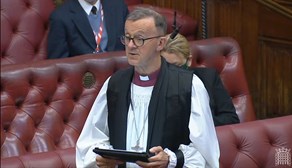
On Tuesday 17th January 2023, the House of Lords debated the Levelling Up Bill in its second reading. The Bishop of Leeds made a speech on the importance of good transport links and amending discrepancies in education:

The Lord Bishop of Leeds: My Lords, I am delighted to follow the noble and right reverend Lord, who has already stolen some of what I was going to say—great minds and all of that, maybe. When I first heard the phrase “levelling up”, I thought, “Here we go again—another slogan in search of substance”. Yet what we have heard today so far is that there is a great deal of potential substance to this Bill. I applaud the motivation and ambition behind it, and the attempt in the 12 missions to have a holistic approach rather than simply to pick off bits of our society. But I do think we need to take seriously, after the honest analysis that we had from the Minister, the argument that it gives the lie to the opening assertion of the White Paper that the UK is an unparalleled success story. If it was, we would not need the detail that we have before us. This sort of language of hubris can very easily militate against us taking seriously the scale of the task.

Continue reading “Levelling Up Bill: Bishop of Leeds highlights the importance of transport and education”

Bishop of Carlisle asks about funded childcare schemes

The Bishop of Carlisle asked a question on the benefits of funded childcare schemes on 17th January 2023, during a debate on access to childcare for working families:

The Lord Bishop of Carlisle: My Lords, following the recommendation in a recent report published by the Work and Pensions Committee on universal credit and childcare costs, can the Minister tell us what assessment His Majesty’s Government have made of childcare funding schemes in Scotland and in some Scandinavian countries? Have they investigated whether their costs are offset by other benefits to society, such as increased economic activity, additional tax receipts and personal well-being?

Continue reading “Bishop of Carlisle asks about funded childcare schemes”

Extreme Risk Management: Bishop of Leicester highlights benefits of including faith groups in planning for response to crises

On 12th January 2022, the House of Lords debated a motion to take note of a report from the Risk Assessment and Risk Planning Committee: Preparing for Extreme Risks: Building a Resilient Society (Session 2021–22, HL Paper 110). The Bishop of Leicester spoke in the debate, advocating for greater inclusion of faith groups in emergency planning:

The Lord Bishop of Leicester: My Lords, I, too, am grateful for the Select Committee’s work in tackling such an important subject and, in particular, I concur with the authors’ recognition that,

“the UK must move away from a risk management strategy which … often ignores or fails to appreciate the interconnected nature of our society”,

and that we must instead,

“produce a risk management system that ties all sectors of society together.”

Interdependence is a fundamental part of human nature and policies that follow the grain of that nature are far more likely to succeed.

I was disappointed, therefore, that although the report advocated for a whole-society approach, no reference was made to the role of faith groups in emergency planning and response. Faith groups and leaders across the country were an integral part of the response to Covid-19. A 2020 report by the All-Party Parliamentary Group on Faith and Society, based on research with local authorities, found that faith communities were instrumental in local responses by offering buildings, running food banks, information-sharing, befriending, collecting, cooking and delivering food, and providing volunteers for local authority programmes. Accordingly, the APPG found that local authorities developed a new-found appreciation for the agility, flexibility and professionalism of faith-based organisations, and that local authorities were keen to continue and build on those relationships in the future.

Continue reading “Extreme Risk Management: Bishop of Leicester highlights benefits of including faith groups in planning for response to crises”

Bishop of London urges government to work with faith groups to tackle health inequalities

On 12th January 2022, the House of Lords debated changing mortality rates in the UK in Grand Committee. The Bishop of London spoke in the debate, advocating for greater inclusion of faith groups to aid in tackling health inequalities:

The Lord Bishop of London: My Lords, I thank the noble Lord, Lord Sikka, for securing this important debate. I also look forward to hearing from the noble Lord, Lord Evans, in his maiden speech.

The paper at the heart of this debate provides a useful focus, because it highlights one of the worst health outcomes that we have seen in the past 10 years: that of widening inequalities. It is also helpful because, by focusing on the impact of austerity, we begin to see that public health is impacted by many factors besides healthcare access—factors called the social determinants of health. Those include housing, our jobs, our environment, our education and much more. They can be summed up as the opportunities that we have to lead healthy lives. The Heath Foundation noted that 50% of people in the most deprived areas report poor health by the age of 55 to 59, which is more than two decades earlier than in the least deprived areas. It is not just about life expectancy; it is also about healthy life expectancy.

The debate is poignant also because it comes at a time of great strain on the NHS and on social care, and at a time when those other determinants of health are challenging for many of us. We are also at a moment when I hope we are beginning to realise the importance of prevention of ill health, which is essential for the sustainability of our healthcare system.

Continue reading “Bishop of London urges government to work with faith groups to tackle health inequalities”

“Democracy Denied” Report: Bishop of St Albans speaks in support of recommendations

On 12th January 2022, the House of Lords debated a report from the Delegated Powers and Regulatory Reform Committee: Democracy Denied? The urgent need to rebalance power between Parliament and the Executive. The Bishop of St Albans spoke in support of the report’s recommendations on legislation and regulatory powers:

The Lord Bishop of St Albans: My Lords, as has already been noted by other speakers in this debate, delegated legislation is indeed a necessary part of the process, but I echo the concerns about the increasing use of skeleton legislation, Henry VIII powers, disguised legislation and tertiary legislation. I support these two excellent reports that look at how we might limit the use of delegated legislation and address the culture that is now taking it for granted. Both committees highlighted very valid concern about the transfer of power from Parliament, with clear democratic oversight and public scrutiny, to instead ruling by Executive edict.

The past few years have been turbulent times, although probably if anybody looked back over any decade in the life of this nation they would see that there have always been turbulent things happening. Therefore, I guess it is easy to understand why the Executive may need to respond in unusual and challenging circumstances with delegated authority. However, it is absolutely crucial that this is done sparingly and in a transparent manner. The Government’s response to the pandemic is the classic example of this. Of course, there are times when a national emergency will demand that we fast-track legislation, or grant broad delegated powers, but those should be exceptional and rare cases. The Government must always recognise the importance and value of parliamentary scrutiny. What is concerning, as is brilliantly highlighted in these reports, is that the Government’s widening use of delegated legislation is not limited to emergencies but is now being used routinely.

Continue reading ““Democracy Denied” Report: Bishop of St Albans speaks in support of recommendations”

Financial Services and Markets Bill: Bishop of St Albans speaks on cryptocurrency, access to cash, credit unions, and net zero

The House of Lords debated the Financial Services and Markets Bill in its second reading on 10th January 2022. The Bishop of St Albans spoke in the debate concerning issues of access and regulation:

The Lord Bishop of St Albans: My Lords, theologians sometimes discuss the personal and social ethics in the teaching of Christ under the three headings of money, sex and power, those three areas which can be the most extraordinary gift and blessing when used rightly and for the common good but which, when they are an end in themselves, can become extraordinarily disruptive. Of these three areas, Christ had most to say about money, as its use reveals our values as individuals and as a society, often in a very stark way. A close reading of this Bill reveals a set of cultural assumptions and values about what is considered important and valuable. There are four areas that I want to highlight and which we need to consider if a growing and vibrant financial sector will work for the common good.

First, on crypto asset regulation, as others have said, we need to act fast both to protect our citizens and so that we do not fall behind the rest of the world. The problem at the moment is that the almost complete lack of regulation means that, for many people, crypto- currencies are just another form of gambling. The recent collapse of FTX has demonstrated the volatility of this market and its vulnerability to fraud. Some have made a fortune, while others have lost their life savings and will now be looking to the state to provide for them. Just as we need a sensible and balanced approach to the regulation of online gambling, so we need sensible, balanced regulation of crypto- currencies. The provision in this Bill to ensure that crypto is treated as a regulated activity and giving the FCA and the PSR the power and, as others have noted, the resources to do their work and to protect customers, is welcome.

Continue reading “Financial Services and Markets Bill: Bishop of St Albans speaks on cryptocurrency, access to cash, credit unions, and net zero”

Financial Services and Markets Bill: Archbishop of Canterbury stresses importance of serving the common good

On 10th January 2023, the House of Lords debated the Financial Services and Markets Bill in it’s second reading. The Archbishop of Canterbury spoke in the debate, highlighting the need for good practice and quality of service in the finance industry:

The Lord Archbishop of Canterbury: My Lords, this year marks the 10th anniversary of the final report of the Parliamentary Commission on Banking Standards, Changing Banking for Good. I declare my interest having served on that commission, and I welcome the presence in this debate of the noble Baroness, Lady Kramer, who also served, as did the current Lord Speaker. I also welcome the maiden speeches of three noble Lords today: the noble Lords, Lord Ashcombe and Lord Remnant, and the noble Baroness, Lady Lawlor.

We need to remember that the extraordinary crisis in 2008—which led to the various commissions, reports and changes in regulations, including the financial services Act 2013, in which the Parliamentary Commission on Banking Standards played a part—caused huge and ongoing crises. While welcoming the Bill very strongly, I join some of the hesitations mentioned by the noble Lords, Lord Hunt, Lord Sharkey and Lord Vaux. It has been estimated that the financial services industry, and particularly the major banks, have an effective subsidy as a result of the implicit government guarantee that they receive, which is worth approximately £30 billion a year. If there is £30 billion a year going spare, many other industries and not a few churches would welcome that very warmly. However, that subsidy, which is at the risk of the taxpayer, as we saw in 2008 and 2009, is what gives the result of the banks having heavy social obligations; we must look carefully at that when the Bill reaches Committee, as has already been said. The issues of inclusion, stability and access at all levels, especially for micro-businesses, are very important, not least for levelling up.

Continue reading “Financial Services and Markets Bill: Archbishop of Canterbury stresses importance of serving the common good”

Bishop of St Albans pays tribute to House of Lords staff and those who have left the House

On 20th December 2022, the Bishop of St Albans paid tribute to the House of Lords staff, and to those who had retired and left the house this year:

The Lord Bishop of St Albans: My Lords, I will not detain the House for long but, on behalf of the Lords spiritual, we thank all those extraordinary staff who, through their dedication, have served us so well. I am thinking of the clerks, the doorkeepers, and the catering, security and domestic staff. We really could not function without them and the extraordinary level of professionalism and dedication that they bring.

I will not go through a list of people, although I highlight—because she was a huge help to me— Philippa Tudor and her extraordinary competence and professionalism. We on these Benches also extend our best wishes to the family and friends of Lee Barnes. We offer all those who have been mentioned today our best wishes as they move either into retirement or on to new challenges, and we wish them a very happy Christmas.

Hansard

Bishop of St Albans stresses importance of Overseas Development Aid

The Bishop of St Albans spoke in a debate on Overseas Development Aid (ODA) on 15th December 2022, with particular reference to famine in the Horn of Africa, urging the government against cutting back on aid:

The Lord Bishop of St Albans: My Lords, I too thank the noble Lord, Lord Bruce of Bennachie, for his excellent introduction, which was informed and passionate. I would also like to highlight and underline my deep regret at His Majesty’s Government’s cuts to official development assistance spending.

I find myself in touch weekly with some of the poverty here in our own country as I visit food banks, debt advice centres, or the clubs that some of our churches now run to give breakfast to schoolchildren. I am acutely aware that we have real need here in our own country, but it is of a completely different order compared with what many other countries in the world face. I agree with the noble Lord, Lord Hannan, that we need to spend our aid carefully. It is actually quite difficult to spend large amounts of money. We sometimes find it difficult in this country and sometimes people do not spend it well. Of course we need to work at that, but the answer is not to cut our aid but to make sure that we are using it in the most effective way.

Continue reading “Bishop of St Albans stresses importance of Overseas Development Aid”

Public Order Bill: Bishop of Chelmsford speaks in favour of amendments on Serious Disruption Prevention Orders and police powers

On 13th December 2022, the House of Lords debated amendments to the Public Order Bill in the third day of Committee. The Bishop of Chelmsford spoke in support of two sets of amendments to the bill:

  • firstly to amendments tabled by Lord Paddick, with the support of the Bishop of St Albans, which would raise the burden of proof required to impose a serious disruption prevention order on protesters.
  • secondly to amendments tabled by Baroness Chakrabarti and the Bishop of Manchester, which would place a moratorium on extending existing police powers without a parliamentary debate on current recruitment, vetting, and discipline of police officers.
Continue reading “Public Order Bill: Bishop of Chelmsford speaks in favour of amendments on Serious Disruption Prevention Orders and police powers”