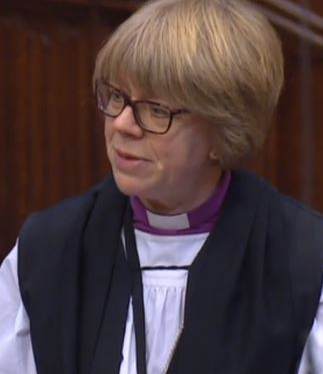
Bishop of Derby asks about development of guidance on child safeguarding

The Bishop of Derby received the following written answer on 27th January 2026:

The Lord Bishop of Derby asked His Majesty’s Government, further to the Written Answer by Lord Hanson of Flint on 23 December 2025 (HL12716), what is the timeline and development plan for non-statutory guidance to be issued to all relevant frontline practitioners safeguarding children from criminal exploitation to ensure a range of stakeholders can contribute; and what steps they will take to mitigate limitations to non-statutory guidance, including inconsistencies across documents and delays in updating guidance that is not statutory.

Continue reading “Bishop of Derby asks about development of guidance on child safeguarding”

Bishop of Gloucester asks about prisoner demographics and data

The Bishop of Gloucester received the following written answers on 26th January 2026:

The Lord Bishop of Gloucester asked His Majesty’s Government how many people of each ethnic group were in prison as of 30 September 2025 by religion.

Continue reading “Bishop of Gloucester asks about prisoner demographics and data”

Bishop of Manchester asks about age of criminal responsibility in Sweden

On 21st January 2026, the Bishop of Manchester asked a clarifying question on changes to the age of criminal responsibility in Sweden during a discussion on the age of criminal responsibility in England and Wales

The Lord Bishop of Manchester: My Lords, the Minister referred a few moments ago to Sweden lowering its age below 15. I have done a quick google check, and as far as I can understand, it has lowered it to 14, which is rather different from 10. Can she confirm that that is correct?

Baroness Levitt (Lab, MoJ): I thank the right reverend Prelate. I think it is from 15 to 13.

Hansard

Bishop of Gloucester asks about prisons and prisoners

The Bishop of Gloucester received the following written answers on 19th January 2026:

The Lord Bishop of Gloucester asked His Majesty’s Government how many and what proportion of (1) men, and (2) women, arriving in custody have self-declared as part of the basic custody screening interview that they have been in the care of local authority children’s services, in each year since 2016.

Continue reading “Bishop of Gloucester asks about prisons and prisoners”

Votes: Sentencing Bill

On 6th January 2026, the House of Lords debated the Sentencing Bill. Votes were held on amendments to the Bill, in which Bishops took part:

Division 2:

The Bishop of Chester and the Bishop of Gloucester took part in a vote on an amendment tabled by Lord Keen of Elie:

Lord Keen of Elie moved amendment 25, in clause 1, page 3, line 10, at end to insert—
“(i) the offender has been convicted of a sexual offence, within the meaning of section 3 of the Sexual Offences Act 2003, or
(j) the offender has been convicted of an offence which constitutes domestic abuse within the meaning of section 1 of the Domestic Abuse Act 2021.”

The amendment was disagreed. Content: 180 / Not Content: 219

The Bishop of Chester and the Bishop of Gloucester voted Not Content.

Hansard

Continue reading “Votes: Sentencing Bill”

Sentencing Bill: Bishop of Gloucester tables amendment defining the purpose of imprisonment

During a debate on the Sentencing Bill on 6th January 2025, the Bishop of Gloucester tabled her amendment to the bill, inserting a new clause which “would define the purposes of imprisonment in law and require the courts and the Secretary of State to have regard to the purposes of imprisonment:

The Lord Bishop of Gloucester: After Clause 4, insert the following new Clause—

“Purposes of imprisonment(1) Where a court is imposing sentence the court must have regard to the purposes of imprisonment.(2) The Secretary of State must have regard to the purposes of imprisonment when exercising the Secretary of State’s duties under this Act. 

(3) For the purposes of subsections (1) and (2) the purposes of imprisonment are—(a) the incapacitation of prisoners in order to restrict their ability to re-offend in the community,(b) the rehabilitation of prisoners under safe and decent conditions to reduce re-offending,(c) the deterrence of prisoners and others from committing further offences, and(d) the just punishment of prisoners, including provision to achieve justice for the victims of crime.”Member’s explanatory statement

This new clause would define the purposes of imprisonment in law and require the courts and the Secretary of State to have regard to the purposes of imprisonment.

My Lords, I am bringing back this amendment on Report as I do not think it was adequately addressed in Committee. Amendment 52, in my name and that of the noble Lord, Lord Moylan, would define in law the purposes of imprisonment and require the courts and the Secretary of State to have regard to the purposes of imprisonment.

Continue reading “Sentencing Bill: Bishop of Gloucester tables amendment defining the purpose of imprisonment”

Sentencing Bill: Bishop of Gloucester supports amendments on greater independence

The Bishop of Gloucester spoke at a committee debate on the Sentencing Bill, advocating for greater independence in sentencing:

The Lord Bishop of Norwich: My Lords, I will make a few brief comments; I am aware of time, and there is a lot to get through. I wholeheartedly agree with the remarks made by the noble Lord, Lord Marks, and I thank him for his kind comments.

When it comes to sentencing, I have believed for many years that we need more independence and not less. My own submission to David Gauke’s sentencing review focused on this, and, as has been said, followed the Justice Committee’s recommendations—I ought to underline that—in its own inquiry on public opinion and the understanding of sentencing.

Continue reading “Sentencing Bill: Bishop of Gloucester supports amendments on greater independence”

Sentencing Bill: Bishop of Leeds tables amendment on purpose of imprisonment

On 26th November 2025, the Bishop of Leeds spoke to the Bishop of Gloucester’s amendment to the Sentencing Bill, which would seek to give a statutory definition to the purpose of imprisonment:

The Lord Bishop of Leeds: My Lords, I shall speak to Amendment 45A in the place of the right reverend Prelate the Bishop of Gloucester, who, regrettably, is not able to be here today. It seems that in wider society there is a greater push for harsher punishment and longer sentences, and there is a tension with what the purpose of such punishment is. This amendment is designed to provide some elucidation on that. It would define in law the purposes of imprisonment and require the courts and the Secretary of State to have regard to the purposes of imprisonment.

Continue reading “Sentencing Bill: Bishop of Leeds tables amendment on purpose of imprisonment”

Sentencing Bill: Bishop of Gloucester questions lack of long-term planning in bill

On 12th November 2025, the Bishop of Gloucester spoke at the second reading of the Sentencing Bill, expressing concern at the lack of comprehensive long term planning in the legislation:

The Lord Bishop of Gloucester: My Lords, I declare an interest as Anglican bishop to His Majesty’s prisons in England and Wales. I, too, pay tribute to the late Baroness Newlove, not least in her role as Victims’ Commissioner. I want to echo so much of what the noble Lord, Lord Beith, and the noble and learned Lord, Lord Burnett, have just said, which has lifted my spirits.

There is much to welcome in this Bill. For example, as has been said, we know in general that short custodial sentences do more harm than good, so I am delighted that we are now seeing some evidence-based policy-making rather than policy shaped by media headlines. We also need to clarify our long-term vision and aims. As a Christian, I believe that every human being is made in the image of God and is created to live in interdependent relationship, and broken relationship sits at the heart of all brokenness. Strong relationship sits at the heart of all that is good and transformative. I thank the Minister for his introduction, but I am dismayed that we are setting the context of this Bill as overcrowded prisons and a current crisis. Surely our long-term vision and big picture is not simply about more prisons or even decent prisons, but ultimately about strengthening communities so that people flourish in a network of healthy and safe relationships.

Continue reading “Sentencing Bill: Bishop of Gloucester questions lack of long-term planning in bill”

Bishop of Leeds asks about government response to Leveson recommendations

The Bishop of Leeds asked a question on the government response to the Leveson recommendations on delays between charges and trials in the courts on 10th November 2025:

The Lord Bishop of Leeds: My Lords, the Minister has said a couple of times that the response to the Leveson recommendations will be delivered in due course. Can she possibly tell us what “in due course” looks like, because it has been quite a long time already?

Continue reading “Bishop of Leeds asks about government response to Leveson recommendations”