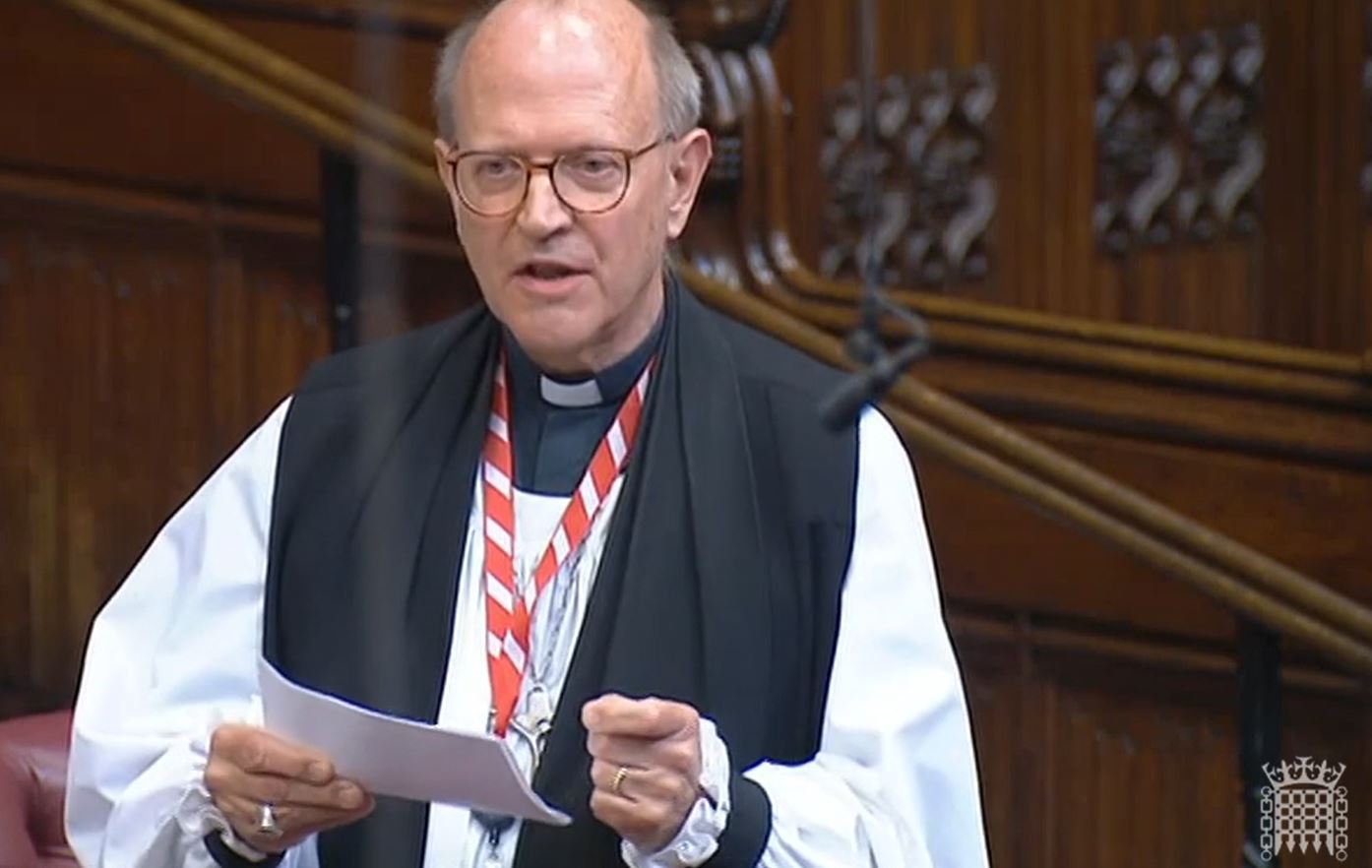
Bishop of Winchester asks about protection of vulnerable communities in the Democratic Republic of the Congo and in Iraq

The Bishop of Winchester received the following written answers on 7th October 2024:

The Lord Bishop of Winchester asked His Majesty’s Government whether they intend to work within international forums to establish a commission of inquiry to investigate and hold accountable those responsible for human rights violations against the Banyamulenge in the Democratic Republic of the Congo.

Continue reading “Bishop of Winchester asks about protection of vulnerable communities in the Democratic Republic of the Congo and in Iraq”

Bishop of St Albans asks about issues facing African countries, and refugees in Myanmar

The Bishop of St Albans received the following written answers on 7th October 2024:

The Lord Bishop of St Albans asked His Majesty’s Government what assessment they have made of the risk of renewed violence in South Sudan during that country’s upcoming election.

Continue reading “Bishop of St Albans asks about issues facing African countries, and refugees in Myanmar”

Bishop of Southwark asks about discrimination against women and girls in Bangladesh

On 3rd September 2024, the Bishop of Southwark asked a question on gender based discrimination in Bangladesh, asking that UK aid take into account the voices of Dalit women and girls particularly:

The Lord Bishop of Southwark: My Lords, the Minister will be aware that, notwithstanding the change in government in Dhaka and the protections that the laws and constitution of Bangladesh afford all its citizens, Bangladeshi women still face gender-based discrimination, and Dalit women and girls are particularly vulnerable to untouchability practices and violence. Will the Minister assure the House that UK aid in this area will now be shaped by consultations with representatives of Dalit women and girls, who rarely have access to decision-making in the society in which they live?

Continue reading “Bishop of Southwark asks about discrimination against women and girls in Bangladesh”

Votes: Safety of Rwanda (Asylum and Immigration) Bill

On 16th April 2024, the House of Lords debated Commons reasons and amendments to the Safety of Rwanda (Asylum and Immigration) Bill. Votes were held on further amendments to the bill, in which Bishops took part:

Continue reading “Votes: Safety of Rwanda (Asylum and Immigration) Bill”

Victims and Prisoners Bill: Bishop of St Edmundsbury and Ipswich expresses concern over human rights protections

During a debate on the Victims and Prisoners Bill on 12th March 2024, the Bishop of St Edmundsbury and Ipswich, on behalf of the Bishop of Manchester, spoke in support of removing clauses 49-52 from the bill on the basis that they would potentially weaken human rights protections in the UK through disapplication of certain rights to prisoners:

The Lord Bishop of St Edmundsbury and Ipswich: My Lords, my right reverend friend the Bishop of Manchester regrets that he cannot be here today to speak to the amendments to which he has put his name.

The basis of our opposition to Clauses 49 to 51, to echo points made by the noble Lord, Lord German, and the noble Baroness, Lady Lister, is that human rights need to be applied universally, even when disapplication might seem expedient. We know that, when people are marginalised, it is then that human rights protections are most necessary and, as such, the disapplication of rights to prisoners, who rely on independent courts and the justice system to guarantee basic minimum standards of fairness and respect, is particularly egregious. The Law Society has warned that these clauses

“significantly weaken the system of human rights protections in the UK”.

My right reverend friend and I add our voices to these concerns.

Continue reading “Victims and Prisoners Bill: Bishop of St Edmundsbury and Ipswich expresses concern over human rights protections”

Bishop of St Albans asks about forced labour in China

The Bishop of St Albans received the following written answer on 5th March 2024:

The Lord Bishop of St Albans asked His Majesty’s Government what assessment they have made of recent Human Rights Watch research that suggests several major carmakers could be complicit in abuse of China’s Uyghur Muslims.

Lord Johnson of Lainston (Con, DfT): Modern slavery is a barbaric crime which we are determined to stamp out. In 2022, the UN Office of the High Commissioner for Human Rights published its assessment of the human rights situation in Xinjiang, which found that China had carried out “serious human rights violations” against Uyghurs and other predominantly Muslim minorities.

Continue reading “Bishop of St Albans asks about forced labour in China”

Safety of Rwanda (Asylum and Immigration) Bill: Archbishop of Canterbury supports amendments on rule of law

On 4th March 2024, the Archbishop of Canterbury spoke in a debate on the Safety of Rwanda (Asylum and Immigration) Bill, in support of a group of amendments seeking to ensure compliance with the rule of law in the application of the bill:

The Lord Archbishop of Canterbury: My Lords, at this stage of the debate on this group, we are looking at two distinct things. One is the question of whether Rwanda is safe. If, as the noble Lord just said, it is unquestionably safe, it seems to me that these amendments are not a problem because, at that point, the Secretary of State can easily say, “It’s safe”, and they will have evidence of that, for this and future Governments.

Continue reading “Safety of Rwanda (Asylum and Immigration) Bill: Archbishop of Canterbury supports amendments on rule of law”

Safety of Rwanda (Asylum and Immigration) Bill: Bishop of St Edmundsbury and Ipswich supports amendment challenging disapplication of the human rights act

On 14th February 2024, the House of Lords debated the Safety of Rwanda (Asylum and Immigration) Bill in committee. The Bishop of St Edmundsbury and Ipswich spoke in support of amendment 36 to the bill, on behalf of the Archbishop of Canterbury. The amendment would leave out clause 3 of the bill, in order to “limit the Bill’s disapplication of the Human Rights Act to immunising the Secretary of State from challenge of his decision to lay positive UNHCR advice.” The Bishop also pointed out the risks associated with disapplying the universal principle of human rights to asylum seekers:

The Lord Bishop of St Edmundsbury and Ipswich: My Lords, it is a pleasure to follow the noble Lord from Suffolk. The most reverend Primate the Archbishop of Canterbury regrets that he cannot be in his place to speak to Amendment 36, tabled in the name of the noble Baroness who has just briefly left, and to which he has added his name. I will speak briefly and again repeat the moral point.

The amendment leaves out Clause 3, where the Bill disapplies large chunks of the Human Rights Act and replaces it instead with one very limited disapplication of the Act to allow the Secretary of State to lay positive UNHCR advice before Parliament. This seems a necessary corrective to the wider issues in the Bill and supports the other amendments tabled by the noble Baroness, Lady Chakrabarti, to Clause 1 of the Bill, to give the UNHCR a role in providing positive advice on the safety of Rwanda before any asylum seekers can be sent there.

Continue reading “Safety of Rwanda (Asylum and Immigration) Bill: Bishop of St Edmundsbury and Ipswich supports amendment challenging disapplication of the human rights act”

Safety of Rwanda (Asylum and Immigration) Bill: Bishop of Chelmsford points out importance of equality before the law

On 14th February 2024, the Bishop of Chelmsford spoke in a committee debate on the Safety of Rwanda (Asylum and Immigration) Bill, in support of amendment amendment 33 to the bill, which specified the route to be taken by Parliament if a court declares the bill incompatible with the Human Rights Act 1998:

The Lord Bishop of Chelmsford: My Lords, I support Amendment 33 from the noble Lord, Lord Kirkhope of Harrogate, to which I am a signatory. I am grateful to the noble Lord for the amendment and I welcome the opportunity to discuss the role of Parliament if a higher court were to declare this legislation to be incompatible with the convention right, or indeed a number of rights.

We should not forget that the Government have been unable to make a statement in the Bill that it is compatible with convention rights. As the Government nevertheless wish Parliament to proceed with the Bill, it seems prudent to probe what the role of Parliament would be in determining how any potential incompatibility should be addressed. In fact, the Attorney-General has said in the Government’s own legal position paper that it should be for Parliament to address any determination of incompatibility by the courts. The noble Lord, Lord Kirkhope, has eloquently set out the motivation for this amendment, and I agree that what it does is simply to expound what parliamentary sovereignty would look like in this context.

Continue reading “Safety of Rwanda (Asylum and Immigration) Bill: Bishop of Chelmsford points out importance of equality before the law”

Safety of Rwanda (Asylum & Immigration) Bill: Bishop of London points out inconsistency with international law and human rights regulations

On 29th January 2024, the Bishop of London spoke in a debate on the Safety of Rwanda (Asylum & Immigration) Bill, pointing out the inconsistency of the bill’s approach to international law, and the potential harm of disapplying parts of the human rights act to refugees and asylum seekers:

The Lord Bishop of London: My Lords, I share many concerns about the Bill that have been expressed by many other noble Lords, but I will focus on human rights. What underpins my contribution to the House is a fundamental belief that all people are made in the image of God. It is a belief that is the foundation not just of the Christian faith but of many other faiths and religions. People have an inherent immeasurable value and deserve dignity and respect. In the Bill, unfortunately, the value of people is consistently maligned. For example, the Bill decides who is and is not entitled to human rights. Has history not taught us the risk of that?

It is an odd situation that we find ourselves in when it feels necessary to state in your Lordships’ House that the Government should obey the law, yet the Minister has stated on the face of the Bill that he is unable to say that the measures within it are compatible with the European Convention on Human Rights. Clause 3 disapplies sections of our Human Rights Act and Clause 1(6) lists great swathes of international law that will be contravened to pass the Bill. As many noble Lords have said, it is illogical that the Government are disregarding international law while relying on Rwanda’s compliance with it to assure us it is safe. That is not a mark of global leadership.

Continue reading “Safety of Rwanda (Asylum & Immigration) Bill: Bishop of London points out inconsistency with international law and human rights regulations”