Divisions – Tax Credit Regulations

On 26th October 2015 the House of Lords debated a motion to approve the Government’s Tax Credits (Income Thresholds and Determination of Rates) (Amendment) Regulations 2015.

House of Lords Division Lobby

Alongside the motion to approve the House also considered four amendments to the motion, from Liberal Democrat, Crossbench and Labour Peers and one from the Bishop of Portsmouth, Rt Rev Christopher Foster. Continue reading “Divisions – Tax Credit Regulations”

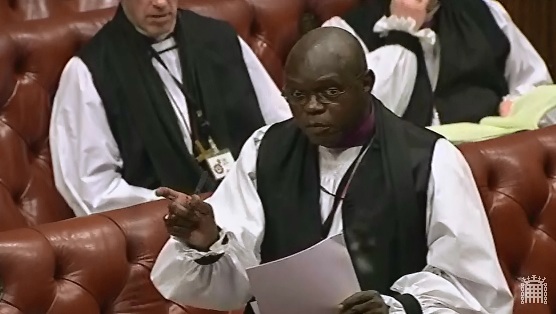
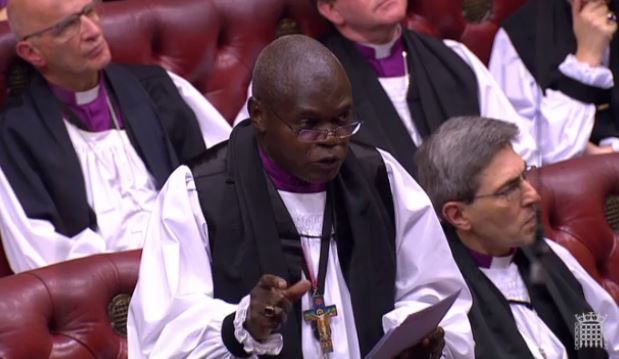
Archbishop of York speaks against Government proposals on tax credits

Employers who have already adopted a living wage policy have lifted thousands of people out of working poverty. They are not claiming tax credits because they have been lifted out. The Exchequer could gain up to £4.2 billion a year in increased tax revenues and reduced expenditure on tax credits. That is a much neater way of doing it.“- Archbishop of York, 26/10/15

ABYtaxcreditsdebateOn 26th October 2015 the House of Lords debated a motion to approve the Government’s Tax Credits (Income Thresholds and Determination of Rates) (Amendment) Regulations 2015.

Alongside the motion to approve the House also debated four amendments to the motion, from Liberal Democrat, Crossbench and Labour Peers and one from the Bishop of Portsmouth, Rt Rev Christopher Foster. Continue reading “Archbishop of York speaks against Government proposals on tax credits”

Archbishop of York speaks in debate on Pension Schemes Bill

On 5th February 2015, the Archbishop of York, the Most Revd and Rt Hon John Sentamu, spoke during the Third Reading of the Government’s Pension Schemes Bill. He spoke in favour of an amendment relating to the provision of pension guidance. Following assurances from the Minister, the amendment was withdrawn. 

Archbishop of YorkThe Archbishop of York: My Lords, if the Minister is assuring us that there will be information online and people will be able to understand everything, why cannot this amendment be put on the statute book so that there is a duty on the Treasury to inform people about this issue? For me the provision is so simply worded that I do not understand why it cannot be on the statute book. Continue reading “Archbishop of York speaks in debate on Pension Schemes Bill”

Introduction of The Bishop of Leeds

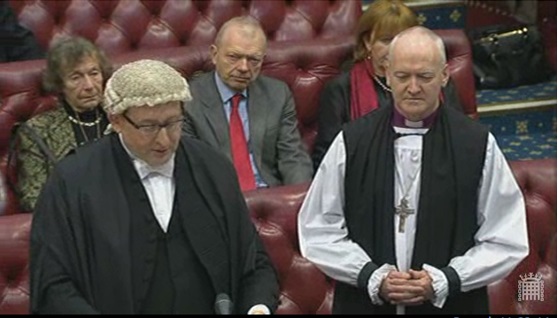
On Thursday 5th February, Nicholas Baines, Lord Bishop of Leeds, was introduced and took the oath, supported by the Archbishop of York and the Bishop of Carlisle, and signed an undertaking to abide by the Code of Conduct.

Leeds Introduction 1

The full procedure for introduction of Lords Spiritual to the House of Lords is set out in the House of Lords Companion to Standing Orders, which can be read here.

Archbishop of York speaks and votes during Report Stage of Social Action, Responsibility and Heroism Bill

On 15th December 2014, the Archbishop of York, the Most Revd and Rt Hon. John Sentamu, spoke during the Report Stage of the Government’s Social Action, Responsibility and Heroism Bill. He asked the Minister whether the legislation was the right tool for encouraging social action and volunteering in communities. He also voted in a division of the House, on Lord Lloyd’s amendment to remove Clause 2 (“Social Action”) from the Bill. The amendment was not accepted.

Archbishop of YorkThe Archbishop of York: My Lords, I am puzzled. Will the noble Lord tell us whether it is ever worthy to use a statute as a means of giving assurance? I thought that a statute was to state the law, not to assure somebody somewhere. That would be okay. It would be an amazing way of—you know what I mean. Continue reading “Archbishop of York speaks and votes during Report Stage of Social Action, Responsibility and Heroism Bill”

Archbishop of York highlights risks to financial stability of higher education system

On 15th December 2014, Lord Sharkey asked Her Majesty’s Government what is their assessment of the Higher Education Commission’s report Too Good to Fail: The Financial Sustainability of Higher Education in England. The Archbishop of York, the Most Rev. and the Rt Hon. John Sentamu, asked a supplementary question:

Archbishop of YorkThe Archbishop of York: My Lords, will the noble Baroness tell us how, in the light of this report, she hopes to mitigate the risks to financial sustainability? Those are very big risks. Can she tell us how she will mitigate them? Forget the canoes.

Baroness Williams of Trafford: My Lords, the Government have asked HEFCE to monitor this situation, particularly in the light of the cap being lifted in 2016. That is a very important point.

(via Parliament.uk)

Assisted Dying Bill – Archbishop of York speaks against

The Archbishop of York, Most Rev John Sentamu, spoke on 18th July 2014 in the Second Reading of the Assisted Dying Bill in the House of Lords.  His speech follows in full:

Archbishop of York

My Lords, let me state at the outset that the ‘official’ Church of England position was made very clear on 9th July 2005, when the General Synod voted on a motion referring to the joint submission of the C of E House of Bishops and the Roman Catholic Bishops’ Conference to your Lordships’ House Select Committee [1].  The motion argued strongly against making assisted suicide or euthanasia lawful. The vote was carried by 297 votes to 1.

This position was reaffirmed in a General Synod motion in 2012 [2].

My Lords, this present Bill is not about relieving pain or suffering. It makes that quite clear in its definition of a terminally ill patient to include those whose progressive illness can be relieved but not reversed.   This bill is about asserting a philosophy, which not only Christians, but also other thoughtful people of goodwill who have had experience in care for the dying must find incredible: that is, the ancient Stoic philosophy that ending one’s life in circumstances of distress is an assertion of human freedom.   That it cannot be.   Human freedom is won only by becoming reconciled with the need to die, and by affirming the human relations we have with other people.    Accepting the approach of death is not the attitude of passivity that we may think it to be.   Dying well is the positive achievement of a task that belongs with our humanity.   It is unlike all other tasks given to us in life, but it expresses the value we set on life as no other approach to death can do.    Continue reading “Assisted Dying Bill – Archbishop of York speaks against”

Second Church Estates Commissioner highlights role of Leicester Cathedral in commemorating King Richard III

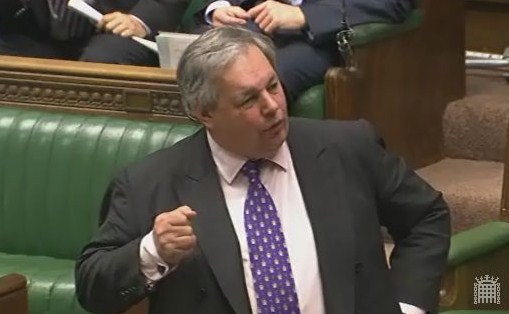
In the House of Commons on 1 July 2014, the Second Church Estates Commissioner, the Rt Hon St Tony Baldry MP, took part in oral questions to the Secretary of State for Justice. He asked a supplementary question on the commemoration of King Richard III, which was answered by the Minister of State, the Rt Hon Simon Hughes MP.


King Richard III

14.01 CCQ BaldrySir Tony Baldry (Banbury) (Con): As the Minister said, Richard III was the King of all England, not just of York or Yorkshire. Is he aware that the Dean and Chapter of Leicester Cathedral see it as their responsibility to rebury the remains of King Richard and to commemorate his memory on behalf of the whole nation, and not just for Leicester or York?

Simon Hughes: I have every confidence that the Dean and Chapter of Leicester cathedral will do that job for the nation. I understand that they intend to apply for an extension so that it may be done in the spring of next year. I believe that it will be a great credit to Leicester and will bring great joy to the people of Leicestershire that a King of England is buried in their county.

(via Parliament.uk)

Archbishop of York: ‘working poor’ “a stain on the conscience of this country”

On 25th June 2014, Labour Peer Baroness Thornton asked Her Majesty’s Government what measures they are taking to address any fall in wages of women in the United Kingdom. The Archbishop of York, the Most Revd and Rt Hon John Sentamu,asked a supplementary question:

Archbishop of YorkThe Archbishop of York: My Lords, the Living Wage Commission published its final report yesterday. It makes it clear that people in the care industry are paid very poorly—and the majority happen to be women. Will the Government take a reality check and recognise that people in the care professions are paid poorly? Will they make sure that, in terms of procurement, local authorities encourage those in the care profession to pay at least the living wage, which we wanted to be voluntary and not compulsory? If that does not happen, concern about women being paid poorly will continue. It is a stain on the conscience of this country that people work hard and are still in poverty.

Baroness Northover: I read the report of the most reverend Primate’s commission with enormous interest. I note that he has just said that he is looking for a voluntary approach rather than regulation, but he challenges responsible employers to pay a fair wage. He is right to identify the difference in pay between men and women.

(via Parliament.uk)

Introduction of the Bishop of Durham

14.03.03 Durham introIMAG1476

On 3rd March 2014 Paul Roger Butler, Lord Bishop of Durham, was introduced and took the oath, supported by the Archbishop of York and the Bishop of Chester, and signed an undertaking to abide by the Code of Conduct.

Photos: Taking the Oath in the Chamber, holding the New Testament; Bishops’ Robing Room, being congratulated on his introduction by his predecessor as Bishop of Durham, the Archbishop of Canterbury.