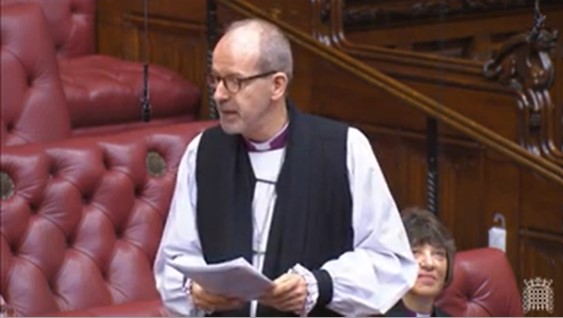
The Bishop of Manchester spoke during a debate on the Children’s Wellbeing and Schools Bill, supporting amendments geared towards stronger protections for care leavers and tabling his own amendments calling for an annual review of the effects of deprivation of liberty (section 25 orders) on children and for public bodies to have due regard to the needs of looked-after children in their decision making:
The Lord Bishop of Manchester: My Lords, I am very grateful that these amendments have been proposed. They may not go as far as my Private Member’s Bill did a few months ago in terms of seeking a better financial deal for care leavers, but Amendment 40 takes us some considerable way towards that. At least it will make local authorities be honest about what they are and are not doing. My only regret is that it will not completely get rid of the postcode lottery that besets so many young care leavers, particularly if they move from one authority to another. But I am grateful for the amendments the Government have tabled, and I hope that they will be swiftly passed.
Hansard
The Lord Bishop of Manchester: My Lords, I am grateful for the amendments in this group. We are continuing, as the Bill makes progress, to strengthen the offer that is made to care leavers. In the previous group, we discussed matters that, assuming they are voted on in a little while, will improve conditions and improve what local authorities have to publish.
My Amendment 95, which I am grateful to the noble Baroness, Lady Tyler of Enfield, for signing, would simply extend that to make sure that care leavers have a clear understanding of what their local authority is willing to offer and what it is not, particularly given that so many care leavers at age 18 or 19 end up leaving. Some, I am delighted to say, go to university and end up in a different town in perhaps a different part of the country entirely; others, for whatever reason, may decide it is appropriate to move and perhaps go back to be closer to friends from former times.
It is therefore not just the people who are already in a particular local authority who need to really know what the care leaver offer is; it is young people who might be considering moving to that area. As became clear in discussion of my own Bill a few months ago, that is often where people fall through the gap: they move for good and solid reason from one part of the country to another, and in that new part of the country they find that the services they expected are not there because that local authority either chooses not to provide them to anybody or, as is sometimes the case, chooses to provide them only to young people who have been in its care through the previous years.
I hope that we can get some support for Amendment 95. Understanding procedure—I am slowly learning this place, after about six years in—I know we probably will not get to a vote on this tonight, so maybe the noble Baroness, Lady Tyler, and I can agree between now and Wednesday whether this matter should be put to a Division or not.
Hansard
Baroness Barran (Con): My Lords, we come to this important group, which covers children who are deprived of their liberty. Noble Lords will remember from our debate in Committee that the number of such children has risen by 11 times in only seven years to almost 1,300 in 2024. Most troublingly, the number of children under the age of 12 deprived of their liberty grew by more than 50% in the last quarter, and 97% of these children are already in care. They are deprived of their liberty, typically for an average of six months, and restraint of those children is permitted in two-thirds of cases. The amendments in my name, and those of the noble Lords, Lord Russell and Lord Meston, and the right reverend Prelate the Bishop of Manchester, offer a practical route to turning this tide. They would create greater integration of services, stronger accountability and a focus on recovery rather than containment.
Amendment 56 would place an explicit responsibility on local authorities and health partners to be jointly responsible for the funding of care for children who are deprived of their liberty or at risk of being so. The amendment would make clear, through government guidance, the expectation that agencies work together not only at the point of crisis but at an earlier stage.
Amendment 58 would require the Secretaries of State for Education and Health to lay a report before Parliament annually with transparent data showing how many children are deprived of their liberty, as well as their characteristics, circumstances and outcomes. This would bring crucial transparency to the system and show whether the Government’s initiatives are working.
Amendment 55 would ensure there is comprehensive guidance for placement and care planning in relation to the specific aims when applying for a deprivation of liberty order and, crucially, to how a child’s plan will support their recovery so that they spend the shortest possible time with their liberty removed. Currently, children are stuck in limbo for many months, and this amendment would address that.
Amendment 53 would ensure that children deprived of their liberty receive an education. Amendment 60 would strengthen the role of the independent reviewing officer to make sure that decisions are scrutinised robustly. Finally, Amendment 54 would ensure monthly reviews of every deprivation of liberty order by a director of children’s services or head of social work practice to ensure that it continues only where strictly necessary.
These proposals have not been developed in isolation. They seek to build on the important collaborative work led by the Nuffield Family Justice Observatory, which has brought together representatives from child and adolescent mental health services, children’s social care, regional care co-operatives, NHS England and the Department for Education itself. I urge the Minister not to wait for another review or pilot. These children do not have lobbyists; they do not write to their MP; they do not have front-page advocates. They are, for the most part, invisible. Their lives are bound by locked doors and constant supervision. They cannot ask for change. We must therefore act for them.
The Lord Bishop of Manchester: My Lords, I have promoted a number of amendments in this group and signed others, for the reasons that the noble Baroness, Lady Barran, has so elegantly given. I will not waste your Lordships’ time by repeating them. I simply say that, over these last few years, I have become all too familiar with the acronym ACE—adverse childhood experience. We know that any child who has had four or more of those experiences is effectively traumatised, in one way or another, for life. It is a major thing to deprive them of their liberty, so whatever we can do to support these children and ensure it happens as little, for as short a time and with as careful scrutiny as possible will be vital. I therefore urge noble Lords, if these matters are put to a Division, to support them.
Hansard
The Lord Bishop of Manchester: 58: Clause 11, page 17, line 40, at end insert—
“(12) The relevant Secretaries of State for Education and for Health and Social Care must collaborate to lay before Parliament, annually, a review of the impact of the measures contained in this section.(13) The review must, as a minimum, consider and report on the following matters—(a) the numbers of new section 25 orders made during the last year in England and in Wales, the ages of the children placed under them, and an analysis of whether and where the rate of use is increasing or decreasing;(b) the durations of child detention or other restriction of liberty under such orders (minimum, maximum, mean and median);(c) the types of accommodation in which section 25 orders have been applied, including their registration status with Ofsted or the Care Quality Commission; (d) the approval and use of “recovery plans” for all children to move on from section 25 orders in a short a period as safely possible; (e) the involvement of Independent Reviewing Officers, independent advocates and children themselves in the making and reviewing of section 25 orders;(f) the types of accommodation where children live following the end of a section 25 order.”Member’s explanatory statement
This amendment would require a review to be laid before Parliament, outlining the quantity and impact of section 25 orders that year.
My Lords, we made good progress this evening. None the less, having an annual report laid before Parliament would bring together the information that we need in a coherent form, which would allow this House and the other place to properly scrutinise what is going on. I therefore wish to test the opinion of the House.
Hansard
The Lord Bishop of Manchester: 75: Clause 21, page 39, line 28, at end insert—
“(e) to have due regard to the need to remove or minimise the disadvantages suffered by looked-after children and relevant young persons.”Member’s explanatory statement
This amendment strengthens the current duty to be “alert to” the needs of looked-after children by requiring public bodies to have due regard to removing or reducing the disadvantages they face. It builds on awareness by turning it into action, ensuring that understanding leads to measurable improvement.
My Lords, I am grateful for the opportunity to have this debate this evening. I will keep it fairly short, given the time.
Amendment 75, in my name, simply seeks to change the current duty of being “alert to” the needs of looked-after children to one requiring public bodies to have “due regard to” removing or reducing the disadvantages they face. There are lots of things that I am alert to; that does not mean that I take any great notice of them. I am alert to them, but I can choose to ignore them. What we need is something that requires local authorities to take this seriously, and the concept of “due regard” is well understood in many other aspects of law. As a bishop, I am used to there being policies of the Church of England to which I am required to have due regard. If I simply had to be alert to them, I do not think that they would get the attention and focus they need. Instead of a duty of being alert, Amendment 75 would put in place something that I think we all understand to be a higher bar, but something that I think is achievable.
Amendment 76 says:
“A relevant authority exercising the duty … must take reasonable steps to avoid, reduce or otherwise mitigate any adverse impact of its policies and practices on looked-after children and relevant young persons”.
The key here is that we are not asking for anything unreasonable. This concerns what it is that it is reasonable for a public body, particularly a local authority, to do, beyond just being aware. The word “aware” is really no better than “alert”. How are they going to take reasonable and practical steps to prevent harm that is being done when some policy is being implemented? This would complement the aims of the Bill and provide a clear framework for shared action and accountability.
Finally, Amendment 96 concerns equality impact assessments. I know it is not practically possible to make being care-experienced yet another protected characteristic in the law, but we need some way of understanding the particular impact that those bits of the law have on children in care, or people who have been in care. There is a misprint, I fear, in the text as printed on the Marshalled List. The very famous Equality Act was of course enacted in 2010, not 2020 —it has been around rather longer than the amendment says. I am sorry; it was my people who put the wrong year in there.
The amendment is asking that we look at the impact on persons under 25 who are looked after by local authorities. Again and again we have tried, through various aspects of the Bill, as I did in my own Private Member’s Bill a few months ago, to say that the impact of care experience needs, at the very least, to be tracked through to the age of 25. We need to support young people up to that age. As was said on an earlier group this evening, most young people are still heavily dependent well beyond the age of 25—including, I fear, my kids, who were still heavily dependent on my wife and me well beyond that age. We are talking here about young people who do not have the bank of mum and dad or traditional parental support. We really need to do our best for them.
I will not delay your Lordships any further. I urge the Minister to give me such assurances as she can possibly give me this evening that will persuade me that I do not need, at this late hour, to test the opinion of the House. I am grateful to the noble Lord, Lord Mohammed of Tinsley, who has supported these amendments. I hope that he will have something to add in a moment or two.
Hansard
The Lord Bishop of Manchester: My Lords, I am very grateful for the short debate that we have had this evening. It is clear that we are all passionate about the same thing—we would not be here at this time on a Monday night if we were not. We are passionate about getting the best deal we can for care leavers and young people in care, and I am very grateful to hear that. The fact that we are hearing that from all the Front Benches gives me some assurance that this is not something that would float away were there to be a change of Government—at least not one to any of the parties in this Chamber tonight.
Moving on quickly, I really appreciate the guidance that has been spoken of, and I accept the assurances of the Minister that there are many matters that we sought to put in the Bill, as is proper on Report, but which can be dealt with in that way before the Act is implemented in due course.
Were I merely alert to the fact that it is late at night and I do not have the support of the Front Benches, I might still waste your Lordships’ next 15 minutes by pushing this to a Division, but I am not only “alert to”, I am “having due regard to” those factors. Therefore, I beg leave to withdraw Amendment 75 and will not press Amendment 76 either.
Amendment 75 withdrawn.
Hansard






You must be logged in to post a comment.