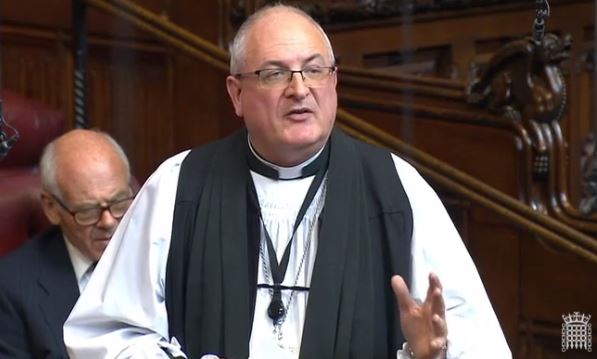
Bishop of St Albans encourages partnerships between libraries and rural churches

St Albans 2On the 13th October 2016 Lord Bird led a debate in the House of Lords: “That this House takes note of the cultural, civic and educational significance of libraries, bookshops and booksellers in the United Kingdom.” The Bishop of St Albans the Rt Revd Alan Smith, spoke about the impact closure could have on rural communities and the importance of imaginative partnerships which are developing between libraries and churches.

The Lord Bishop of St Albans: My Lords, I, too, add my congratulations the noble Lord, Lord Bird, for securing this debate. I want to speak today about the future of libraries and other shared community spaces in rural areas, as a vital contributor to rural sustainability. I should declare an interest as the president of the Rural Coalition, which brings together a range of rural interest groups, and as a bishop responsible for a large number of rural parishes across Bedfordshire and Hertfordshire.

Continue reading “Bishop of St Albans encourages partnerships between libraries and rural churches”

Bishop of Norwich speaks on educational selection and grammar schools

norwich121016bOn 13th October 2016 Baroness Andrews led a debate in the House of Lords “that this House takes note of the Government’s proposals for the extension of grammar schools and selection in education”. The Bishop of Norwich, the Rt Revd Graham James spoke in the debate:

The Lord Bishop of Norwich: My Lords, I am grateful to the noble Baroness, Lady Andrews, for securing this debate. The right reverend Prelate the Bishop of Ely, our lead bishop on education, cannot be in his place today, but I am glad to contribute from these Benches and to hear an excellent maiden speech from the noble Baroness, Lady Vere.

Like many others in your Lordships’ House, I attended a grammar school. I was also the first in my family to receive a university education. At Northampton Grammar School for Boys, as it then was, you imbibed an ethos and culture which simply assumed you would seek university entrance. My grammar school was hierarchical, full of petty rules and almost entirely male—the perfect preparation for a career in the Church of England. Continue reading “Bishop of Norwich speaks on educational selection and grammar schools”

BBC needs to promote religious literacy, Bishop of Norwich tells Peers

On 12th October 2016 the House of Lords debated a Government motion “that this House takes note of the drafts of the BBC’s new charter and the agreement between the Secretary of State for Culture, Media and Sport and the Corporation.” The Bishop of Norwich, Rt Revd Graham James, spoke in the debate about the need for well-resourced and informed coverage of religion. 

norwich121016bThe Lord Bishop of Norwich: My Lords, I have been pondering what interest to declare in this debate. I have never been employed by the BBC, but have received very modest remuneration for occasional broadcasts; I listen to Radio 4 more than any other channel; I fall asleep when watching “Newsnight”, despite my best intentions; and I belong to a generation for whom, in our childhood and early life, television and radio were the BBC—in my native Cornwall in the late 1950s, there was no ITV. I say all this because I realise that the BBC is so much part of the fabric of my life that I can be an incurable romantic about it.

In some ways, the BBC is rather like the Church of England: it is both national and local, and everyone in the BBC, as in the Church of England, imagines that power is being exercised somewhere but they always believe that it is somewhere else and that they do not have any. Continue reading “BBC needs to promote religious literacy, Bishop of Norwich tells Peers”

Bishop of Rochester calls for more affordable housing

RochesterOn 11th October 2016, Baroness Bakewell of Hardington Mandeville asked the government “how they plan to improve the quality and affordability of housing in the United Kingdom”. The Bishop of Rochester, the Rt Revd James Langstaff, contributed to the debate.

Continue reading “Bishop of Rochester calls for more affordable housing”

Bishop of Derby discusses committee report on sexual violence in conflict

Derby 191115cOn 10th October 2016, Baroness Nicholson of Winterbourne moved the motion “that this House takes note of the Report from the Sexual Violence in Conflict Committee (Session 2015–16, HL Paper 123).” The Bishop of Derby, the Rt. Revd. Alastair Redfern, who was a member of the Committee, spoke in the debate.


The Lord Bishop of Derby: My Lords, I, too, served on the committee, and it was a great privilege to be part of it. I pay tribute to the expert chairmanship of the noble Baroness, Lady Nicholson. We were, to put it mildly, a diverse group, but she held us together, and we produced a report that will be significant as a foundation, as other noble Lords have said. I also offer my congratulations to the Minister, who leads by great example, as seen not just at the recent meeting at the UN in September but in all kinds of ways. She has been an encouragement and a force for the right direction within government, and I am very grateful for that contribution. I also pay tribute to the noble Lord, Lord Hague, for his PSV initiative. I had the privilege of being present at the summit in 2014, which has created a momentum that we need to learn from and develop. I will pick up the theme mentioned by the noble Lord, Lord Hague, of the significance of important Governments making a public stand. In doing that, I will also speak as a faith community leader. Continue reading “Bishop of Derby discusses committee report on sexual violence in conflict”

Bishop of St Albans speaks in debate on school admissions

On 8th September 2016, Lord Lucas led a short debate on the question to Her Majesty’s Government: “what plans they have to support parents in navigating schools’ admissions arrangements”. The Rt Revd Dr Alan Smith, Bishop of St Albans, contributed to the debate. 

StAlbans171115The Lord Bishop of St Albans: My Lords, I am also grateful to the noble Lord, Lord Lucas, for bringing this Question to the House for debate. The right reverend Prelate the Bishop of Ely normally takes the lead on these matters but he is unable to be here today, so I want to make just a few comments. The subject of admissions is a complex one. As a child’s education is so vital and important, not surprisingly it often leads to impassioned responses. That can be true of the subject of admission to church schools, on which I know that several Members of this House have expressed opinions in the past. Before I turn directly to the topic of faith-based admissions, which your Lordships will not be surprised I wish to address, I would like briefly to set out some points by way of context. Continue reading “Bishop of St Albans speaks in debate on school admissions”

Archbishop speaks on banking reform, culture and practice

On 8th September 2016 the Bishop of St Albans, Rt Revd Alan Smith, led a debate in the House of Lords: “To ask Her Majesty’s Government what is their assessment of progress towards implementing the recommendations contained within the report of the Parliamentary Commission on Banking Standards, Changing banking for good.” The Archbishop of Canterbury, Most Rev & Rt Hon Justin Welby spoke in the debate, having previously served on the Parliamentary Commission on Banking Standards.

The Bishop of St Albans’ opening speech and the response of the Minister can be read here.  

abcbankingstandardsThe Archbishop of Canterbury: My Lords, I add my congratulations to those of other noble Lords on the appointment of the noble Lord, Lord Ashton, as the Minister at DCMS. I have no doubt that we will come across each other again as “C”, “M” and “S” all seem to cover the Church in various forms. I should also say that I served on the Parliamentary Commission on Banking Standards and had the very good fortune to do so with the noble Baroness, Lady Kramer, from whom I learned a great deal. I am also chairman of the Church Commissioners, who were involved in seeking to buy some of the spin-off assets of the Royal Bank of Scotland.

I am grateful to the right reverend Prelate for arranging this debate. I agree entirely with his speech and indeed with the other four speakers that have been made before mine. I shall try to avoid repeating what they said. As we know, and as previous speakers have said, the key issue is banking culture. Culture comes from actions and decisions, and actions and decisions feed into culture. There is no doubt that changes introduced by the Government and the Bank of England have been extensive, and in many cases very effective. However, there are four linked areas, all of them around “too big to fail”, leading to what must be the long-term aim of ensuring that the Government do not have a contingent liability with respect to large banks that would result in them needing to provide support in the event of serious problems, as they had to do in 2008 at such cost. Continue reading “Archbishop speaks on banking reform, culture and practice”

Bishop of St Albans leads debate on banking reform

On 8th September 2016 the Bishop of St Albans, Rt Revd Alan Smith, led a debate in the House of Lords: “To ask Her Majesty’s Government what is their assessment of progress towards implementing the recommendations contained within the report of the Parliamentary Commission on Banking Standards, Changing banking for good.”

The Bishop’s opening speech is below, followed by the response of the Minister. Other members spoke in the debate, including the Archbishop of Canterbury (speech here) who had served on the Parliamentary Commission on Banking Standards.

Bishop St Albans June 2015The Lord Bishop of St Albans: My Lords, I start this debate by saying how pleased I am to see the Minister responding today in his last time in his present role, although I look forward to working with him when he takes up his new duties at DCMS.

We are now three years on from the publication of the parliamentary commission’s report Changing Banking for Good. Thanks to the decisions made by this and previous Governments, our banking system is taking tentative but important steps along the road to recovery. We must not forget, however, the blunt summary in the report which laid out the scale of the problems with banks over the previous decade:

“Banks in the UK have failed in many respects. They have failed taxpayers, who had to bail out a number of banks including some major institutions, with a cash outlay peaking at £133 billion, equivalent to more than £2,000 for every person in the UK. They have failed many retail customers, with widespread product mis-selling. They have failed their own shareholders, by delivering poor long-term returns and destroying shareholder value. They have failed in their basic function to finance economic growth, with businesses unable to obtain the loans that they need at an acceptable price”.

Continue reading “Bishop of St Albans leads debate on banking reform”

Bishop of Derby speaks about importance to democracy of charities, trade unions and civil society

Derby 191115cOn 8th September 2016 Baroness Hayter of Kentish Town led a debate in the Lords: “That this House takes note of the role that charities, trade unions and civil society groupings play in a democracy, including the provision of advice and information to government, and of the case for regulating lobbying activities, including those undertaken by business and private interests.”

The Bishop of Derby, the Rt Revd Dr Alistair Redfern contributed to the debate:

The Lord Bishop of Derby: My Lords, I, too, want to thank the noble Baroness, Lady Hayter, and I want, in the nicest possible way, to take for granted what she said, because it was very important and I agree with it absolutely. I want to invite us to look at the last three words, “in a democracy”, as a very important context for this discussion and debate, not least for the role of charities, trade unions and civil society.

Democracy works through two very important elements. One, of course, is the offer of ideas and suggestions about what to do to best order society. It is about answers to problems. The lobbying industry and the contribution that charities make to that, as the noble and right reverend Lord, Lord Harries, and the noble Lord, Lord Griffiths, and others have shown, is very important—

“From our experience, here is the answer to this kind of question”. Continue reading “Bishop of Derby speaks about importance to democracy of charities, trade unions and civil society”

Archbishop of Canterbury pays tribute to departing Lord Speaker

abc-mcfall-2On 5th September 2016, the Archbishop of Canterbury, the Rt Hon. and Rt Rev. Justin Welby, paid tribute to the outgoing Lord Speaker and Deputy Lord Speaker, Baroness D’Souza and Lord Laming. Archbishop Justin also welcomed the new Lord Speaker, Lord Fowler, and the new Senior Deputy Lord Speaker, Lord McFall, to their roles.


Archbishop of Canterbury: My Lords, on behalf of the Lords spiritual I join in the tributes to the noble Baroness, Lady D’Souza, and to the noble Lord, Lord Laming. The noble Baroness, Lady D’Souza, has been a great friend to the Lords spiritual, who normally arrive with even more trepidation and less familiarity with the processes of a House such as this than anyone else coming here. She has been assiduous in seeing new bishops and advising them, and then advising them later when they did not quite make it—something that I appreciated on more than one occasion. She always did it with the greatest tact and courtesy and I think that we would all say that she was an encourager of great aptitude. Continue reading “Archbishop of Canterbury pays tribute to departing Lord Speaker”