The Bishop of Manchester asked a question on the governments plans to tackle holiday hunger for children on 24th July 2024, raising the example of church projects offering support to children and families in school holidays:
The Lord Bishop of Manchester: Something like seven out of every eight local authorities now use this money to alleviate holiday hunger among our children. Can we have any hope that the Government will look at a more strategic way of helping children cope with hunger during the school holidays? Many of the churches in my diocese, and those of my right reverend friends here, are having to put on voluntary projects to support children during those periods. What can we hope for?
The Bishop of Manchester spoke at the second reading of the Post Office (Horizon System) Offences Bill on 13th May 2024, supporting the intent of the bill and commenting on the importance of safeguarding the rule of law whilst ensuring the swift exoneration of the victims of the Horizon scandal:
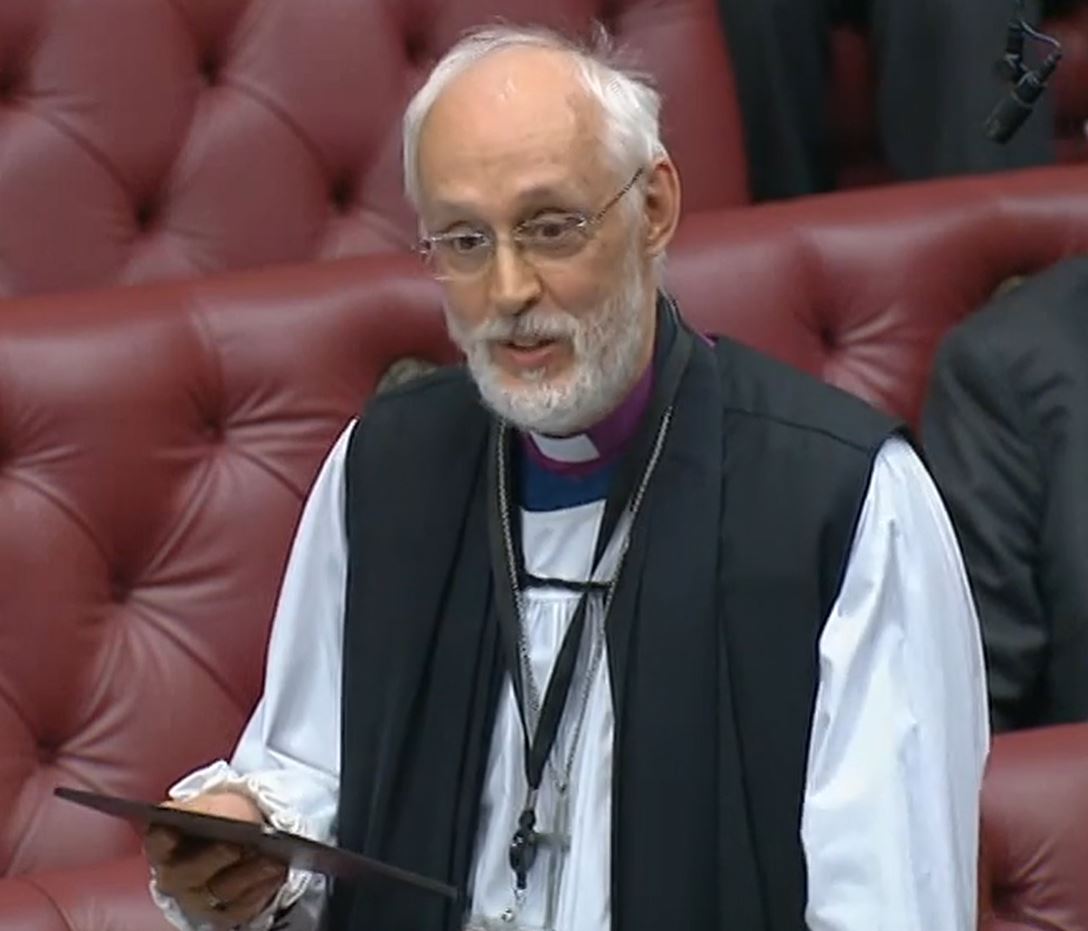
The Lord Bishop of Manchester: My Lords, I admit to being a little nervous as a non-lawyer entering a debate that has already heard from so many distinguished minds. Some may think that they have heard enough from the lawyers and do not need to hear from me.
I am grateful to the Minister for introducing the Bill. I concur with other noble Lords in hoping that it will be swiftly passed into law. The many victims of this long-running scandal and injustice must now benefit without further undue delay. As the noble Lord said in opening this debate, Parliament is not the usual route by which we overturn wrongful convictions. I echo others today, as well as what I have said in debates on other matters, in believing that we need to tread very carefully when acting in ways that move us on to territory more normally occupied by the courts and the judiciary. That is particularly important in Britain, because we give such huge weight to precedent. The Minister has, I am pleased to note, assured us that this Bill should not be considered a setting of precedent, and others have concurred. However, I think that that aspect of what we are doing merits, albeit briefly, deeper consideration. What one Government do today, no matter how warily, may be drawn on by future Governments in ways that stretch the original intentions well beyond breaking point. Our best defence against that, perhaps our only defence, is to set down very clear principles, not merely general assertions, at the outset.
The Bishop of Manchester asked a question on the issue of advanced release dates preventing prisoners from completing qualifications begun whilst in prison, during a discussion on the End of Custody Supervised Licence Scheme on 13th May 2024:
The Lord Bishop of Manchester: My Lords, I declare that I am a trustee of the Clink Charity: we are involved with training people in prison for qualifications for restaurants, catering and the like. Those last few weeks in prison are often a crucial time for prisoners gaining the qualifications they need to get a decent job when they are released. I am sure every prisoner wants to go as soon as they can, but is the Minister aware, and will the Government take consideration, of the effect of prisoners not receiving their qualifications because they have not quite been completed by the time their advanced release date comes?
The Bishop of Manchester tabled a question on the potential benefits of bringing the rate of Universal Credit for care leavers under 25 in line with the rate for over-25s on 13th May 2024:
The Lord Bishop of Manchester: To ask His Majesty’s Government what assessment they have made of the potential benefits of bringing the rate of Universal Credit for care leavers under 25 in line with the rate for over-25s.
On 8th May 2024, Bishop of Manchester spoke in support of a Motion to Regret tabled by Lord Berkeley: “That this House regrets the Government’s decision to lay the National Networks National Policy Statement, laid before the House on 6 March, without carrying out the systematic review of road projects recommended by the Climate Change Committee; addressing the risk of insufficient environmental action by the Department for Transport highlighted by the National Audit Office; or joining up their policies with the missions presented to Parliament under the Levelling-up and Regeneration Act 2023.“
The Lord Bishop of Manchester: My Lords, as it seems compulsory in this short debate to quote Voltaire, perhaps I might take us to his wonderful creation, Dr Pangloss, who continues to assert:
“All is for the best in this best of all possible worlds”
even while the horrors are descending around him. I feel there is something of that in the statement; it is a bit Panglossian. As noble Lords have already said, we face a climate emergency and crisis, and this statement is not adequate to the seriousness of the situation that we are in.
The Bishop of St Albans received the following written answer on 29th April 2024:
The Lord Bishop of Manchester asked His Majesty’s Government what plans they have to introduce legislation which would ban the practice of conversion therapy.
Baroness Barran (Con, Women & Equalities): The Government is taking account of the recently published final report from the independent Cass Review.
On 24th April 2024, the House of Lords debated the Leasehold and Freehold Reform Bill in Committee. The Bishop of Manchester moved his amendment 28 to the bill, and made a speech in support of the amendment, which “would provide that, where the freeholder in the case of a lease extension or freehold enfranchisement is a charity which had owned the freehold interest since before the passing of the Bill, marriage and hope value are payable.”
The Lord Bishop of Manchester: My Lords, while I thoroughly enjoyed that previous group, I hope this one will not prove quite so wide-ranging. In tabling these amendments, my aim is to deal with an issue that in the charity world is specific to a small number of bodies but would severely impact the work that they do. First, I am a leaseholder myself, as it happens, as set out in the register of interests. I have been through the process of extending my lease; my flat is not in London, and it was quite a simple and cheap process. Secondly, although I am no longer on the board of governors of the Church Commissioners, it is the body that pays my stipend, owns my home and covers my working expenses, so I declare that interest too.
The commissioners are directly affected by the proposals in the Bill. They would indeed benefit from my amendments but, as has already been mentioned by the noble Lord, Lord Truscott, in the previous group, that charity is large enough to withstand the adverse impact. Smaller charities would struggle much harder to maintain their work, and it is their case I seek to plead today.
On 23rd April 2024, the House of Lords debated the Victims and Prisoners Bill. The Bishop of Manchester spoke in support for his amendments 60, 64, and 70 to be the bill, which focus on establishing support services for victims of crime:
The Lord Bishop of Manchester: My Lords, I will speak to my Amendments 60, 64 and 70, which echo amendments on support services for victims that I tabled in Committee. I am grateful to the Minister for his responses at that stage and for his kindness in meeting me and representatives of Refuge and Women’s Aid in the interim. In light of those conversations, it is not my intention to press any of these amendments to a Division today. However, I hope that, in this debate and in the Minister’s response to it, we can clarify a little further how His Majesty’s Government will seek to ensure that victims across the country have access to quality support services provided by organisations that hold their confidence and understand their specific circumstances. As we are now on Report, I will not repeat the detailed arguments of Committee, but I think their force still stands.
Amendment 60 places a duty on the Secretary of State to define in statutory guidance
“the full breadth of specialist community-based support domestic abuse services”.
On 17th April 2024, the House of Lords debated theEconomic Activity of Public Bodies (Overseas Matters) Bill in committee. The Bishop of Manchester spoke in support of amendment 54 to the bill, calling for the government to provide clarity over the scope of the bill in relation to charities and educational institutions:
The Lord Bishop of Manchester: My Lords, I shall speak in favour of Amendment 54, to which I have added my name. I also support the other amendments in this group. I listened carefully to the previous debate. As other noble Lords have noted, there is a strong overlap between this and the previous group.
Again as others have said, my concern is that, before we pass this Bill, we get clarity on who it covers. I declare a particular interest in that those of us on these Benches, along with other diocesan bishops of the Church of England, do carry out public functions. From time to time, these might bring an individual, in our corporate capacity as bishop of a diocese, within whatever definition of a public body or authority we might eventually land on.


 The Church of England in Parliament
You must be logged in to post a comment.